

Relevance, proximity, and prominence decide which law firm shows up first in a local legal search. Google’s own documentation calls the second factor distance, though most people in SEO still say “proximity.” Google’s own page even mixes “popularity” and “prominence” as labels for the third factor, so precision here matters more than it might seem.
For a law fir SEO, these three factors explain why a nearby firm doesn’t always win, and why a well-known firm can still lose to someone closer. Of the three, proximity tends to confuse people the most, since it can override relevance or prominence in ways that feel unfair. This article breaks down what each factor means, how they interact, and how to diagnose which one is actually holding your firm back.
What Do These Three Factors Mean?
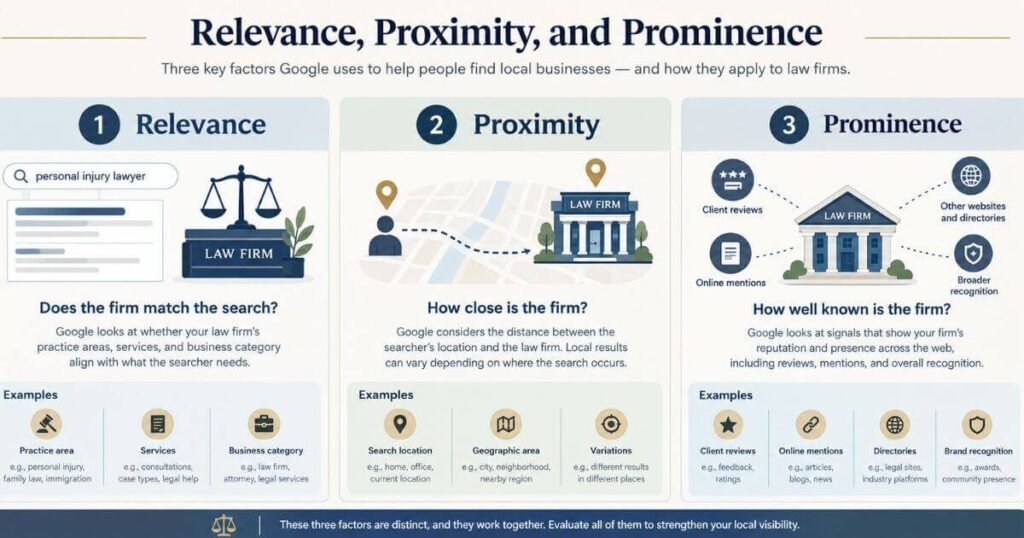
Relevance: Does the Firm Match?
Google defines relevance as how well a business profile matches what someone is searching for. For a law firm, this comes down to practice area, the services actually offered, and the business category set on the profile. Google’s own guidance on how local results are ranked says relevance improves when a business provides “complete and detailed” information, so a firm listing every practice area vaguely under “Lawyer” gives Google less to match against.
Search intent decides whether a match counts as relevant at all. A relevant match looks like a personal injury firm showing up for “personal injury lawyer near me.” An irrelevant match looks like that same firm showing up for “immigration lawyer,” just because it’s a law firm in the area. Google isn’t matching on the word “lawyer” alone; it’s matching on what the firm actually does.
Proximity: How Close Is the Firm?
Google’s documentation uses the word distance, defined simply as how far a business is from the person searching. If someone doesn’t share their location, Google uses what it already knows about where they likely are. This is why a “near me” search and a city-specific search can return different results, even for the same practice area.
Local results shift depending on where the search happens, not just what’s typed in. A search from one side of a city can surface a completely different set of firms than the same search from the other side. This variation is built into how Google handles location, not a sign that something is broken with a listing.
Prominence: How Well Known Is It?
Google ties prominence directly to two things: reviews and links and mentions, describing it as “how many websites link to your business and how many reviews you have.” A law firm that’s frequently mentioned or linked to across legitimate sites signals real-world business recognition, not just a filled-out profile.
Prominence isn’t the same as profile completeness. A firm can have every field filled in on its Google Business Profile and still show low prominence if almost nobody links to it or reviews it. Completeness helps relevance more directly, while prominence depends on how the wider web treats the firm, something a profile alone can’t fake.
How Do the Factors Interact?
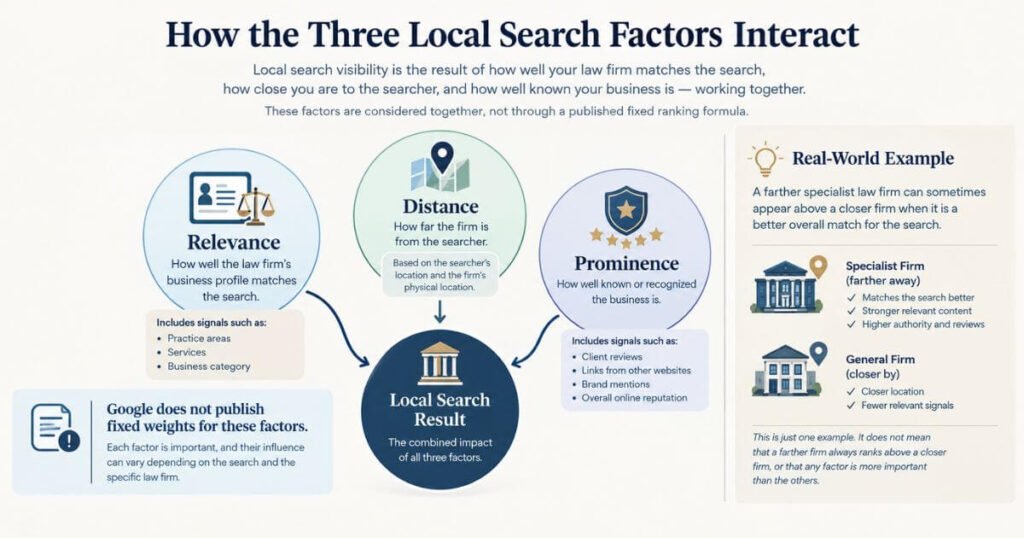
When Relevance Beats Proximity
A general practice firm sitting two blocks from a searcher doesn’t automatically beat a specialist firm ten miles away. If someone searches “immigration lawyer” and the nearby firm only lists “Lawyer” as its category, Google may still surface the farther immigration specialist first, because it actually matches what was searched for.
This is the part people get wrong most often. Being the closest firm feels like it should count for more than it does, but Google is trying to answer the actual question asked, not just find whoever’s nearest. A specific match on practice area can outweigh a shorter distance, especially when the search itself names a specialty.
When Prominence Makes a Difference
Sometimes two firms match a search almost identically and sit at a similar distance from the searcher. When relevance and proximity are close to equal, prominence becomes the factor that separates them. One firm might have more reviews, more mentions across other sites, or more recognition built up over time.
Google doesn’t publish a fixed weight for how much this tips the scale, and no verified source claims to know an exact number. What’s documented is simpler: prominence comes from external signals like reviews and links, not from anything printed on the firm’s own website. Two similarly matched, similarly located firms can still end up in a different order because one has built more of a real reputation than the other. Understanding how these signals work together is an important part of law firm SEO, particularly when evaluating local visibility across different locations and practice areas.
How to Diagnose Local Visibility
Relevant but Too Far Away
A firm can match a search perfectly and still lose to distance. If a specific practice area is clearly listed, the category is accurate, and the services match what’s being searched, but visibility still lags, distance is worth checking first before anything else. This shows up most often when a firm’s actual office sits at the edge of a service area, far from where most searches originate.
The instinct here is usually to add more location keywords to the website. That doesn’t address a distance problem, since Google bases distance on the business’s actual address, not on words describing nearby cities. If distance is the real limitation, no amount of location text on a page changes how far the office physically sits from the searcher.
Nearby but Poorly Matched
A firm can sit close to a searcher and still not show up, because it doesn’t actually match the search. This usually traces back to business information that’s incomplete, services that aren’t listed clearly, or a category that’s too broad or simply wrong for what the firm does.
Search intent gets missed most often when a category like “Lawyer” stands in for something more specific, like “Personal Injury Attorney.” A nearby firm with a vague or mismatched profile can lose to a farther firm that matches the search intent precisely. Fixing this starts with checking whether the profile actually says what the firm does, not just that it exists nearby.
Nearby, Relevant but Weak
Sometimes a firm is close enough and clearly matches the search, but still doesn’t show up where expected. At that point, the issue usually sits with prominence. This means looking at the firm’s broader online presence, how many sites mention or link to it, and how many reviews it has actually earned.
This diagnosis only holds once distance and relevance are already ruled out. Jumping straight to “we need more reviews” without checking the other two factors first can lead to fixing the wrong problem. Separating this diagnosis from guesses about exact ranking impact matters too, since no verified source publishes how much a specific review count or link count moves a listing.
Proximity vs. Prominence vs. Relevance
Each factor answers a different question about a law firm’s local search visibility. Seeing them side by side makes it easier to spot which one applies to a specific ranking problem.
| Factor | Core Question | Legal Example |
| Relevance | Does the firm match the search? | A personal injury lawyer showing up for a personal injury search |
| Proximity | How close is the firm? | A firm located near the person searching |
| Prominence | How well known is the firm? | A firm with a strong reputation and outside recognition |
None of these factors work alone. A firm can score well on one and still underperform if the other two are weak, which is why diagnosing local visibility means checking all three rather than assuming the answer is always more reviews or a better location page.
FAQs
Can a Farther Firm Rank Higher?
Yes. Geographic closeness doesn’t automatically decide the result. If a farther firm matches the search more precisely or carries stronger prominence, it can outrank a firm that’s physically closer to the searcher.
Do More Reviews Guarantee Rankings?
No. Reviews contribute to prominence, one of three factors Google combines to rank results. A firm with strong reviews doesn’t automatically outrank a competitor who matches the search better or sits closer to the searcher.
Does the Website Affect Prominence?
Indirectly. Google ties prominence to how many other websites link to a business, not to the business’s own website content by itself. A firm’s website matters more for relevance, while external links and mentions from other sites feed prominence.
Is Proximity Equal Across a City?
No. Local results can shift depending on exactly where a search happens. A search from one part of a city can surface different firms than the same search run from another part of the same city.
Can Similar Firms Rank Differently?
Yes. Two firms with nearly identical relevance and proximity can still show up in a different order. The difference usually comes down to prominence, since one firm may have more external recognition, reviews, or mentions than the other.
Learn More About Local Search
Understanding relevance, proximity, and prominence is just the starting point. Google’s own Business Profile Help Center covers each of these factors directly and gets updated as the guidance changes, making it a solid next stop for anyone who wants to go deeper into how local search actually works. For more breakdowns like this one, Faheem Bhatti SEO covers legal local search topics in plain, source checked terms.
