

A stuck ranking rarely comes from one single cause. Weak crawl budget or poor indexing can hide a strong page from search results. Mismatched search intent and weak relevance signals push pages down fast too. Low content quality and thin topical authority make the climb even harder. Competition level matters, but it rarely explains everything on its own. A firm’s ranking position is one diagnostic signal among several.
Many firms get stuck on page three or beyond, a range where visibility drops sharply and clicks become rare. Algorithm updates and major core updates can shift rankings without warning. Meaningful ranking movement can take time, and the timeline varies by site and situation. Google itself says some changes can take effect within days, while others can take several months, without singling out any particular industry.
Start With Technical Health Checks
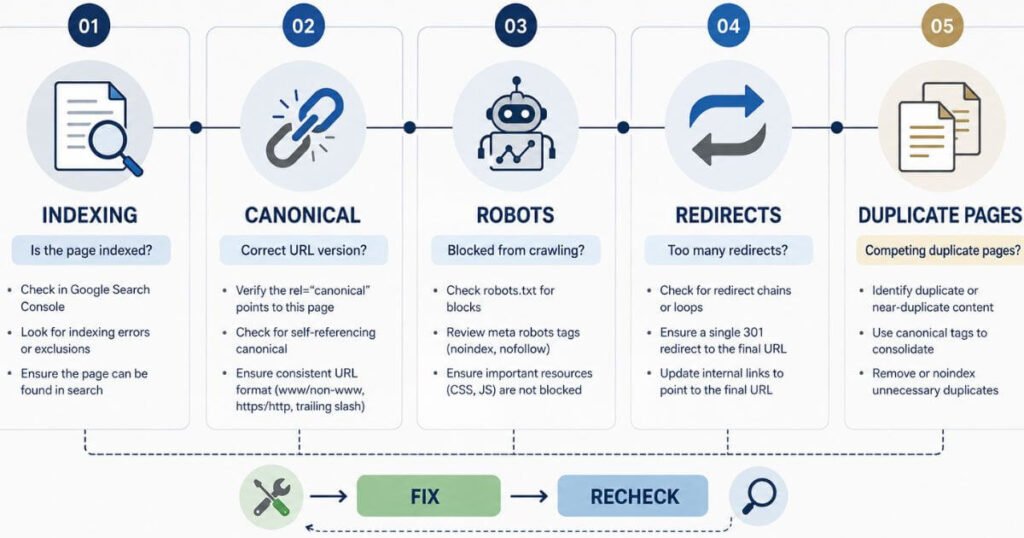
Confirm Your Page Is Indexed Correctly
Check the page’s indexing status directly before anything else. If it isn’t indexed, nothing else on this list matters yet. Confirm the canonical URL points to the correct page, review robots directives to rule out accidental blocking, and test crawl accessibility using Google’s URL Inspection Tool.
The coverage report reveals excluded pages, crawl errors, and server errors hiding in plain sight. Watch closely for 5xx codes, since they signal a broken server response. Compare your indexed pages count against your total page count for gaps, and look for duplicate URLs, thin location pages, and orphan pages that may be dragging performance down.
Check For Technical Blocking Issues
| Issue | Symptom | Fix |
| Stray noindex tag | A strong page silently disappears from search | Remove the tag or confirm it was intentional |
| Blocked resources or incorrect canonicals | Page appears fine but doesn’t rank | Review canonical tags and unblock necessary resources |
| Redirects and long redirect chains | Slower crawling, wasted crawl budget | Flatten chains to a single direct redirect |
| Duplicate content across pages | Search engines unsure which version to rank | Consolidate or canonicalize to one version |
| Misconfigured X-Robots Tag or meta robots | Rendering or indexing problems | Audit tag settings against intended behavior |
| JavaScript rendering issues | Content not visible to Google | Check dynamic or server side rendering setup |
| Leftover staging noindex | Production site accidentally excluded | Confirm noindex was removed after launch |
| Messy robots.txt file | Wrong pages blocked or allowed | Review and clean up robots.txt rules |
Google recommends using appropriate canonicalization methods and advises against using robots.txt as a canonicalization method.
Understand What Searchers Actually Want
Identify The Intent Behind Your Query
Every search carries an intent type behind it. Informational intent looks for answers, while commercial intent looks for options to compare. Local intent wants a nearby firm, and navigational intent searches for one firm by name. Transactional intent signals someone ready to act right now.
Understanding searcher needs starts with studying the exact query wording used. Personalization, device type, and search location all shape which results Google shows. A search on mobile near downtown often returns different results than the same search from a desktop miles away. Reading these signals correctly shapes the whole content strategy.
Compare Your Page With Search Results
Look closely at the content type ranking pages use for your target query. Check the page purpose, depth, and format search engines seem to reward. Study user expectations and location relevance shown across the top results. A mismatch here often explains a stuck ranking better than any technical issue.
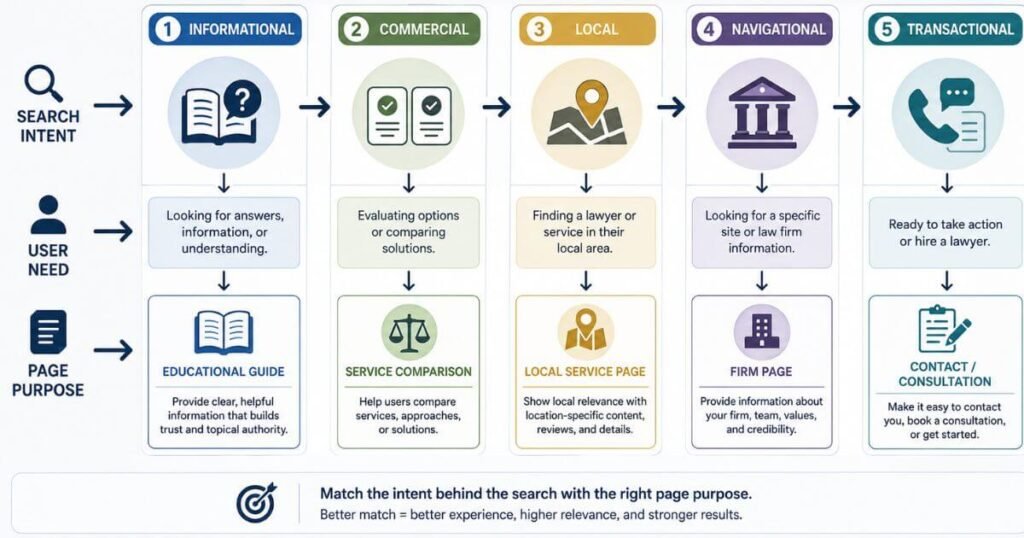
Note which dominant intent search engines favor for that specific term. Watch for SERP features crowding the page, including AI Overviews and featured snippets. Image packs and knowledge panels also compete for the same visual space. These features shape both visibility and how much traffic a top ranking actually earns.
Study Content Depth And Coverage
Compare Your Coverage With Ranking Pages
Read through the pages already ranking above yours carefully. Note the important questions and subtopics those pages cover in detail. Check their explanations, evidence, and examples used to support each claim. Strong pages layer practical information on top of basic facts.
Compare that content depth against what your own page currently offers. Thin content and duplicate city pages often explain a stuck position fast. Many firms publish the same page for five cities with only the name changed. Information quality separates pages that rank from pages that stall.
Add Information Competitors Do Not Provide
Look for unanswered questions that every competing page skips over. Missing perspectives create an opening for a stronger, more complete page. Add original analysis and useful examples pulled from cases the firm has handled. First hand insights carry weight that recycled content simply cannot match.
Better explanations move a page ahead of thin competitors fast. This kind of information gain gives readers something genuinely useful that competing pages don’t offer. Show genuine expertise by answering the real client questions the firm hears most often. Pages built this way earn trust that generic content never will. Google specifically recommends original information, substantial coverage, insightful analysis, and content that provides substantial value compared with other pages in search results.
Strengthen Entity And Topic Connections
Connect Your Core Legal Entities Clearly
A personal injury page with no named attorney or clear practice area connection reads as generic, even with strong content. Readers and search engines both struggle to place a page that doesn’t clearly say who the firm is, who handles the case, and where they operate.
A strong site names its law firm, attorneys, and practice areas clearly and often. Connect these entities to the legal matters and client problems they solve, and tie each service to the specific locations the firm actually serves. Detailed attorney bios build trust and support every practice area page and location page entry. Include full attorney names, recognitions, and accurate contact details on every page, since clear entity signals help both search engines and readers trust the firm faster.
Connect Supporting Topics To Core Services
Every core service page benefits from nearby supporting topic content. A related question deserves its own relevant page, linked back to the main service. This builds contextual relevance that helps both readers and search engines understand how the pages relate to each other.
Group these connections into clear topical clusters around each practice area. Supporting content should link back through semantic internal links, not random placement. Strong hub pages organize this structure so visitors and search engines both follow it easily. A clear site architecture makes every connection obvious at a glance.
Build Authority Signals
Build Relevant Internal Authority
Strong internal links help readers and search engines discover related pages. It makes it easier for weaker pages to get noticed alongside your strongest content. Point related articles toward your best service pages and practice area pages. Do the same for location pages and central hub pages across the site. Review your internal link structure for gaps and dead ends.
Confirm your homepage links to subpages that actually need the support. Watch for orphan pages with no internal links pointing to them at all. Fix any broken internal links quickly, since they waste crawl budget and hurt site structure. For broader guidance on building a crawlable site structure and useful links, see Google’s SEO Starter Guide.
Earn Relevant External References
Authority also comes from outside your own website. Reach out to legal publications and respected professional organizations in your field. Reputable local sources and industry publications carry weight with search engines. A mention from a state bar association or a trusted legal directory adds genuine credibility, since it comes from an independent, recognized source rather than the firm itself.
Connections with bar association committees, law schools, and universities open opportunities. Local groups like chambers of commerce and community organizations also help build trust. Coverage from local news through smart digital PR earns lasting editorial backlinks. Watch your count of referring domains grow over time, and use a third party authority metric like Domain Authority or Domain Rating only as a rough comparison tool, not a Google ranking signal. Keep every mention tied to topical relevance, geographic relevance, and consistent NAP.
Study The Competitive Landscape
Compare Ranking Pages Against Yours
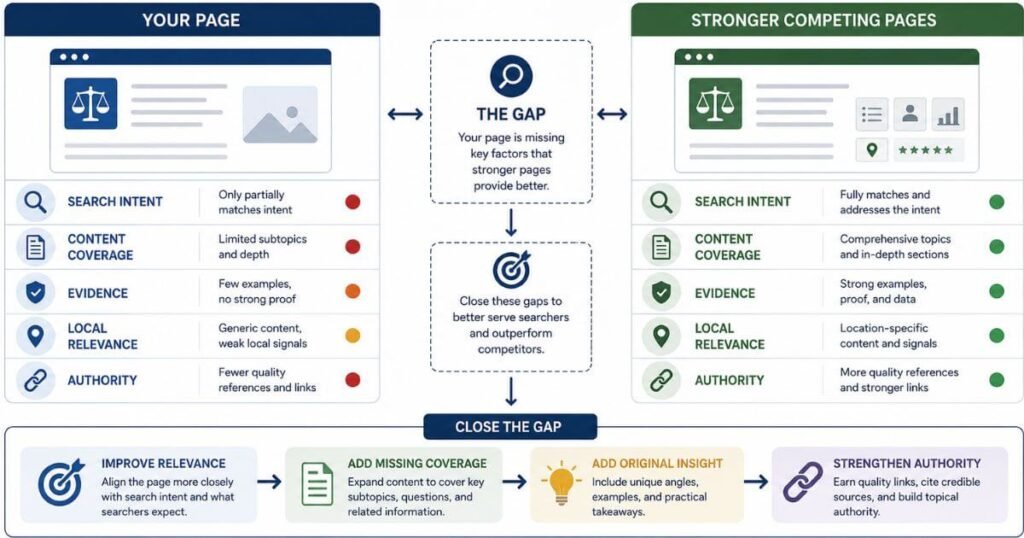
Pull up the pages ranking above yours and study them closely. Compare search intent match, content coverage, and overall information quality side by side. Check their expertise, internal linking, and authority against your own page.
Note their local relevance signals too, since location can meaningfully influence local rankings. Sort competitors into winners, near winners, and clear underperformers for a clearer picture. Some pages need only small fixes, called intent correction, to catch up fast. Others need a complete rebuild before they can compete at all.
What’s the One Thing Competitors Do That You Don’t?
Every stuck page has one dominant weakness holding it back, not a dozen small ones. Find that gap by studying what top pages demonstrate that yours does not, whether that’s coverage, evidence, local relevance, or authority.
Once found, prioritize impact over fixing every small issue at once. Study the full competitive landscape, since a niche practice area competes differently than a broad one. A mid size market behaves differently than a market full of established firms. Watch closely how high volume terms perform, since they show the clearest competitive pressure.
Diagnose Position And Click Problems
Find Queries Stuck Between Positions
Search Console data reveals exactly where pages get stuck. Look for queries sitting on page three or beyond, where visibility and click through rate drop off sharply Review impressions, average position, clicks, and CTR together for the full picture. Study each landing page tied to these stuck queries closely. Separate branded queries from non branded queries, since they behave very differently.
Watch for a query mix shift that quietly changes which terms drive traffic.Some pages show low impression volume even while sitting in a decent position, which usually points to a low search volume query or a snippet that isn’t drawing clicks. Google Search Console defines impressions, clicks, CTR, and average position as separate performance metrics and recommends looking at trends in impressions and clicks rather than position alone.
Separate Ranking Problems From CTR
A low position ranking problem looks very different from weak click performance. Strong position low CTR points instead to a search result presentation problem. This often traces back to a weak snippet quality signal in the listing. If your law firm website is getting traffic but still not producing inquiries or cases, start by identifying where the client journey is breaking down.
Check the title tag and meta description for clarity and appeal. A zero click pattern nearby can quietly steal traffic too. Compare your numbers against click through rate benchmarks for your position. Position and CTR should generally move together. When a page ranks well but its CTR is unusually low compared to similar queries, that often signals a fixable snippet or title tag problem.
Apply The Right Fix For The Right Problem
Improve Relevance When Intent Is Weak
When intent looks weak, start with a full content rework. Restructure the page so it matches what searchers actually expect. Align with searcher needs first, before touching design or technical details. Study the dominant intent carefully to avoid guessing wrong twice.
An intent mismatch usually needs more than small edits to fix. Full page repositioning often solves what small tweaks cannot touch. This fix works best when the page topic is right, but the format is wrong. Getting this step right helps avoid wasted effort later.
Improve Coverage When Information Is Missing
When coverage falls short, the fix usually means deepening what already exists. Expand existing content rather than creating additional thin pages. Deepen each section with the detail readers actually need.
Focus on information that adds genuine value for the reader. Review your topical coverage and overall content depth against top competitors. Close any competitor coverage gap you find during that review. This fix works best when intent already matches, but content feels incomplete.
Improve Authority When Competitors Lead
Some pages lose simply because competitors carry more trust. Strengthen internal relationships first, since that costs nothing and helps fast. Then work to earn relevant references from real, credible sources.
Review your current backlink profile for weak or missing links. Track your referring domains over time, and use a third party metric like Domain Authority as a rough point of comparison against competitors, keeping in mind it’s not a metric Google itself uses. This fix takes the longest, but it tends to produce more durable results than quick technical fixes alone.
Change The Page When Intent Is Wrong
Sometimes the fix means starting over on a different page entirely. Reconsider the page if it targets the wrong intent completely. Work to target the correct entity query relationship instead of forcing the old page to fit.
Wrong search intent usually means no amount of editing will help. Review your URL targeting and confirm it matches the real query. Full page repositioning becomes the only real fix in these cases. This path takes more work, but it stops wasted effort on a page that can never win.
Frequently Asked Questions
Why Is My Law Firm Stuck?
A ranking plateau often happens once a page reaches page two. These stuck rankings usually come from a competitive market that needs steady, compounding actions over time.
How Long Do Rankings Usually Take?
Meaningful movement can take several months, but there is no universal SEO timeline. Google says some changes can take effect in a few days, while others can take several months, depending on the changes and circumstances.
Can More Content Improve Rankings?
More content only helps when it adds depth. Thin content and duplicate content can hurt your site. Focus on information gain instead. It contributes more to topical authority than simply publishing more articles without added depth. Depth and usefulness matter more than the number of pages published.
Should I Change My SEO Strategy?
Always start with diagnosis before action, before changing anything. Steady, compounding actions tend to produce better results over time. Give real changes several months before judging results, since Google says some improvements can take several months to show an effect in Search.
Should I edit an existing page or create a new one?
Edit the existing page if it already ranks and the intent is right, but the content is thin or outdated. Create a new page only when the topic or intent is genuinely different from what the existing page targets. When in doubt, editing is the faster, safer fix.
Find What Is Keeping Your Firm Back
A hidden ranking gap often explains a stuck position better than guesswork. Some firms sit with strong impressions but are buried in results, invisible to real clients. From there, targeted SEO changes can fix what guessing never will. Ready to find your firm’s blocker? Request a free audit at faheembhatti.com today, and let us identify specific gap areas holding your rankings back
