

A personal injury page built around one keyword misses most of the real picture. Real cases involve negligence, liability, damages, and insurance claims together. Semantic SEO connects those pieces into one structure.
Google’s own systems already work by reading meaning and relationships between words, not just exact matches. That doesn’t confirm “semantic SEO” as a named ranking factor, but it does support why connected, complete content fits how search actually works.
What Is Semantic SEO for Lawyers?
Semantic SEO for lawyers means connecting legal topics that clients search for together. Each concept answers a real question a client has after an accident. This structure helps readers move from one question to the next.
From One Keyword to a Connected Legal Picture
Real cases involve car accidents, negligence, liability, and insurance claims together. A single keyword page cannot cover that full picture. Semantic SEO treats the practice area as the core topic instead. Negligence raises the question of who caused the accident. Liability answers who may be responsible. Damages cover what the client can recover. Insurance claims explain how a client collects that money. Location narrows the page to the laws and courts that apply.
Why Semantic SEO Matters for Law Firms
Google’s ranking systems prioritize helpful, reliable content built to benefit people, not to manipulate rankings. A law firm applies that principle by making practice area pages complete and easy to follow. This does not mean Google confirms a “semantic SEO” ranking method. It means connected content fits a standard Google already documents.
What Google Actually Says
Google’s Search Central states that automated ranking systems are designed to prioritize helpful, reliable information created to benefit people, and not content made to manipulate rankings . That page also asks whether content gives a complete, comprehensive description of a topic. It never mentions “semantic SEO,” entity relationships, or content clusters by name. A law firm can meet this standard without any special technical method.
What This Means in Practice
A connected structure helps a reader move from a broad topic to a specific question. A visitor lands on a personal injury page. They find a clear path to car accident claims. From there, they reach a page about proving negligence. That path matches the “substantial, complete” test Google describes. It does not claim a ranking mechanism Google hasn’t confirmed.
Practice Areas, Entities, and Relationships
A law firm practice area page builds authority through connected entities, not isolated keywords. Each entity links to the next through a real relationship, not just a shared mention. That structure gives a reader a complete path through their situation.
A Worked Example: Personal Injury
Start with the core entity: personal injury lawyer. Add the supporting entities a real case touches: car accident, truck accident, negligence, liability, damages, insurance, medical expenses, and location. Personal injury includes car accident claims as one case type. A car accident raises questions about negligence and liability. Liability determines who may owe compensation. Damages cover the losses a court or insurer may recognize.
Why the Relationship Matters More Than the List
A list of entities tells a reader what topics exist. A relationship tells a reader how those topics connect. “Negligence causes liability” gives more value than “negligence, liability” side by side. This matters most on legal topics. A claim about what negligence means should trace back to the relevant state’s statutes or case law. An SEO article should not serve as the authority for a legal definition.
Content Clusters and Topical Authority for Law Firms
Topical authority is a content planning concept, not a confirmed Google ranking factor. It grows from a complete, connected set of pages around one practice area, not from page count alone.
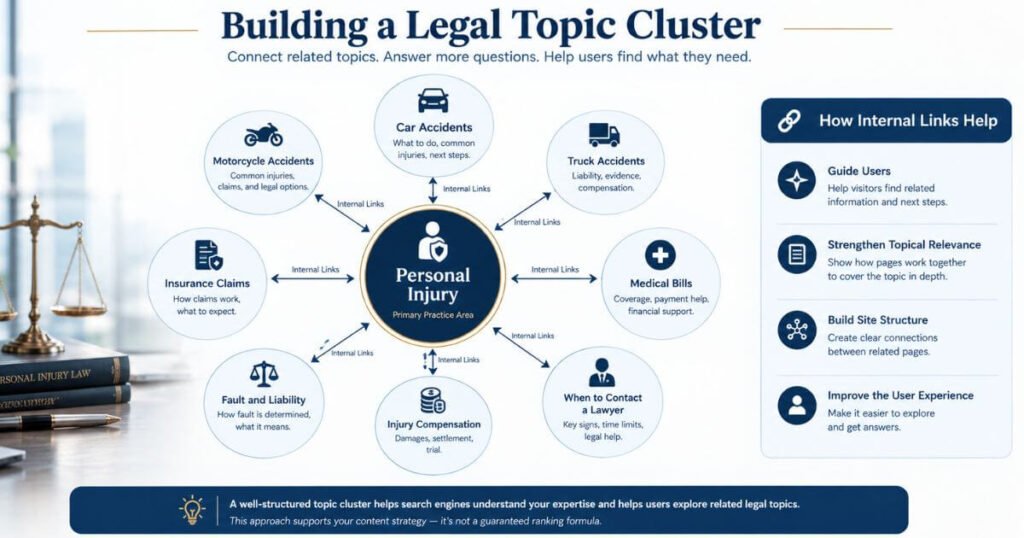
A Sample Cluster Structure: Personal Injury
Core page (pillar): Personal Injury Lawyer [Location]
Supporting pages (spokes):
| Page | Question It Answers |
| Car Accident Lawyer | Who handles a crash claim? |
| Truck Accident Lawyer | What makes trucking cases different? |
| Motorcycle Accident Lawyer | What changes with a motorcycle case? |
| What to Do After a Crash | What are the first steps? |
| Who May Be Liable | Who pays for the damage? |
| Insurance Claims | How does the claim process work? |
| Common Damages | What can a client recover? |
| Location Specific Service Page | Does the firm serve my city? |
What This Structure Does and Doesn’t Prove
Supported by Google’s own guidance: content should give a substantial, complete description of a topic. Original analysis adds real value over thin, duplicate pages.
Not supported by any Google source: the claim that more connected pages produce higher rankings. This is a content planning strategy. It is not a documented ranking mechanism.
Build the cluster because it helps a reader move from a broad question to a specific one. Don’t present it to a client as a guaranteed ranking lever.
Internal Linking for Semantic SEO
Internal links help readers and search engines discover related pages. Google’s own linking guidance supports this. It does not support the claim that a fixed click count is a ranking rule.
What to Remove
The claim that a three click rule keeps every page within easy reach should not appear as a Google requirement. Google has not published a rule stating that every page must sit within three clicks of the homepage. Treat this as a general usability guideline, not a confirmed ranking factor.
What to Use Instead
1. Link important pages from the pages most relevant to them.
2. Use descriptive anchor text that names the destination topic, not “click here.”
3. Place the link where the reader actually needs the next piece of information.
4. Make important pages reachable through the site’s main navigation, not orphaned links alone.
Minimum Internal Link Requirement for This Article
Every article needs three or more genuine internal links. Each link must point to a page that actually exists. Each page must relate to the surrounding content.
1. Link “personal injury practice page” to the firm’s actual personal injury service page
2. Link “entity SEO” to What Is Entity SEO and Why Do Law Firms Need It?
3. Link “content cluster structure” to a supporting article on internal linking or site architecture, if one exists on the firm’s site.
Confirm each destination URL is live and the anchor text matches the target page’s actual topic before publishing.
Structured Data and Schema.org
Schema.org defines the types and properties used to mark up content, such as LegalService, Attorney, and FAQPage. Google’s structured data documentation explains which markup Google supports. It also explains which search features that markup may make a page eligible for. Structured data gives search engines machine readable information. Google may use eligible markup for certain search features. Implementation does not guarantee that a feature will appear. The statement “schema markup improves rankings” overstates what Google documents. A law firm should not present schema implementation as a ranking strategy.
Where This Applies for a Law Firm
1. LegalService or Attorney schema on practice area and attorney pages.
2. FAQPage schema on genuine FAQ sections, following Google’s current eligibility guidelines.
3. BreadcrumbList schema to describe the site’s page hierarchy.
Does Semantic SEO Help With AI Overviews?
Google states there are no additional requirements or special optimizations to appear in AI Overviews or AI Mode. Existing SEO fundamentals remain relevant. A page must be indexed to qualify as a supporting link. It must also be eligible to show a snippet in regular Search. AI Overviews and AI Mode draw from the same index as standard search results. They use the same quality systems too.
A firm does not need a separate “AI content strategy.” Sound SEO practice is enough. Useful, complete practice area pages remain the foundation. Internal links stay useful for discovery. Structured data should follow Google’s existing requirements. There is no special AI schema to follow instead.
Claims to Avoid
1. “AI Overviews reward semantic SEO.” No Google source supports this.
2. “Connected content earns AI citations.” Google does not confirm this as a mechanism.
3. “Five related questions increase trust.” No published evidence supports this specific number.
4. “Short answers consistently outperform long answers.” This needs a controlled study, which doesn’t exist publicly.
5. “Citation potential is a ranking factor.” Google has not confirmed this framing.
Search Intent and Law Firm Content
Search intent means matching a page to what a searcher actually wants to find. Understanding legal search demand also helps firms identify which practice areas and questions deserve deeper content coverage. Jurisdiction changes what “right” means for legal answers.
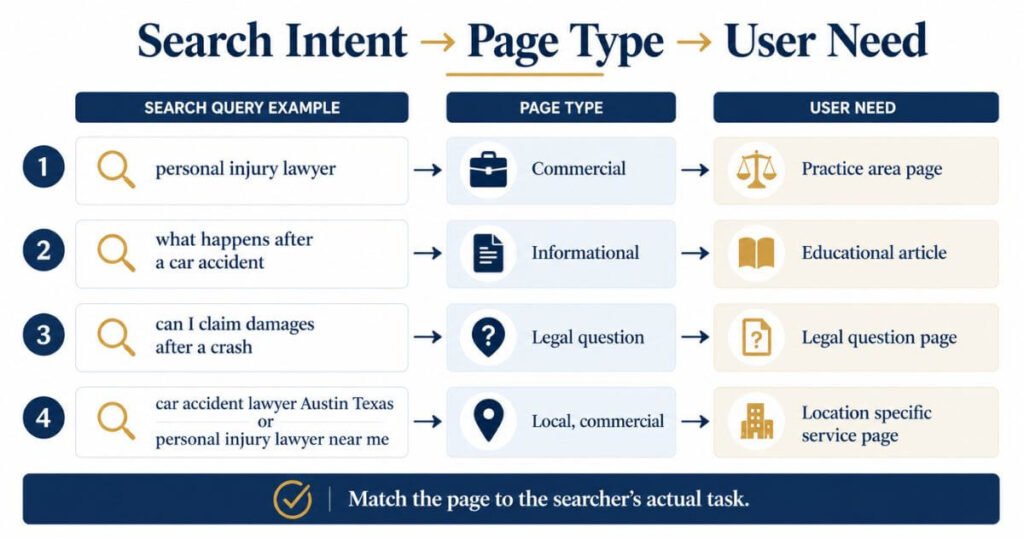
| Search Query | Intent Type | Page That Answers It |
| “personal injury lawyer” | Commercial | Practice area page |
| “what happens after a car accident” | Informational | Educational article |
| “can I claim damages after a crash” | Legal question | Legal question page |
| “car accident lawyer Austin Texas” / “personal injury lawyer near me” | Local, commercial | Location specific service page |
Why Jurisdiction Changes the Answer
A legal question rarely has one universal answer across the United States. Comparative negligence rules differ by state. Some states cap damages in personal injury cases. Texas follows modified comparative negligence. A client’s own fault can reduce or block their recovery under that rule. A page answering a legal question needs the actual state statute or case law behind it. Content written for a national audience should say so directly. It should not imply that one rule applies everywhere.
Local SEO and Geographic Relevance
Local relevance comes from a real, stated service area. It does not come from stacking city names for coverage. Confirm the firm actually practices in a city before adding a page for it. List the jurisdictions where its attorneys are licensed. List the counties and courts where it has filed cases.
A real local page includes:
• The specific city, county, or region the firm serves.
• The local courts relevant to that practice area, such as a county district court.
• Any local rules, filing deadlines, or procedures specific to that jurisdiction.
• Consistent name, address, and phone details matching the firm’s Google Business Profile.
Measuring Semantic SEO Performance
Track a chain of metrics from visibility to business outcome. No single number proves that a content structure caused a result.
| Metric | What It Shows | Its Limitation |
| Impressions | How often pages appear in search results | Doesn’t show if the visitor found the page useful |
| Rankings for related queries | Visibility across a topic, not one phrase | Doesn’t measure conversion |
| Organic inquiries | Real interest from a visitor | Requires proper tracking setup |
| Signed cases | Actual business outcome | Takes the longest to measure; depends on intake process too |
Don’t state that semantic SEO increases qualified leads as a fact. Search Console and intake data can support that claim. Cite that data with a timeframe when it exists. If it doesn’t exist yet, present the framework as something to track going forward.
Frequently Asked Questions
Does every law firm need a separate page for every practice area?
A separate page makes sense when the practice area has real search demand and enough substantive content to support it. A practice area with only a sentence or two of unique content should not get its own page yet.
How do you decide which pages should link to each other?
Link pages that share a real topical relationship, such as a practice area page linking to its related legal questions. Avoid linking pages together only because they exist on the same site.
Should a law firm create a separate page for every city?
Only for cities or counties the firm actually serves. A city page with no real local presence or content adds little value and can appear as thin content.
Does structured data guarantee a rich result?
No. Structured data makes a page eligible for certain search features. Google decides whether to display that feature. Eligibility never guarantees it will appear.
Does semantic SEO guarantee higher rankings?
No. Google has not confirmed a “semantic SEO” ranking factor. Connected, complete content supports the standards Google has published, but it isn’t a documented ranking mechanism on its own.
Is Your Law Firm’s Content Actually Connected?
A law firm’s content works best when its practice areas, attorneys, and locations connect through one clear structure. That structure helps a reader move from a broad question to the specific answer they need. Google’s own guidance supports useful, complete, people-first content. It does not confirm a guaranteed ranking outcome tied to any single method, including semantic SEO. If you want to review whether your firm’s practice area pages are properly connected, you can request a content structure review from Faheem Bhatti SEO.
