

Entity SEO organizes a law firm’s content around one connected subject, rather than a scatter of standalone pages. Attorneys, practice areas, and services get tied into a single structure that search engines and readers can both follow with ease. Traditional SEO leans on keywords in isolation; entity SEO instead maps the relationships between people, services, and topics.
This guide covers:
- What an entity means in an SEO context for Law Firms
- How a law firm functions as a core entity
- How attorneys and practice areas relate to that entity
- How modern search systems read these relationships across a site
What Is an Entity in Search
An entity is defined as a thing or concept that is singular, unique, well-defined, and distinguishable. A law firm is one entity. An attorney is another. A practice area is a third.
Entities Have Attributes
Each entity carries its own set of defining details. A law firm has
- a name
- a location
- a roster of attorneys
An attorney has
- credentials
- a role
- a firm affiliation.
A practice area ties to a specific legal service and a jurisdiction. These attributes sketch out a full picture of each entity on their own, and the relationships connecting them add a further layer of structure, together forming a chain.
Entities Have Relationships
Entities connect to each other through relationships. These connections form the structure a search engine reads.
- Law Firm employs Attorney
- Attorney practices Personal Injury
- Law Firm serves Texas
Each relationship adds a layer of structure. Together, they form a chain: Firm → Attorney → Practice Area → Location
Why Context Matters for an Entity
A name alone rarely identifies anything specific. “John Smith” could refer to almost anyone. But add Attorney, Personal Injury, Texas, and Law Firm, and the picture narrows quickly. Context turns a generic name into a specific, identifiable entity. One that a search engine can confidently attach to a real person and firm.
How a Law Firm’s Entity Information Becomes Clear Across Its Website
A law firm’s online identity forms from several connected parts. Firm identity, attorney information, and practice areas all play a role. Location details, supporting content, and structured data add further layers. External references, like directories and citations, reinforce the picture.
The Law Firm as the Central Entity
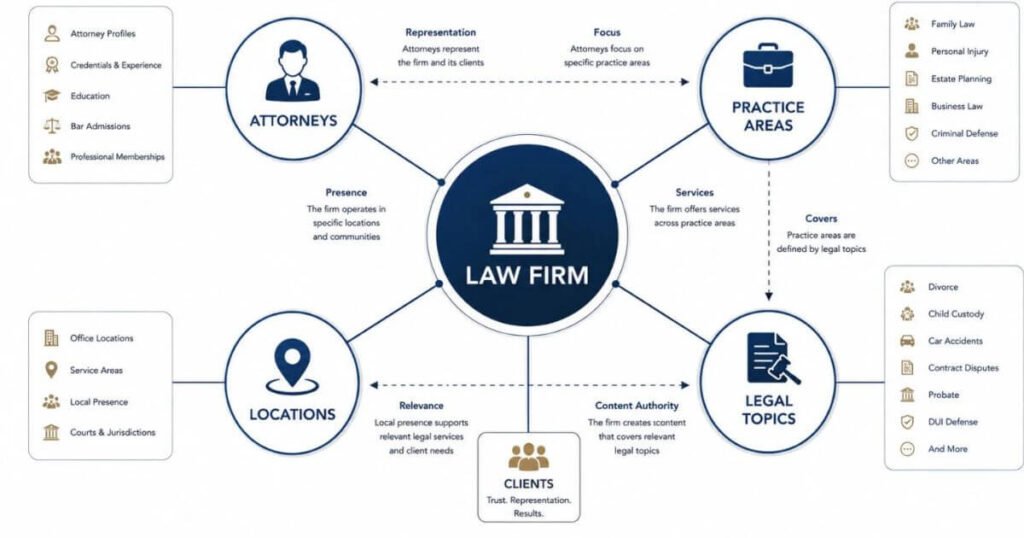
One useful way to organize a law firm’s site is around a central entity model:
- Law Firm → the anchor point
- Attorneys → connect back to the firm
- Practice Areas → connect back to the firm
- Locations → connect back to the firm
- Legal Topics and Supporting Pages → connect back to the relevant practice area or attorney
Each page has a clear anchor to return to. Pages without that anchor tend to feel disconnected from the rest of the site.
This structure helps people navigate the site more easily. It can also give search systems clearer relationships to interpret, since related pages point back to a consistent, central identity. A clear structure does not guarantee a ranking or trust outcome. It gives search systems more accurate information to work with.
Attorneys, Services, and Locations
Attorneys, services, and locations each establish a different piece of the firm’s identity:
| Page | What It Establishes |
| About/Firm | Firm identity |
| Attorney | Person, credentials, affiliation |
| Practice Area | Service and legal topic |
| Location | Genuine geographic service information |
| Article | Supporting legal topic or question |
An attorney page establishes real expertise behind a practice. A practice area page establishes real capability the firm delivers. A location page establishes real reach in a specific service area. Consistent, accurate details across these pages give readers a clear picture of the firm. They also give search systems a clearer set of relationships to read, without relying on any single page to carry the full identity.
How Entity SEO and Semantic SEO Work Together
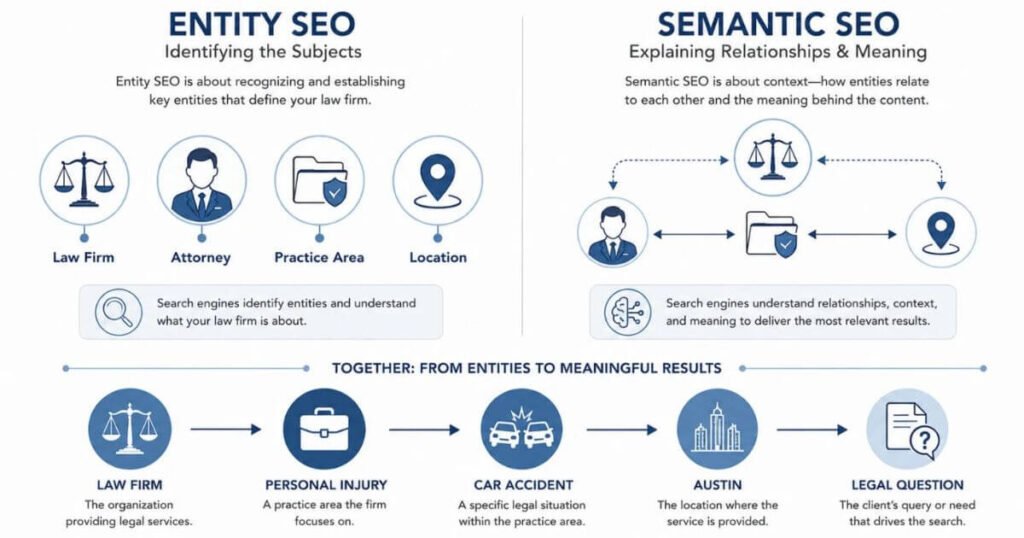
Entity SEO and law firm semantic SEO are two connected concepts within an SEO framework. They are not official ranking systems defined by any search engine. They describe how content can be structured for clarity.
- Entity SEO identifies and establishes subjects. It answers who or what a page is about.
- Semantic SEO establishes meaning and relationships between those subjects. It answers how those subjects connect and what the content actually means.
Together, they map a real path:
Law Firm → Personal Injury → Car Accident → Austin → Legal Question
The firm is the entity. Personal injury is the practice area. Car accident and Austin add specificity. The legal question is what a real reader is trying to answer.
From Entities to Topics
A core practice area anchors a group of related topics. Semantic SEO for lawyers helps connect a practice area with the related questions, entities, and topics that support it. Take personal injury as an example:
- Car accidents
- Truck accidents
- Motorcycle accidents
- Insurance claims
- Comparative responsibility
- What to do after an accident
These are not just keywords. They represent real questions a reader carries through their search, one after another, before they ever pick up the phone. A site built around this structure answers each question as it comes up. That coverage keeps a reader on the site instead of bouncing back to search.
Why These Relationships Matter
Instead of restating why relationships matter, use this as a working checklist:
- Is every attorney clearly affiliated with the firm?
- Is every practice area connected to an actual service the firm delivers?
- Does every location represent genuine service coverage, not a placeholder?
- Do supporting articles clearly relate to a specific practice area?
- Do internal links make these relationships easy to follow?
A firm that can answer yes to each question has a site structure that gives search systems and readers a clear, accurate picture to work from.
What Entity SEO Looks Like on a Law Firm Website
Entity SEO shows up in specific, controllable places across a site:
| Website Element | Entity Being Established | Relationship |
| About page | Law firm | Firm identity |
| Attorney profile | Attorney | Attorney → firm |
| Practice area page | Legal service | Firm → service |
| Location page | Location | Firm → service area |
| Blog/article | Legal topic | Topic → practice area |
| Internal links | Relationships | Page → related page |
On its own, each element establishes just one piece of identity. But connected through consistent naming and internal links. They come together into a single, coherent picture: firm, attorney, personal injury, car accident, Austin, Texas, all pointing back to one another and reinforcing the same identity. This isn’t a stack of disconnected pages. It’s a structure where every page has a defined role and a clear relationship to everything else on the site.
Where Structured Data Fits Into Entity SEO
Entity SEO often gets confused with schema markup. Structured data supports entity SEO. It does not replace it, and it does not equal it.
A useful hierarchy explains why:
- Content establishes information for users. This is the writing itself: firm details, attorney credentials, practice area explanations.
- Site architecture connects that information. Internal links and page structure show how the pieces relate to each other.
- Structured data provides a machine readable representation of eligible information already present on the page.
Structured data sits at the bottom of this chain. It formats information for machines. It does not create or verify that information.
What Structured Data Can Communicate
Structured data can describe information about the firm, its people, its locations, and its content in a machine readable format, when the relevant markup is supported and correctly implemented. Understanding how schema markup supports law firm SEO can help firms use structured data without treating it as a ranking shortcut.
Common examples on a law firm site:
- Organization markup for firm level details
- Person markup for individual attorneys
- LocalBusiness markup where a genuine physical location applies
- Article markup for blog and informational content
- Breadcrumb markup for site navigation
This gives search engines cleaner, machine readable information to process. It does not replace good writing. It supports it.
What Schema Cannot Establish?
Schema cannot build expertise on its own, no matter how detailed it gets. It cannot create authority or reputation for a firm. It cannot guarantee stronger rankings just by being present on a page. Structured data describes information. It does not make unsupported information true.
Google Search Central covers this directly in its own documentation. Schema supports good content. It never replaces it. A firm still needs real expertise behind every page schema describes.
How External Sources Can Corroborate a Law Firm’s Information
External sources can corroborate the information a firm’s website already states, when that information is accurate and consistent.
- Consistent firm identity across external sources supports accuracy
- Attorney profiles on trusted external sites corroborate that a person is real and credentialed
- Professional organizations and credible legal directories reflect legitimate affiliation
- Legitimate publications and local coverage add outside, independent reference points
- Accurate, matching business information across sources reduces conflicting signals
What matters here is relevance, accuracy, and consistency, not volume. A handful of accurate, relevant mentions carries more weight than a large number of mentions that are unrelated or inconsistent.
Entity SEO in Local and AI Search
Entity SEO plays a role in both local search and AI generated answers. Each context uses entity information differently, and each deserves a separate, careful look.
Local Search
Local search connects a firm’s identity to a specific service area. A useful way to check this is a local entity audit:
Firm → Location → Service → Practice Area → Supporting Evidence
Verify each link:
- Firm identity: Is the firm name consistent everywhere it appears online?
- Location: Does the address match across the website, directories, and profiles?
- Service area: Is the geographic area the firm actually serves stated clearly and consistently?
- Attorney affiliation: Is it clear which attorneys work at which location?
- Practice area: Is each practice area tied to a specific, real service the firm delivers?
- Consistent business information: Do name, address, and phone details match across the site and external sources?
Gaps here often show up when a location page states one detail and an attorney or service page states another. Closing those gaps is a matter of accuracy, not a guaranteed path to a ranking outcome.
AI Search and Entity Context
AI powered search tools synthesize information from multiple sources when generating an answer. A few things are reasonably well understood:
- These systems pull from multiple sources rather than a single page.
- Consistent, accurate information is easier for a synthesis process to use.
- Contradictory information across sources can create ambiguity about which detail is correct.
Because of this, entity clarity is a useful information quality objective. It is not a confirmed driver of AI citation visibility. No independent evidence in this article establishes that clean entity structure produces stronger citation rates inside AI generated answers, and the article does not claim that relationship. Consistent, accurate entity information is a reasonable practice on its own merits. It does not come with a guaranteed visibility outcome.
How to Tell Whether a Law Firm Has Strong Entity Clarity
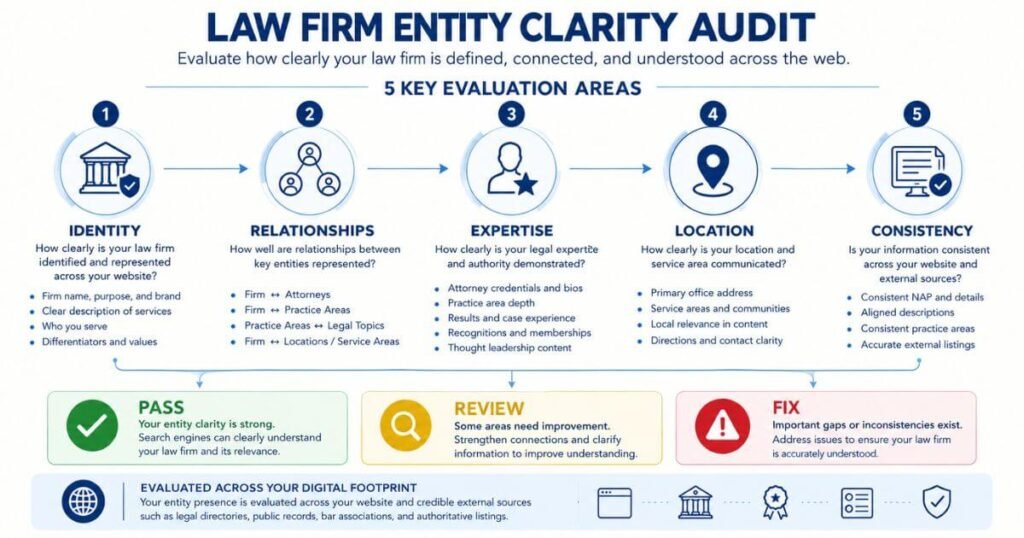
Use this framework to audit a firm’s entity clarity. Each item includes a measurable test and a PASS, REVIEW, or FIX rating.
Identity
Can someone identify the exact firm from the website and credible external sources?
- PASS: Firm name, address, and phone match everywhere.
- REVIEW: Minor inconsistencies, like an abbreviated name on one directory.
- FIX: Conflicting names, addresses, or missing firm details.
Relationships
Can you clearly establish which attorneys work for the firm and which practice areas they handle?
- PASS: Every attorney page states firm affiliation and practice area.
- REVIEW: Affiliation is implied but not directly stated.
- FIX: No clear connection between attorneys and the firm or practice areas.
Expertise
Are credentials and relevant experience clearly documented rather than merely asserted?
- PASS: Bar admission, education, and experience are specific and verifiable.
- REVIEW: Credentials are mentioned but lack detail.
- FIX: Expertise is claimed with no supporting detail at all.
Location
Does the firm clearly identify where it genuinely provides services?
- PASS: Service area matches the firm’s actual physical presence and coverage.
- REVIEW: Service area is broad or vaguely worded.
- FIX: Service area claims coverage the firm cannot substantiate.
Consistency
Do important firm, attorney, and location details agree across credible sources?
- PASS: Details match across the website, directories, and profiles.
- REVIEW: Small discrepancies exist in older listings.
- FIX: Directories, profiles, and the website contradict each other on key details.
A firm scoring FIX on any item has a concrete, specific place to start.
Frequently Asked Questions
Do I need both entity and semantic SEO?
Yes, they do different jobs. Entity SEO identifies subjects like the firm and its attorneys. Semantic SEO connects those subjects through clear, accurate relationships.
Can entity SEO affect law firm rankings?
There is no guaranteed ranking effect. Clear information architecture can support how search systems understand a site. Rankings depend on many other factors too.
Does schema markup guarantee better rankings?
No. Schema helps machines read a page’s information in a structured format. It does not create expertise or replace real content.
Does entity clarity guarantee visibility in AI Overviews?
No. Consistent entity information is easier for AI systems to synthesize from. That is not the same as a guarantee of citation or placement.
Which law firm entity relationships should I audit first?
Start by mapping the core connections, including the firm’s link to its attorneys, its practice areas, and its location. Then check how each practice area connects to its related legal topics, and how content on the site connects back to the practice areas it supports.
Ready to Build Your Law Firm’s Search Authority?
Firm identity, attorneys, practice areas, and locations will keep anchoring search results. Legal topics and the relationships between all these pieces will matter even more over time.
Entity SEO is not an isolated ranking tactic sitting off to the side. It is the structure that holds everything else together. Ready to build this structure the right way? Explore our website, Faheem Bhatti SEO, to see how entity clarity fits into a complete strategy.
