

Attorney focused SEO in Austin connects the firm’s actual practice areas with real legal search intent. It builds on Austin specific local demand, attorney expertise, and genuine trust. It leans on authoritative legal content, technical accessibility, and strong local search signals. The goal is meaningful authority, not a page that just looks busy.
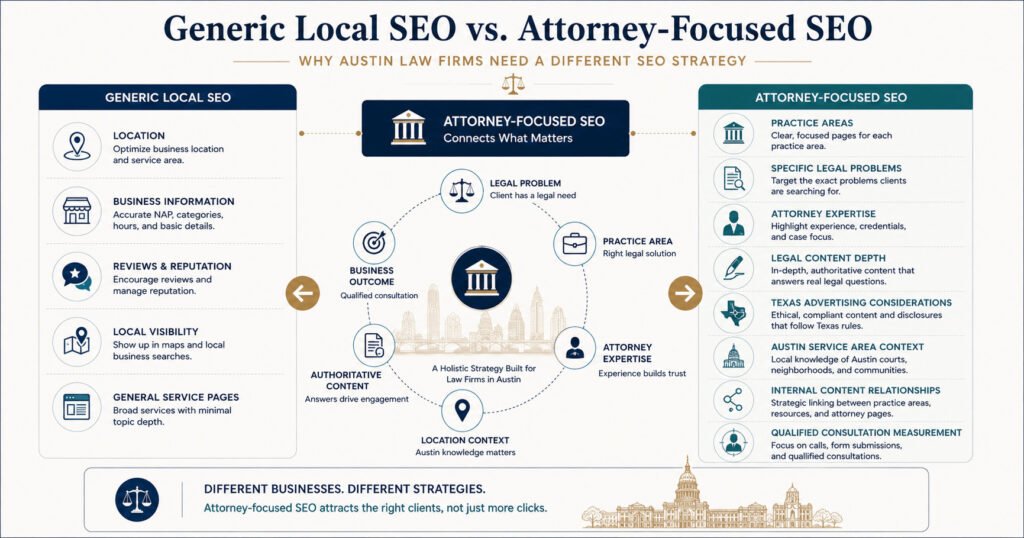
This is not generic local SEO with an Austin lawyer stuffed into a page title. Attorney focused SEO ties legal expertise, search intent, local relevance, content authority, and technical SEO around what the firm’s actual services truly are. We have watched firms rank for the wrong words and still lose calls. That gap is what this guide fixes.
What Makes SEO Different for Austin Law Firms?
Legal searches are often problem driven, not product driven. Someone typing a question is usually scared, confused, or stuck. That is very different from someone comparing two pairs of shoes. Practice areas create their own separate search ecosystems. A custody question and a DUI question rarely share a reader or a page.
Legal content carries high stakes decisions, so attorney identity and expertise matter more here than in most industries. Local relevance still works alongside practice area relevance. Professional advertising considerations shape how confidently an Austin law firm SEO can word its claims. We have seen strong rankings mean nothing when the content misses this mix.
How Practice Areas Should Shape Austin SEO
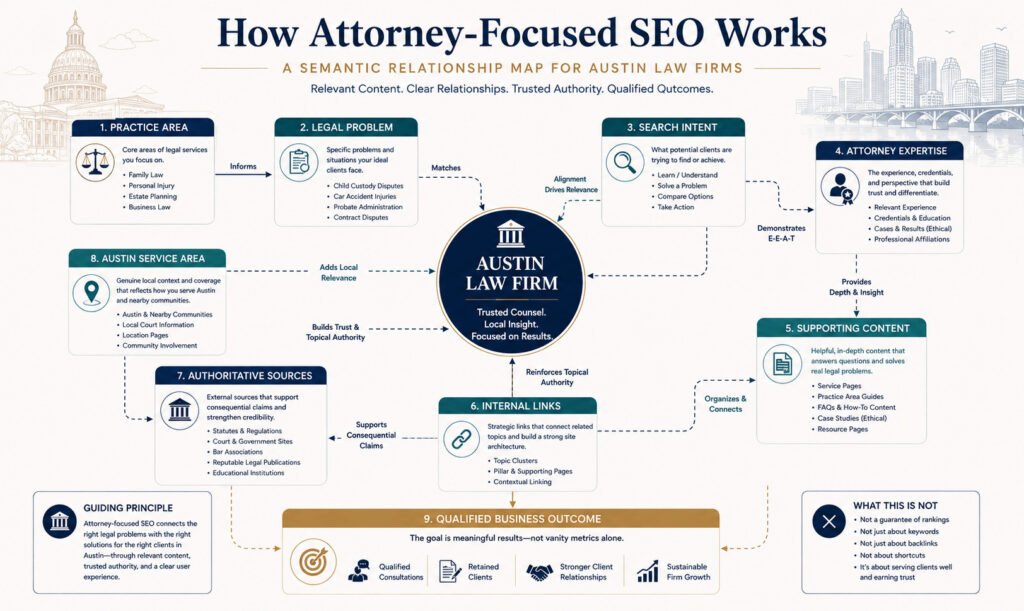
Good SEO architecture starts with a firm’s real practice areas. Each area shapes different legal search intent, connects to clear topic clusters, and builds strong internal links across every related practice area page.
Start With the Firm’s Actual Practice Areas
Every strong SEO architecture begins with the services a firm truly practices, not a generic label. The real path moves from firm to attorney, then to practice area, then to legal problem, then the search query itself across the site. A broad Austin lawyer strategy cannot represent different legal services well.
Small law firms can still compete when their SEO focuses on the right practice areas, local searches, and client needs. Each practice deserves its own clear home on the site. This structure helps readers and search engines see exactly which service fits their specific legal need without confusion or delay.
Map Legal Questions to Search Intent
Curious readers move through clear stages before they call anyone. Someone might type “do I have a case” or ask “what happens if” a deadline passes. Others search “how does Texas law handle” a specific dispute they are facing right now.
Other searchers jump straight to “lawyer for” a specific charge, or type “attorney near me” when they need help fast. These informational queries often turn into transactional visits once real trust with the firm has been earned.
Build Topic Clusters Around Each Practice Area
A central practice area page grows stronger with supporting legal topics built around it. Related questions, connected entities, and thoughtful internal links all guide readers back toward that main anchor page consistently across the whole site structure over time.
This pattern reflects real information gain, not just extra pages. Publishing more blog posts alone will not build authority on its own. Real strength comes from showing exactly how each piece connects to the next clearly.
How Austin Local Search Fits Into Attorney SEO
Target the Real Service Area, Not Just “Austin”
Most firms do not serve just one small part of Austin. Areas like Downtown Austin, South Austin, and North Austin often send real, paying clients too. Round Rock and Cedar Park matter just as much.
Pflugerville often brings in solid clients too, quietly. Pages should reflect the firm’s true, honest service area. Thin pages built only to rank rarely help anyone. Real coverage always works better than fake, padded reach.
Connect Local Relevance With Practice Area
Austin plus personal injury is not the same search as Austin plus family law at all. Each pairing creates its own kind of worried reader. Each one also needs its own kind of clear page.
Mixing these topics causes real, lasting confusion. Readers get lost, and so do search engines. Local relevance only truly works when it sits next to the exact right legal service.
Make Website and Local Signals Reinforce Each Other
A Google Business Profile should match the website exactly, every time. The firm’s name, address, and phone number must agree everywhere online. Small mismatches can quietly hurt local trust and rankings over time.
Local citations and reviews should also line up cleanly. Website pages should mention the same local details too, consistently. When every signal agrees, both readers and search engines trust the page far more.
What Should Legal Content Demonstrate?
Answer Real Client Questions
Good content answers real legal problems first, before anything else. It should not just try to sell a service right away. Cover process questions and clear eligibility questions early on the page itself.
Jurisdiction questions and next step questions matter just as much. A page built only as a sales pitch often fails quietly. It should answer the real question the reader actually typed into search.
Demonstrate Attorney Expertise
Real trust comes from a named, known, real attorney. Show clearly who wrote the page or who reviewed it. Add a short bio with real credentials and years of hands on practice behind it.
Accurate legal explanations matter far more than fancy words ever do. Clear ownership of the content builds lasting, real trust. This shows real expertise instead of simply claiming it exists somewhere on the page.
Build Meaningful Content Depth
Real depth comes from how ideas connect, not simple word count. A main legal issue leads into smaller, related issues nearby. Those issues connect to real questions that clients actually ask out loud.
Writing dozens of short, thin blog posts will not build real trust. Quality and connection matter far more than raw quantity ever will. Show clearly how each piece truly supports and builds on the last.
Where Technical SEO Supports Attorney Focused Search
Make Legal Content Easy to Crawl and Understand
Search engines need to read a page with total ease. Use clear web addresses that make plain sense. Keep headings in a simple, logical order every single time. Plain text works better than fancy, busy formatting.
The page must also work well on phones and tablets. A slow or messy page loses tired readers fast. A clean page keeps a worried visitor calm and focused. That calm feeling often leads to a phone call.
Use Internal Links to Show Topical Relationships
Internal links connect related pages across the whole site. A practice area page should link to real legal questions people ask. Those question pages can link back to helpful support pages too.
This shows how each page truly relates to the others. Search engines read these links as clear signals of connection. Good links help both new readers and returning visitors find their way around easily.
Use Structured Data Where It Actually Applies
Structured data helps search engines read a page correctly. It labels the content in a clear, simple, organized way. This does not replace real writing or genuinely useful information already on the page.
Some firms treat it like a magic trick for rankings. That is simply not how any of it works. It just helps eligible content get understood and shown in the right, correct way.
How Authority and Trust Develop Beyond the Website
Earn Relevant External References
- Seek mentions from relevant legal publications.
- Earn recognition from professional organizations.
- Build citations through reputable local sources.
- Focus on industry publications and genuinely useful citations that reflect the firm’s actual work.
Prioritize Relevance Over Link Volume
- Avoid chasing hundreds of unrelated backlinks.
- Remember that link volume alone does not create meaningful authority.
- Prioritize relevant, high quality links that support stronger rankings.
Connect Attorney Reputation With Digital Authority
- Showcase attorney expertise across your online presence.
- Build credibility through professional recognition.
- Earn legitimate external mentions from trusted sources.
- Strengthen your authoritative references with consistent branding.
- Maintain entity consistency to reinforce long term digital authority.
What Texas Legal Marketing Rules Mean for SEO
Texas attorney advertising requirements shape how content can be worded. Accurate representation of legal services matters, along with careful claims about expertise and specialization related language.
Testimonials, reviews, and case results all need proper context. Attorney identification and confidentiality concerns should guide every page. Firms should lean on State Bar of Texas and ABA guidance rather than guesswork.
How AI Search Changes Attorney SEO in Austin
Create Content That Answers Before It Persuades
Good content answers first, right at the top. It does not make readers wait or dig for it. Short, clear answers help both people and search tools right away. Clear headings make each answer easy to find fast.
After the short answer, add a bit more depth. Explain the why behind it in plain, simple words. This helps regular readers and it also helps answer based search do its job well. Real depth should always come second, not first.
Make Legal Entities and Relationships Clear
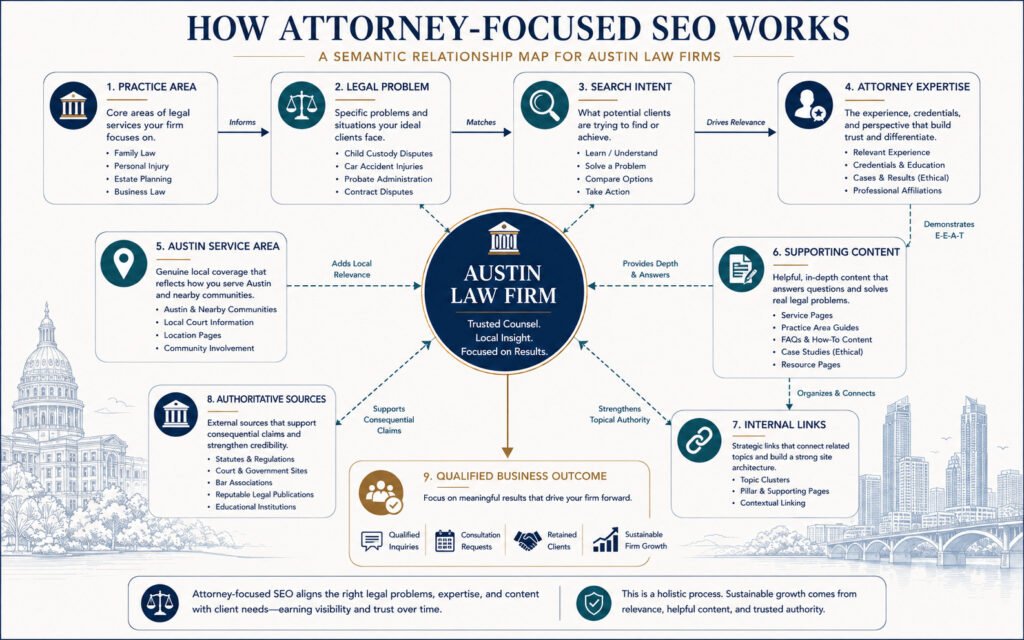
Show how each part of the firm connects to the next one clearly. The attorney links to the firm. The firm links to a practice area. That practice area then links to a real legal topic and problem.
Then connect that topic back to Austin itself. Add trusted outside sources to support each claim made. This clear chain helps search engines fully understand the whole page. It also helps real readers trust it right away.
Don’t Treat AI Search as a Separate SEO System
Firms do not need a strange, brand new system just for AI search. Good, solid SEO already covers most of this ground. Google still asks for the same basic things it always has, nothing more.
The real change is simply how clearly a page gets organized. Information should be easy to find and easy to read for anyone. That is the actual shift, not a whole new set of secret tools.
How the Pieces Work Together in an Austin
An Austin law firm builds strength by linking every layer together. Practice area feeds legal search intent, which shapes each topic cluster. Expert legal content sits inside that cluster, held up by careful internal linking and solid technical accessibility. Local relevance and external authority support it from outside the page.
A strong personal injury page gets more useful once injury related questions link back to it, the local presence confirms geographic relevance, and authoritative references add trust. That full chain is what real semantic SEO understanding looks like, not a list of separate tasks.
How Austin Law Firms Should Measure SEO Progress
Measuring SEO progress works best across three clear levels. Proxy signals come first. These include relevant organic visibility, impressions, and referring domains. Indexed pages and local visibility count here too. Search performance comes next. This covers rankings for relevant legal queries and clicks.
Steady practice area visibility growth belongs here as well. SEO investment should also be evaluated against the work required to improve those practice areas, rather than judged by a standard package price alone. Business outcomes matter most of all. These include qualified enquiries and phone calls. Consultation requests and real organic conversions fall under this level too.
Common Misconceptions About Attorney SEO
- Ranking first for Austin lawyer is not the whole goal.
- Publishing more blog posts does not automatically build authority.
- Local SEO and organic SEO are not separate strategies.
- More backlinks do not always mean better rankings.
- Schema alone will not improve rankings.
- AI SEO does not require a completely separate website strategy.
- Traffic alone does not equal successful SEO if it never turns into real clients.
Frequently Asked Questions
What is different about SEO for law firms?
Law firm SEO centers on real practice areas, true legal intent, and provable expertise. Local relevance and authority matter, and every claim must respect professional considerations.
Does an Austin law firm need local SEO?
Yes. Local visibility works alongside broader organic practice area visibility, and both feed different parts of the client journey.
How long does attorney SEO take to show results?
Timing depends on competition, current site condition, existing authority, content depth, and how tough the target queries are. There is no honest fixed timeframe to promise.
Should law firms focus on keywords or topics?
Keyword research still has real value, but it shouldn’t drive the whole strategy alone. Real strategy organizes around entities, topics, and intent, and around how these all connect through relationships.
Does AI search change the fundamentals of law firm SEO?
AI search changes how answers get surfaced, not the core rules. Google’s core requirements around useful, accessible content still stand.
Ready to Build a Stronger Law Firm SEO Strategy?
Good rankings mean nothing if they never turn into real clients. That’s the gap most law firm SEO misses. At Faheem Bhatti SEO, we close that gap through authoritative content, sharp local SEO, solid technical optimization, and honest, ethical link building, all built around your firm’s actual practice areas.
