

Google does not treat Moz’s DA score as a ranking input for any page. Law firm pages with stronger DA do not automatically rank higher in search. We still see high DA sites show up prominently in real search results. That gap confuses law firms who chase a bigger Domain Authority number instead of results.
The real reason is correlation, not causation, between backlinks and rankings. Google leans on multiple signals, not a single domain level authority score, to rank pages. Link analysis systems such as PageRank study link quality across the entire web. Google Search Central explains that real ranking signals differ from any domain level score.
Does Domain Authority Actually Affect Google Rankings?
Domain Authority is not a Google ranking factor. Google never confirmed it uses this score to rank pages. Domain Authority does not affect Google rankings. John Mueller confirmed Google ignores DA during crawling, indexing, and ranking. Moz built DA as a third party score to estimate link strength, not to predict a Google position.
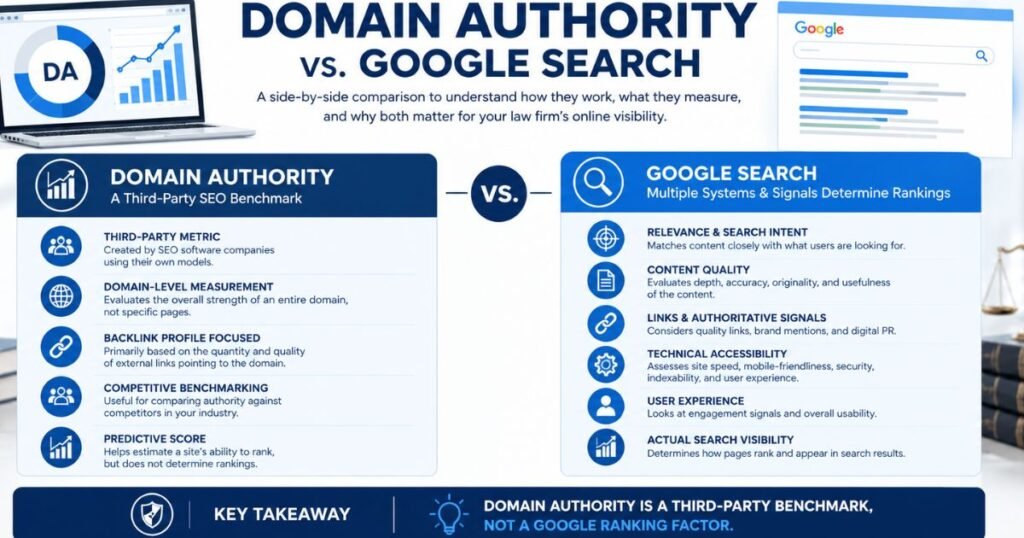
Domain Authority sits outside Google’s ranking system entirely. Google’s John Mueller stated the algorithm ignores DA during crawling and indexing. Moz built DA as a separate, third party score. The company’s own documentation frames DA as a strength predictor, not a ranking guarantee. Agencies use the score to gauge strength, not to predict placement. Backlink quality and page content explain the result, not the DA number. DA can correlate with strong backlink profiles without causing higher rankings. We track DA as a competitive benchmark, not a ranking target.
What Domain Authority Tells a Law Firm About Its Website
Domain Authority tells a law firm how its link profile compares to competitors. Moz built the score to estimate relative link strength across a domain, not to predict whether one page or one search query will rank. DA measures the strength of a domain’s link profile. Firms use it to compare their site against competitors in the same practice area. It flags gaps worth closing over time. Moz built DA to track broad trends, not single page outcomes. A rising or falling score signals a shift worth checking.
DA cannot predict whether a specific page will rank. The score cannot forecast rankings for one specific search query, according to Moz’s documentation. Google does not use DA in ranking. John Mueller confirmed DA plays no role in Google’s ranking systems. DA cannot tell a firm whether SEO work generated a lead.
| DA can help with | DA cannot establish |
| Broad competitor comparison | Whether a specific page will rank |
| Relative link profile benchmarking | Whether a particular query will rank |
| Identifying potential link profile gaps | Whether SEO work generated a lead |
| Monitoring third party metric movement | Whether Google considers the domain authoritative |
DA Is a Benchmark, Not a Goal
A DA target alone is a poor success measure. Chasing a fixed number like DA 50 ignores what actually drives clients. Google does not rank sites by DA. John Mueller has confirmed the score plays no role in ranking. Moz itself frames DA as a benchmark, not a scorecard.
A firm should track outcomes DA cannot show:
- Organic visibility for commercially relevant queries
- Rankings for the exact searches that bring in clients
- Qualified organic leads reaching the intake form
- Growth in relevant referring domains over time
- Conversion outcomes tied to organic traffic
These outcomes tie SEO work to revenue, not to a single score. Read the Moz Domain Authority explainer once for the full technical breakdown.
Why High DA Websites Often Rank Well Anyway
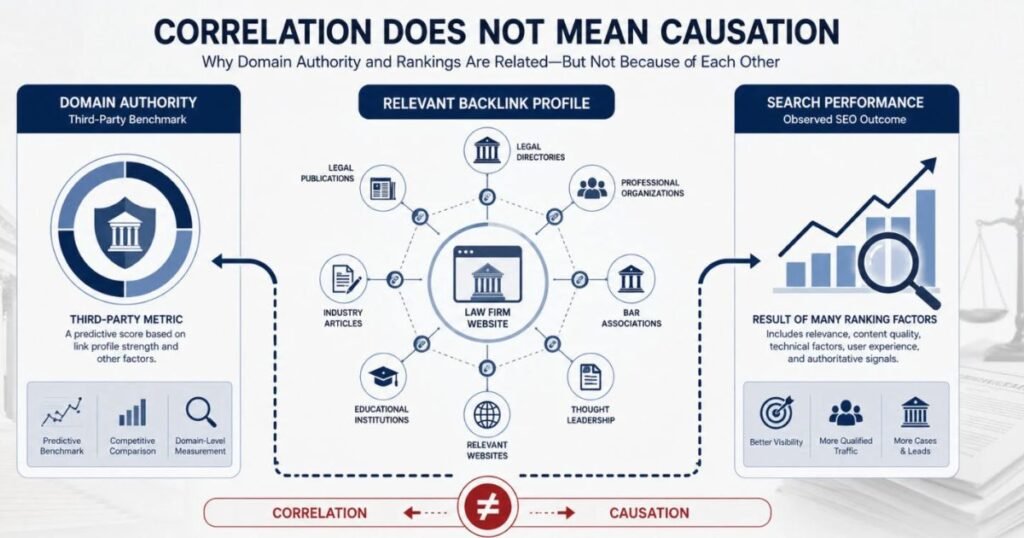
High DA websites often rank well because DA and Google rankings both draw on link related signals. Moz calculates DA from its own model. Google uses separate link signals to rank pages. The overlap creates correlation, not a cause. Moz calculates DA from its own model. The model weighs link related information, including referring domains and link quality. Google also uses link related signals. Both systems rely on similar raw ingredients, though the formulas differ completely. DA can correlate with strong link profiles without becoming a Google ranking factor.
Relevant content and real trust still decide rankings. Google weighs relevance, user intent, and link quality together before ranking a page. Big sites often win for a reason. Their link profiles tend to be broader and more relevant across the board. A law firm site can build that same pattern through real credibility.
Correlation Does Not Mean Causation
Here is a common law firm pattern. A firm earns links from bar associations and legal directories over time. Its DA score rises during that period. Its rankings often rise during the same period as well. Both changes appear together, but appearance alone proves nothing.
Observed: DA and rankings often rise together. Possible explanation: a stronger link profile sits behind both changes. Not established: DA rising caused the ranking gain. Google never confirmed that DA increases move rankings directly. Treat the pattern as a clue, not as proof.
What should law firms measure instead of DA?
Real search authority comes from several parts working as one system, not a single score.
- Relevant backlinks and useful legal content both feed into that system together.
- Practice area depth shows Google and readers that a firm truly knows its field. Matching search intent means answering the exact question a visitor typed in.
- Internal linking connects pages so topical relevance and topical relationships stay clear across the site.
- Local relevance matters too, especially for location specific legal searches near a firm’s office.
- Technical accessibility lets search engines crawl, understand, and index every page correctly.
- External references and an external authority profile add outside proof on top of onsite work.
This reinforcement builds trust and demonstrated expertise around legal entities and client queries. That connected explanation is what search engines reward most. Structured data for law firms can also help search engines understand the entities and information presented.
How Backlinks Fit Into the Domain Authority Question
Backlinks connect to Domain Authority because Moz builds its score from link data, while Google relies on its own link signals to rank pages. Moz counts referring domains, link quality, and link volume. Google treats links as only one factor inside a larger ranking system.Relevant legal link building sources carry more weight than random directory listings ever will.
Earning real links takes outreach, original research, and genuine press coverage over time. Paid link schemes break Google’s link spam policies and risk a manual penalty. Honest link building moves slowly and stays inside Google’s published guidelines throughout the process.
Relevant Links Matter More Than Link Volume
Relevant links carry more weight than link volume. A link from a real legal source usually supports a claim better than an unrelated one. Editorial context around a link shapes its value. A link placed for a genuine editorial reason tends to carry more weight.
A link should help readers, not just search bots. Even a high DA site loses value when its links sit off topic. Manipulative schemes violate Google’s link spam policies. Google’s spam documentation lists paid links and exchanges as violations. Editorial links carry the strongest relevance.
Can a Lower DA Law Firm Outrank a Higher DA Competitor?
Yes, a lower DA domain can beat a higher DA domain for one specific query. A lower DA law firm can outrank a higher DA competitor for one query. Firm A runs a broad site with DA above fifty, but its page there stays thin. Firm B runs a smaller site with DA near twenty and a tightly focused page.
Firm B’s page matches the search intent more closely. Google weighs that match alongside relevance, content depth, and local signals. Firm B can outrank Firm A for this one query. Firm A likely wins broader searches instead. The page decides the outcome, not the score.
How Law Firms Should Measure SEO Authority Instead
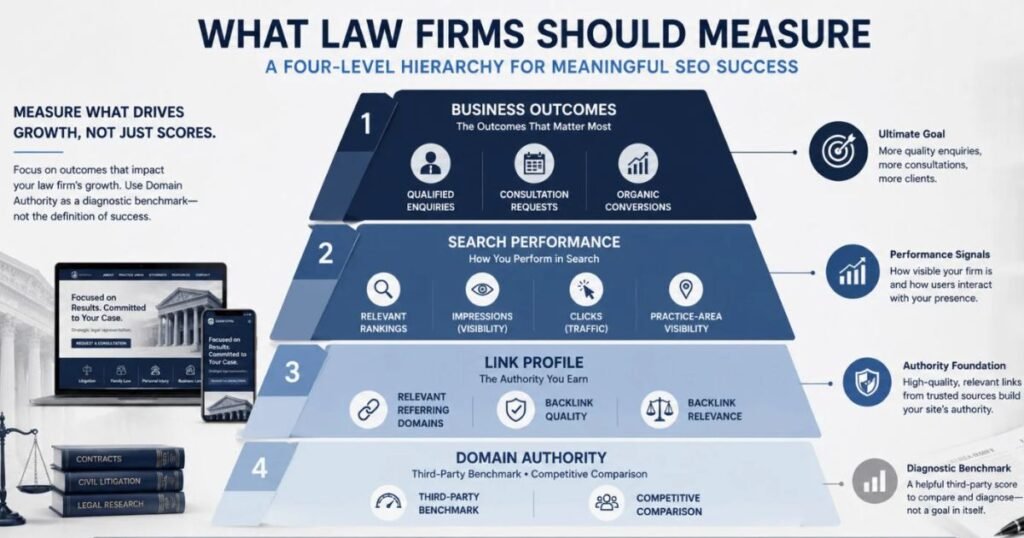
A real measurement framework looks past one score and studies several signals together. True SEO authority shows up through data, not through a single flashy number. We use diagnostic indicators to spot gaps before a client ever asks about rankings.
Authority and Link Profile Indicators
Domain Authority sits alongside referring domains as one early signal to check first. Backlink quality matters more than raw count. Backlink relevance matters even more. Organic visibility and early diagnostic indicators hint at how a site might perform. Google ranking performance still depends on far more than one link profile alone.
Search Performance Metrics
Real rankings for relevant legal queries show whether the work is actually paying off. Track impressions, clicks, and practice area visibility every single month without fail. Understanding which legal topics attract meaningful search demand helps firms prioritize the queries and practice areas worth tracking. Watch the growth of relevant pages as new content earns its own visibility. Meaningful searches tied to actual client needs matter more than vanity terms.
Business Outcomes
Qualified enquiries and calls tell a firm if the traffic actually converts. Consultation requests and organic conversions are the real proof behind every business outcomes report. A third party authority score like DA cannot show you a filled calendar. Closing a competitive gap here means real SEO success, not a bigger number.
What Domain Authority Really Means for Law Firm SEO
Treat Domain Authority as one third party measurement, never as the finish line itself. Backlinks and referring domains act as underlying authority evidence, not proof of rankings alone. Relevant content matched to search intent still drives most real search wins. Technical accessibility and internal linking support everything else happening on the site.
Real trust and external authority feed into a broader SEO system working as one unit. Search visibility and qualified organic enquiries are the actual outcomes worth watching closely. Stop chasing a bigger DA number and build something genuinely relevant, useful, authoritative, and competitive. That mental model keeps a firm focused on searches that bring in real clients.
Common Domain Authority Mistakes Law Firms Should Avoid
- Treating DA as a Google metric. Google has confirmed DA plays no role in ranking. Treat it as a Moz benchmark only.
- Using DA as the primary KPI. Business outcomes and search visibility matter more than any third party score. A rising DA number does not confirm rankings or leads improved.
- Comparing DA against unrelated markets. A DA comparison only means something against firms in the same practice area and region. Comparing across unrelated industries reveals almost nothing useful.
- Ignoring page level relevance. A strong domain score cannot rescue a page that misses the visitor’s intent. Page level work still decides most individual rankings.
- Buying links to inflate DA. Paid links and link schemes violate Google’s link spam policies. That approach risks a manual penalty instead of real authority.
FAQS
Should a law firm report DA to clients?
Reporting DA to clients works only as a supporting data point. Clients care about rankings, leads, and calls more than a third party score. Pair any DA mention with real search visibility and business outcome data.
Can DA fall while rankings improve?
DA can fall while rankings improve. Moz recalculates DA independently of Google’s ranking systems. A page can gain relevance and search visibility even as its domain score drops.
Should law firms compare DA with other law firms?
Law firms should compare DA only against firms in the same practice area and region. A broader comparison across unrelated markets reveals little about actual competitive position.
What should replace DA as the primary SEO KPI?
Business outcomes should replace DA as the primary SEO KPI. Qualified enquiries, consultation requests, and attributable organic conversions show whether SEO work reaches real clients.
Should Law Firms Focus on DA or Backlinks?
Focus on relevant high quality links and genuinely useful content first, every time. Treat DA only as a DA comparative metric, with real backlinks focus driving the actual strategy.
Build Real Authority With Faheem Bhatti SEO
A firm that wants a clearer picture of its own link profile and search visibility can start with a simple audit before chasing any third party score. At Faheem Bhatti SEO, we help law firms build authoritative backlink profiles, and our link building services are built around exactly this kind of work.
