

Schema markup helps translate law firm pages into language machines can actually read. It names entities clearly, which supports Google’s understanding and stronger, enhanced search appearances. This is not a guaranteed ranking boost.
Schema works as machine readable information, layered quietly behind the visible page content on a site. It does not directly move rankings. It shapes real search appearance and entity understanding, and it can unlock rich result eligibility. Think of it as explicit clues that confirm page meaning, nothing more and nothing less.
What Schema Actually Changes for a Law Firm
Structured data never changes the visible content a reader sees on the page. It adds machine readable meaning underneath that same content instead. This markup clarifies page relationships and entity relationships across the site. Mostly, it helps explain real search system function, not rewrite what a page already says.
Schema Gives Search Engines Explicit Context
Schema can label an organization, a person, a service, an article, or a breadcrumb clearly. It can confirm a location too, tied directly to the firm’s real address. These labels state entity relationships directly, instead of hinting at them through plain text alone.
They act as explicit clues for meaning classification, tied straight to the actual page content already sitting there. Google’s structured data documentation explains exactly how these clues get read and used. A firm reading that guide once tends to avoid most common markup mistakes early.
Schema Does Not Replace SEO
Schema cannot fix poor content by itself, no matter how carefully it gets written. It cannot build authority or patch over serious technical problems either. It offers no guaranteed rankings, full stop, despite what some SEO providers still claim.
It has to accurately represent visible content, not fix content that was never solid to begin with. It also cannot compensate for technical issues hiding elsewhere on the site. Schema supports strong content; it never replaces the work of writing that content well.
Does Schema Directly Improve Law Firm Rankings?
No, not directly. Plenty of SEO providers claim otherwise, but that claim does not hold up under scrutiny. Schema can unlock rich results eligibility, not a guaranteed appearance in search results. Adding markup alone never moves a page’s position on its own.
There is no direct ranking improvement tied to adding markup by itself. A simple markup error usually just blocks that rich result silently. A guideline violation, such as misleading or irrelevant markup, is more serious and can lead to a structured data manual action, which removes rich result eligibility until it’s fixed. Skip it entirely, and a page still competes under ordinary web ranking rules regardless. This ranking factor myth simply does not match how the search system actually works.
Where Schema Creates SEO Value for Law Firms
Schema still creates indirect search value worth understanding clearly. Drop the direct ranking boost myth, and the actual value gets much easier to see. This section brings some search value clarity, without overselling what markup actually does. Schema supports three honest things, nothing more dramatic than that.
Improve Machine Understanding
Schema can confirm who the firm is and who the attorney is in plain terms. It can also state what the page is about, without any guesswork involved. It can name which service is offered and where the firm actually operates day to day.
It shows how entities relate to each other across the whole site. This is machine understanding, built from clear labels instead of assumptions or vague hints. That clarity helps search systems read a law firm site the way it was actually built.
Strengthen Search Appearance
Schema can unlock breadcrumbs inside search results for a firm’s practice area pages. It can support article related enhancements too, when the content actually qualifies for them. These sit among the broader applicable Google Search features a page may earn over time.
Real rich result features work as an enhancement promise, not a certainty tied to any markup. They stay tied to genuine eligibility features the page already meets on its own. A firm should treat these features as a bonus, not the main goal of the work.
Reduce Semantic Ambiguity
Schema supports entity first SEO thinking across the whole website structure. It clarifies the law firm, the attorney, the practice area, and the location all at once. This connects clearly to the website and its content, reinforcing solid information architecture underneath it.
Piling on extra markup does not help beyond this basic, accurate coverage. Drop the stuff schema myth and focus on accuracy instead of raw markup volume. More tags never beat correct, well matched tags placed where they actually belong.
Which Schema Types Matter Most for Law Firms?
Most firms only need a small, practical core of schema types to start with. Keep a tight strategic focus here instead of chasing every available type. Skip any deep code tutorial, since that avoidance keeps this practical for a busy firm. Careful schema type selection matters more than covering every type that exists.
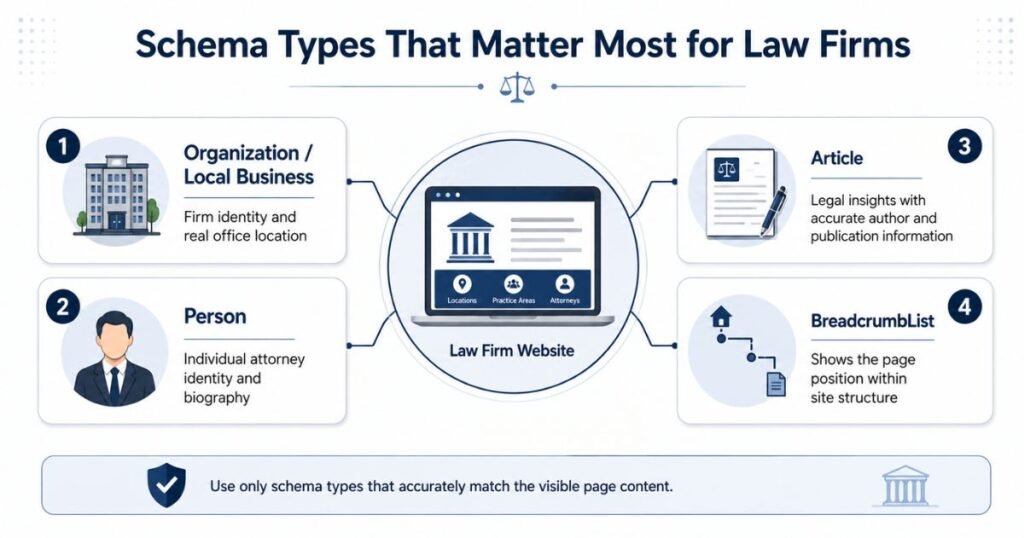
Organization and Local Business
Use this to confirm firm identity clearly across the entire website. It carries real organization information and business information together in one consistent place. Local business schema works well for a firm with a physical office location.
General organization schema fits broader firm level details just as well for larger practices. Choose the type that matches how the firm actually operates day to day. A firm with several offices may need more than one carefully placed instance.
Person for Attorney Profiles
Use person schema for individual attorney pages across the entire site. It should reflect professional identity and a short, accurate biography for each attorney. Confirm the firm relationship clearly through this markup, tying attorney to firm directly.
Every attorney entity deserves its own accurate person schema on its dedicated attorney page. Skip generic, copied biography text that could describe almost any attorney at any firm.
Article for Legal Insights
Article structured data fits genuine blog content and other article content well. It should include author information tied to a named, verifiable attorney or writer. Add accurate publication information too, including a date, not a placeholder value.
This markup only helps when it matches real, existing content, not thin filler dressed up to look substantial. A short, padded post rarely benefits from this markup no matter how it gets tagged. Depth still matters more than any label sitting behind the page.
Breadcrumb List for Site Hierarchy
Use breadcrumbs to show page position within the site’s overall structure. This confirms the path from law firm to practice area to a specific page. Breadcrumb structured data can unlock a visible search feature in results for some queries.
It also helps both readers and machines understand where a page actually sits. A clear breadcrumb path reduces confusion for a reader browsing several related pages. That clarity matters even more on a site covering many separate practice areas.
How Schema Connects the Law Firm’s Entities
Scattered, isolated schema blocks rarely help much on their own across a busy site. Real value comes from a genuine semantic relationship between them, not isolated tags. Entity SEO helps law firms connect the firm, attorneys, practice areas, services, and locations into a clearer digital structure. Building an entity graph creates a coherent structure across the entire site. Skip the trap of disconnected markup sitting in separate corners of a page.
Connect the firm, the attorney, the practice area, the service, and the location through consistent, matching content. Use clear ID relationships and consistent entity identification throughout every page. Keep the same organization references steady everywhere they appear on the site. Schema should only reflect facts, never a stretched page representation. Misleading structured data can trigger a Google warning.
How Schema Supports Local Law Firm SEO
General schema supports accurate representation of a firm’s identity and location for search engines, separate from any direct effect on local visibility. It reinforces true firm identity alongside office location information. This connects to a genuine service area, matched with accurate local business information. Clear attorney identity should tie back to practice area relevance across the site.
Connect Location to the Real Firm
Schema should reflect a genuine business presence, not a stretched claim built for extra reach. Watch out for manufactured location pages built just to chase extra searches nearby. Markup should point to a real office location that actually exists and operates.
It should describe the actual firm location, nothing invented or exaggerated for search visibility. A firm should never create a page for a city with no real presence there. Honest location data protects the firm from both readers and search engine scrutiny.
Keep Local Information Consistent
Match the website, the business profile, and listed contact information carefully across every listing. Keep attorney firm information steady everywhere it appears, from the site to outside directories. Check for legitimate business references across outside sources too, not just the firm’s own pages.
Consistency matters here, but treat the idea of guaranteed Local Pack rankings from schema alone as a myth worth dropping. A firm working through a full on-page SEO checklist should confirm this consistency early, before layering on any structured data.
What Schema Cannot Do for a Law Firm?
Schema cannot fix genuinely weak content, no matter how carefully it gets implemented. It cannot manufacture expertise out of nothing, and it cannot replace backlinks or reputation either. It cannot patch irrelevant page relevance, and it cannot guarantee AI citations or guarantee rich results.
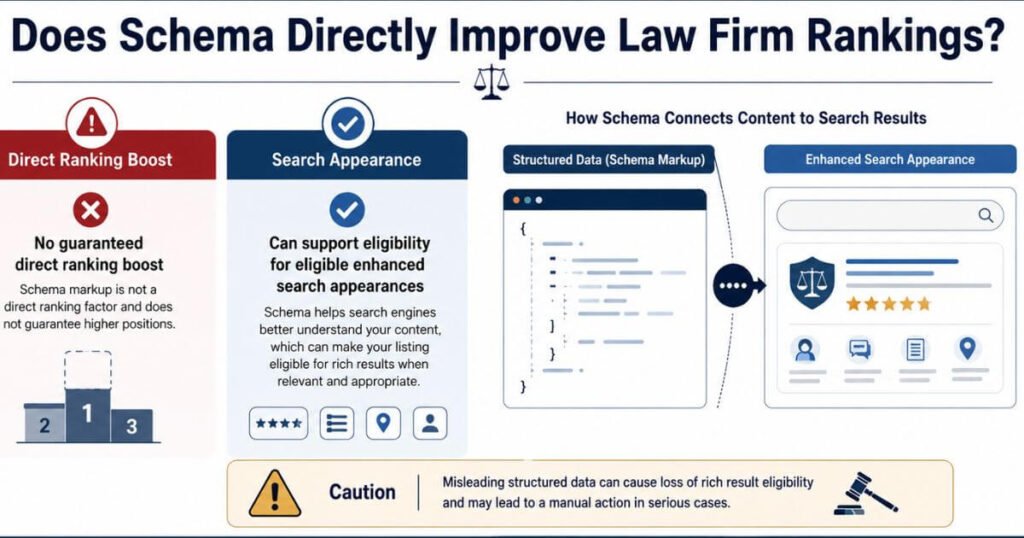
It never makes false information trustworthy, no matter how it gets packaged or labeled. It only supports true representation, and irrelevant or misleading markup actively hurts a site. Drop the add schema and rank narrative completely, since it never matched reality in the first place. Content still has to carry the weight schema alone cannot.
How to Implement Schema Without Creating SEO Problems
Keep a steady quality focus and a validation focus throughout implementation. A careful, minimal approach to markup keeps this simple for most firms. Skip the temptation to add markup everywhere at once without checking it first. A slow, careful rollout beats a rushed one every single time.
Match Markup to Visible Content
Every piece of structured data representation should match content users can see on the page. Nothing hidden, nothing invented, and nothing added just to satisfy a checklist. Confirm careful visible content matching before publishing anything new to the live site.
A mismatch here is the fastest way to trigger a problem later, including a manual action. Reviewing a firm’s on-page SEO alongside its markup catches most of these mismatches early. That combined review takes little extra time and prevents a much bigger fix down the line.
Use Complete, Accurate Properties
Fill in the required properties fully, without skipping fields the schema type actually needs. Add relevant recommended properties too, where they genuinely apply to the page. Prioritize real accuracy and honest completeness over padding the markup with extra fields.
Avoid adding unnecessary markup, since fewer complete properties beat a pile of incomplete or sloppy markup every time. A short, accurate block of markup outperforms a long, half filled one. Quality here matters far more than raw quantity of properties added.
Validate Before and After Publishing
Run the Rich Results Test before anything goes live on the site. Check the URL Inspection tool inside Search Console too, right after publishing. Use the Schema Markup Validator as a second, independent check on the same page.
These simple validation tools catch small mistakes long before they become real, visible problems. A firm skipping this step often finds errors only after rankings or appearance have already suffered. Five minutes of validation regularly saves hours of cleanup work later.
How Law Firms Should Measure Schema’s Impact
Start with technical validation first, before looking at any performance numbers. Confirm valid structured data with no lingering errors or unresolved warnings anywhere on the site. Check that the right indexed pages carry it correctly, not just a handful of test pages. Watch search appearance changes and any shift in rich result eligibility over time.
Track enhanced impressions, clicks, and honest click through rate movement across affected pages. Track schema specific outcomes separately, such as validity, eligible items, and rich result appearance. General SEO performance, including organic impressions and query visibility, should be reviewed on its own, since many factors beyond schema can influence it. Domain authority and rankings should also be evaluated separately from schema performance, because schema markup does not determine a site’s overall authority.
Schema, Entity SEO, and the Future of Legal Search
Schema feeds into structured information that supports entity clarity across a law firm site. It strengthens machine understanding through a genuine, machine readable representation of the site. Treat it as one piece of a much broader strategy built around real world entities.
Answering questions clearly still matters more than markup alone, no matter how complete the markup gets. Schema works alongside broader content signals and other entity signals as one small part of a site’s overall SEO foundation. There is no Google documentation establishing that adding schema guarantees, causes, or materially increases AI Overview citations, so treat any such claim with caution.
Frequently Asked Questions
Does schema markup help law firms rank higher?
Not as a guaranteed direct ranking factor. It supports Google content understanding and can unlock eligible pages for enhanced search appearances.
What schema should a law firm use?
Pick the type that accurately matches the actual page entity, such as organization, person, article, or breadcrumb markup. Only add a type where it genuinely applies. Adding every available type to every page doesn’t help and can create accuracy problems.
Does attorney schema improve local rankings?
Not on its own. Structured data supports accurate context, but Google does not guarantee any Local Pack ranking or organic ranking improvement from it.
Can schema help law firms appear in AI Overviews?
It can support clearer structured information, but there is no guarantee. Be skeptical of any claim that schema alone secures AI Overview inclusion.
Can incorrect schema hurt SEO?
Yes. Misleading structured data or policy violating structured data can cause real rich result eligibility loss, and in serious cases, a potential manual action.
Use Schema as Infrastructure, Not a Ranking Shortcut
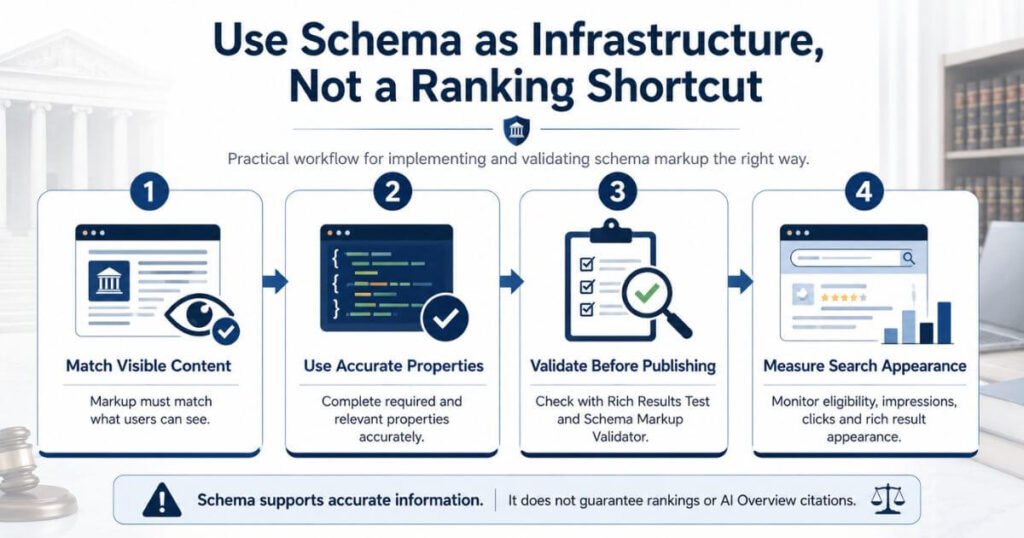
Schema works best as part of a firm’s broader SEO foundation, applied carefully rather than all at once. Strong content, real authority, and solid technical SEO still carry the weight. Add legitimate local signals and accurate implementation on top of that foundation. Ready to put schema to work the right way? Visit faheembhatti.com and let’s build it into your firm’s SEO the correct way.
