

Austin law firm SEO can cost about $1,500 to $10,000+ per month. The final cost depends on the work required. Smaller campaigns may focus on one practice area. They often cover a limited service area too. Larger campaigns cover more ground. They include competitive keywords, several practice areas, content, technical SEO, and local search.
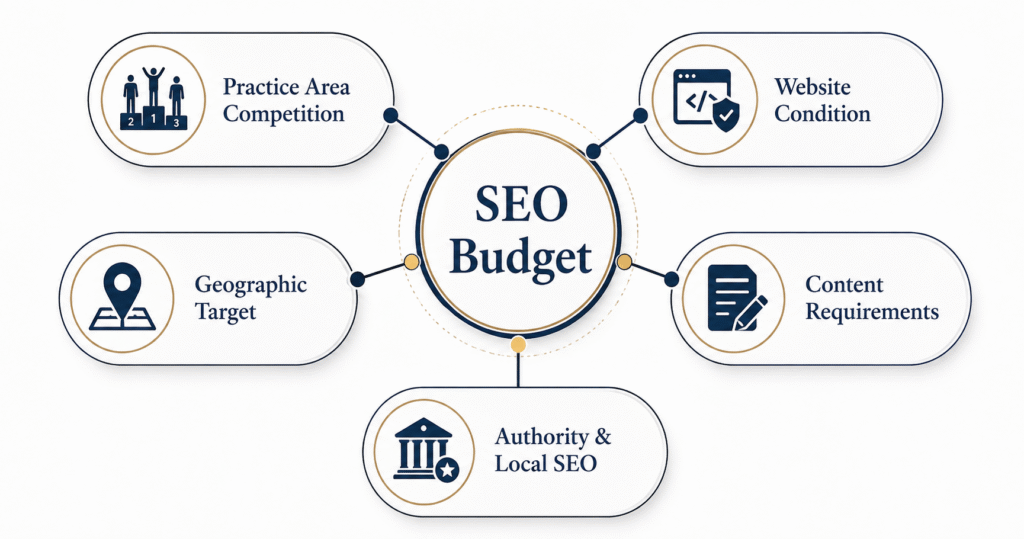
Your website’s starting condition matters. A firm with strong organic visibility needs different work than a new site. A new website often carries technical problems. It may also have little search presence yet. Several factors shape the final budget. Practice area plays a role. Competition level matters too. Geographic scope, content requirements, and reporting needs all affect price.
How much should Austin law firms budget for SEO?
A practical planning range for Austin attorneys is $1,500 to $10,000+ per month. The right number depends on the firm’s target searches and how much work those searches require. A smaller local campaign needs less ongoing work than a campaign covering several competitive services.
Typical monthly SEO pricing ranges
$1,500 to $3,000
This range can fit a focused local campaign. It often targets one main practice area. Work may include technical fixes and local SEO. Keyword research fits into this tier too. A limited content plan rounds out the work.
$3,000 to $6,000
Growth campaigns fit this range. They can cover more content and practice area pages. Technical work continues at this stage. Local SEO stays part of the plan. Authority development also becomes part of the work.

Which budget fits different types of law firms?
A solo attorney with one practice area may start near the lower end when the website is already in reasonable condition. A firm targeting several services needs more pages and ongoing work, which can increase the monthly budget.
Firm size alone shouldn’t determine SEO spending. A solo personal injury attorney can face tougher search competition than a larger firm serving a narrow legal niche, so the target market matters more than attorney count.
What does Austin SEO cost by practice area?
Practice area affects SEO cost because the amount of competition and the number of searches worth targeting can differ substantially. The original draft used fixed budgets for each practice area. Those figures are not supported by a reliable Austin specific pricing source.
| Practice area | Budget pressure | Why the scope can increase |
| Personal injury | Higher | Many service specific and high intent searches |
| Criminal defense | Higher | Strong local intent and competitive services |
| Family law | Moderate to higher | Multiple case types and local searches |
| Employment law | Moderate to higher | Specialized searches and detailed service pages |
| Immigration law | Moderate to higher | Multiple services and geographic targets |
| Estate planning | Moderate | More focused service searches |
| Probate | Moderate | Narrower practice area targeting |
| Business law | Moderate | Specialized commercial searches |
| Bankruptcy | Moderate | Focused local service searches |
A personal injury campaign may require more work than a narrow estate planning campaign, but the practice area alone doesn’t determine the price. Your website, target locations, existing visibility, and number of priority pages still matter.
What factors influence SEO pricing for attorneys?
SEO pricing changes because Austin law firms start from different positions. The same monthly budget can produce very different scopes depending on the website, practice area, geographic target, and amount of work required.
Practice area competition
A useful proposal should show the target terms, competing pages, geographic intent, and work required. An attorney focused SEO strategy should connect those factors to the firm’s actual practice areas and local market. That gives you a better reason for the price than a generic statement about “high competition.
A useful proposal should show the target terms, competing pages, geographic intent, and work required. That gives you a better reason for the price than a generic statement about “high competition.”
Website condition and existing SEO
Your website’s starting condition can change the first months of an SEO campaign. Technical problems, weak page structure, indexing issues, and thin practice area pages can require work before content expansion makes sense.
Site size matters too. A small website and a large legal site don’t require the same level of auditing and maintenance. Existing organic visibility should also influence the starting strategy.
Content, local SEO, and authority building
Legal content requires subject accuracy and useful explanations. Local SEO can include business information, local relevance, and work connected to the firm’s actual service area.
Authority work also needs a clear method. Google warns against manipulative link practices. This includes buying or selling links meant to influence rankings. Agencies should explain how they acquire links. They should not promise a fixed number of links every month.
What should be included in a law firm SEO campaign?
A monthly Austin law firm SEO campaign can include technical SEO, keyword research, practice area page work, legal content, local SEO, authority development, conversion tracking, and reporting. The exact scope should follow the firm’s current website and target searches.
Common SEO deliverables
| Deliverable | Typical scope |
| Technical SEO | Ongoing fixes based on identified issues |
| Legal content | Based on the agreed content plan |
| Practice area pages | Priority pages updated or expanded |
| Authority development | Relevant opportunities based on the campaign |
| Local SEO | Business and local search optimization |
| Reporting | Monthly performance reporting |
| Strategy calls | Based on the agreed service |
| Conversion tracking | Calls, forms, or consultations where available |
A large number of articles or backlinks doesn’t automatically mean better SEO. Ask what each deliverable is supposed to accomplish and how the agency will measure it.
Why can Austin market conditions affect SEO costs?
Austin can require different levels of SEO work depending on the practice area and geographic target. A firm competing for broad citywide searches faces a different workload from one targeting a narrow service and smaller geographic area.
Austin’s competitive legal market
Austin’s legal search market includes many firms competing for local commercial searches. The level of competition also changes by practice area, so a campaign should evaluate the actual search results instead of assigning one competition level to the entire city.
Downtown Austin, Travis County, and surrounding communities can have different search patterns. Your agency should explain which geographic areas matter to your firm and why.
Local search competition and client demand
Austin law firm should not be treated as one uniform search market. Your strategy may include Austin itself, Travis County, Williamson County, or other areas where the firm genuinely serves clients.
That geographic targeting should reflect real service coverage. Creating near identical pages for every nearby location adds little value when the firm doesn’t have meaningful local relevance there.
Why local market conditions affect pricing
More geographic targets can increase the amount of work required. The same applies when a firm targets several practice areas or needs more content and technical support.
The important question is how much work your target market requires. An agency should explain that scope before presenting a monthly price.
How do law firm SEO agencies structure their pricing?
SEO agencies commonly use three pricing models. These include monthly retainers, hourly consulting, and project based pricing. Each model fits a different type of need. The right choice depends on whether your firm needs ongoing work or a defined one time project.
Monthly SEO retainers
Monthly retainers suit firms that need ongoing SEO work. This work spans content, technical SEO, local search, and reporting. The contract should explain exactly what the monthly fee covers.
A large number of articles or backlinks doesn’t automatically mean better SEO. Ask what each deliverable is supposed to accomplish. Ask how the agency will measure it too.
Hourly SEO consulting
Hourly consulting can work when your firm needs specific SEO advice rather than a full campaign. Examples include technical audits, website reviews, migration planning, or strategy sessions.
This model gives you control over the amount of consulting purchased. Progress can be slower when the firm needs regular content, technical implementation, and ongoing optimization.
Project based SEO services
Project based SEO works for defined tasks such as a website migration, technical audit, or major site restructuring. The agreement should identify the exact work, deliverables, responsibilities, and completion point.
This model can suit a firm that needs to fix a specific website problem before deciding whether to continue with monthly SEO.
DIY SEO vs freelancer vs SEO agency
Your choice depends on how much SEO work the firm can handle internally. A solo attorney with time to learn may handle basic tasks, while a larger campaign can require several different skills.
| Option | Best for | Advantages | Limitations |
| DIY SEO | Solo attorneys with time | Lower service cost | Requires time and learning |
| Freelancer | Smaller defined campaigns | Flexible support | Limited capacity |
| SEO agency | Ongoing multi area campaigns | Broader SEO support | Higher monthly cost |
A firm should choose the model based on the work it needs. If the campaign requires technical changes, content production, local SEO, authority development, and tracking, compare whether one person can realistically handle all of those tasks.
What hidden costs can affect your SEO budget?
The monthly retainer may not cover every marketing expense. Website changes, developer work, legal content review, tracking software, photography, or video can create additional costs when those services fall outside the SEO agreement.
| Additional cost | Why it may be needed |
| Website redesign | Improve structure or conversion paths |
| Developer work | Implement technical SEO changes |
| Legal content review | Review published legal information |
| Photography | Update attorney profiles |
| Video | Support educational content |
| Call tracking | Attribute calls to marketing sources |
| CRM integration | Connect leads with consultations |
| Reputation management | Monitor and manage reviews |
Ask agencies to identify these possible costs before signing. That prevents a low monthly quote from becoming a much larger marketing bill later.
SEO vs PPC for Austin attorneys
SEO and PPC serve different purposes. SEO works on organic visibility, while PPC provides paid placement while the advertising campaign runs. A new law firm may use PPC while organic visibility develops. Another firm may use both channels for different practice areas.
The better choice depends on qualified leads, consultation rates, acquisition cost, and revenue rather than clicks alone. Don’t assume SEO will always produce a lower cost per lead than PPC. Track the actual numbers for your firm before moving budget from one channel to another.
Is SEO worth the investment for Austin attorneys?
SEO can make financial sense when organic search produces qualified inquiries and signed matters. Small law firms can benefit from a focused SEO strategy when it targets the right practice areas, locations, and client searches. Rankings alone don’t show whether the campaign is producing business value, so the firm’s tracking setup matters just as much as its keyword positions.
Looking beyond rankings
Track organic impressions and clicks alongside calls, forms, consultation requests, and qualified leads. A page can rank well while producing few useful inquiries, so ranking position should remain one metric rather than the entire definition of success.
The better question is what happens after someone finds the firm. Where tracking allows it, connect organic traffic to inquiries and consultations so the firm can see which search activity contributes to actual business.
Measuring long term SEO value
The value of an SEO lead depends on what happens after the inquiry. Two firms can receive the same number of organic leads but generate different revenue because their consultation and signed client rates differ.
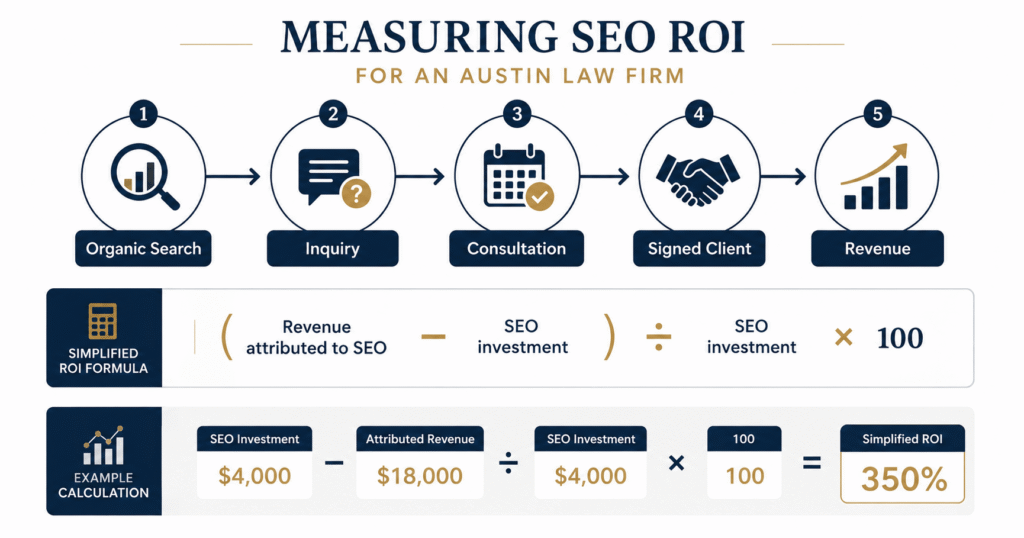
Track the available path from organic search to inquiry to consultation to signed matter. That gives you a stronger basis for judging the SEO investment than traffic growth alone.
How to calculate your SEO return on investment
Once you have reliable attribution data, you can calculate a simplified SEO return. Use revenue attributed to organic search for this calculation.
ROI (%) = ((Revenue attributed to SEO − SEO investment) ÷ SEO investment) × 100
Here’s an example.
- Monthly SEO investment sits at $4,000
- Signed clients attributed to organic search total 3
- Average revenue per client runs $6,000
- Attributed revenue reaches $18,000
- Revenue minus SEO cost comes to $14,000
- Simplified ROI: 350%
The $14,000 figure is not net profit because it doesn’t account for staff, case delivery, overhead, or other business expenses. Use CRM, call tracking, forms, and analytics together when possible.
What mistakes should attorneys avoid when comparing SEO costs?
Comparing monthly prices without comparing the work behind them can lead to the wrong decision. A cheaper quote may contain less work, while a higher quote may include services your firm doesn’t need.
Choosing the cheapest SEO provider
Low pricing isn’t automatically a problem. The concern comes when the price reflects missing work, weak content, poor technical support, or unclear reporting. Ask the agency what it will actually complete each month. Then compare that scope with the other proposals.
Comparing price instead of value
A $2,000 retainer and a $5,000 retainer can cover very different services. Compare target pages across each option. Compare technical work, content, and local SEO too. Authority development, tracking, reporting, and contract terms all deserve a look. The monthly price only becomes meaningful after you understand the work attached to it.
Expecting immediate results
SEO doesn’t have a universal ranking deadline. Google says that changes can take several months to show their effects in Search, depending on the site and the changes made. Ask an agency what it plans to improve first. Ask which signals it will monitor during the campaign.
Frequently asked questions
How much should a solo attorney spend on SEO?
A focused campaign can start around $1,500 to $3,000 per month as a planning range. Your actual budget depends on the practice area. Website condition, target locations, and services included all play a role too.
Why do SEO quotes vary between agencies?
Agencies scope SEO differently. One quote may include technical work and reporting, while another adds content, local SEO, authority development, and conversion tracking. Compare the scope before comparing the price.
Is a monthly SEO retainer better than project based SEO?
A retainer fits ongoing SEO work. Project based SEO fits defined tasks such as technical audits, migrations, or major website changes. Your required work should determine the pricing model.
How long does SEO take to produce results?
There is no fixed timeline for every law firm. Google says SEO changes can take several months to show their effects in Search. Competitive searches and larger technical or content changes can require more time.
Can I increase my SEO budget as my firm grows?
Yes. Increasing the budget can make sense when the firm adds practice areas, expands its genuine service area, or needs more content and technical support. The increase should follow the additional work required.
Should Austin law firms budget for AI search optimization?
Ask what the agency means by AI search optimization. Google says the same foundational SEO practices apply to AI Overviews and AI Mode, with no separate technical requirements for appearing in those features.
Invest in SEO based on the work your firm needs
Austin law firm SEO can range from a focused local campaign to a larger campaign covering several practice areas and geographic targets. Start with the searches your firm wants to compete for. Then review the website, practice areas, service locations, content needs, technical issues, and tracking setup. If you want to compare those requirements with a law firm SEO service, you can review Faheem Bhatti SEO’s law firm SEO service.
