

Yes, SEO works for small law firms in Austin. It works even without a huge marketing budget. Search engine optimization builds organic rankings over time. Local search signals drive that growth steadily. A solo practitioner can compete with larger firms by focusing on highly relevant local and practice area searches rather than trying to match their total marketing spend. Size never decides who wins the search results.
Many firms quit early, thinking Google rankings favor only large offices. The algorithm works differently for legal services searches. Relevance and trust win over size and staff count. This guide shows how digital visibility and client acquisition build lasting online presence.
Can Small Austin Law Firms Really Compete Online?
Yes, small firms compete well in Austin’s online results today. Business size never appears on that list of ranking factors. Google rewards relevance, distance, and prominence over budget. Business size never matters. A strong profile and organic rankings help firms show up in local pack results. Strong organic search rankings work alongside that profile inside real search results.
Why Many Small Firms Doubt SEO
Many attorneys assume size alone wins search rankings. That guess comes from watching big firm advantages play out online. Large offices often fund a full national campaign with steady ad spend. A solo attorney rarely matches that spend dollar for dollar. We have seen this doubt stall firms before they even start.
SEO myths spread fast among firms with limited resources. Many solo shops run a template website built for speed. In house marketing takes time away from real case work. Agency cost concerns stop firms from requesting a quote. Real budget constraints push firms toward broad statewide keywords instead of local ones.
What Google Actually Uses for Local Visibility
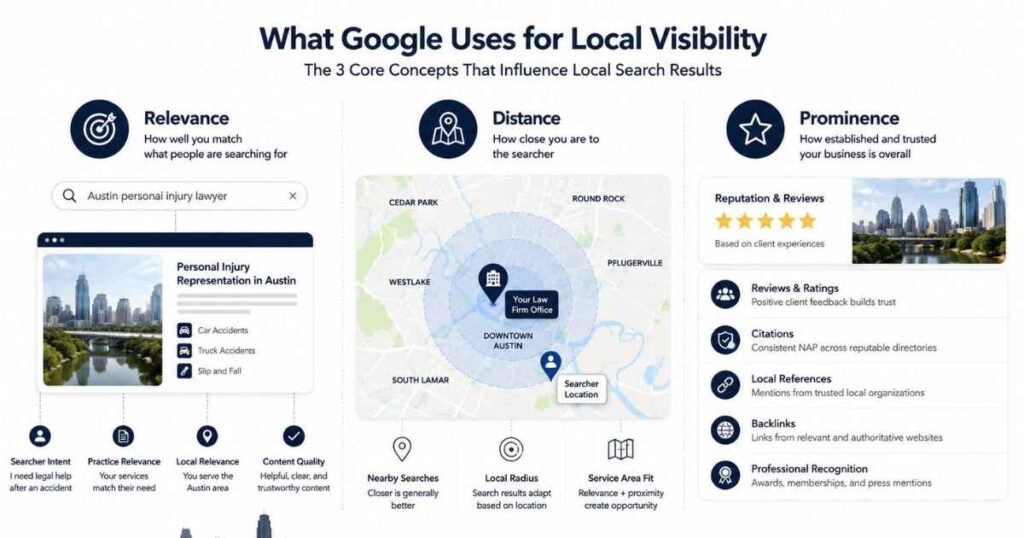
Google ranks Austin law firms by three real signals. Relevance shows how well a site matches the search. Distance measures how close the office sits to the client. Prominence reflects the firm’s reputation across the web. These ranking signals work the same way for every firm size.
Google tries to understand what the searcher is looking for and, for local results, also considers how relevant and geographically appropriate each business is to the search. Proximity alone never saves a site with weak review authority. Strong niche relevant backlinks and clear content quality build real technical health signals. Accurate business information and consistent local references can support the firm’s local presence, while technical SEO helps Google crawl, index, and render the site properly.
What SEO Success Actually Looks Like
Real success means new case inquiries, not just a high ranking position. Qualified leads are more important than raw traffic numbers. Each one moves a visitor closer to a signed case. Conversion turns those leads into signed cases worth tracking. Cost per lead and return on investment tell the real story.
Rankings vs Qualified Case Inquiries
Ranking high means little without real phone calls coming in. Consultation requests and form submissions prove a page actually works. Firms need quality leads, not just page one visibility. Call tracking ties each ranking back to real client interest.
Signed cases are the only number that pays the bills. Lead volume looks good only when paired with a strong conversion rate. A firm should track cost per case, not just 40 keyword rankings. Rankings open the door, but cases close it.
Google Local Pack vs Organic Rankings
Google Maps results show up before regular organic listings load. This map pack grabs attention before a user scrolls further. Three listings appear at the top for most local searches. That top spot pulls in most of the click share.
Local intent searches favor the map pack over blue links below. Click through rate data proves the pattern clearly. The map pack earns 44 percent clicks, and organic gets only 29 percent clicks. Google shows a map pack for 93 percent local intent searches. NAP consistency and full Google Business Profile completeness win that spot.

What Determines Whether SEO Will Work?
Website quality sets the SEO ceiling. Technical foundation, fast mobile sites, and schema markup support rankings. A strong profile and reviews build trust. Content authority and local signals finish the picture.
Website Quality and Technical Foundation
A slow site tests a visitor’s patience fast. Most people search on phones today. That makes mobile responsiveness a bigger factor than before. Technical SEO work fixes these problems before rankings can move. Good site architecture guides both users and Google through every page.
Core web vitals show how a real device experience actually feels. Broken links annoy visitors and burn through Google’s crawl budget. A slow load time sends clients straight back to the search results.
Google Business Profile and Reviews
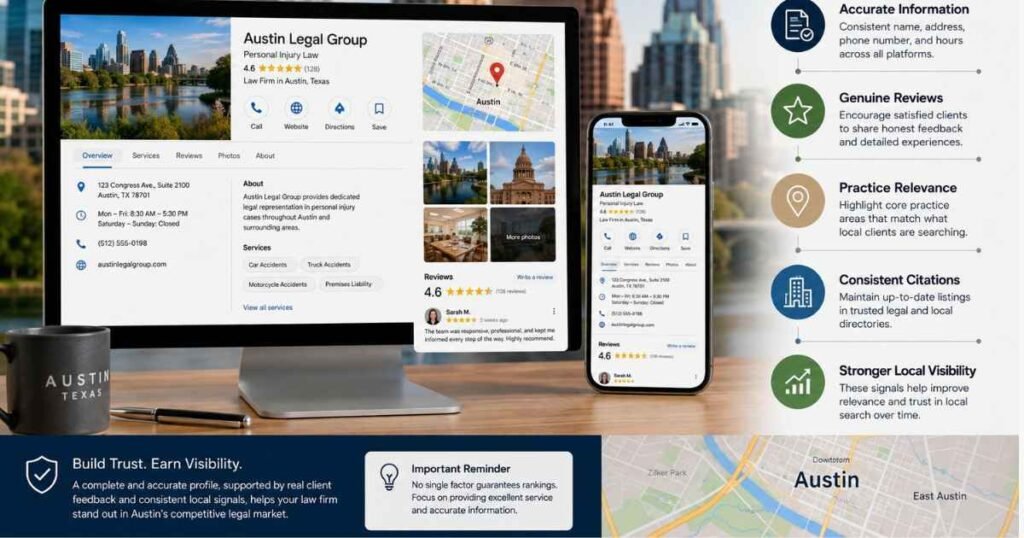
GBP completeness decides whether a profile ranks in local results. Review quantity and review score both carry real ranking weight. Review recency matters too, since old reviews lose their impact fast. A high star rating alone will not fix a thin profile.
Accurate citations across directories support the same trust signal. Firms with 25 reviews often beat rivals stuck near zero. A 4.0 review score builds confidence before a client even calls. Real testimonials on the website add proof beyond star counts alone.
Practice Area Competition Matters
Personal injury keywords stay some of the hardest to rank for. Family law and criminal defense searches carry heavy competition too. Immigration law and employment law terms see steady demand across Austin. Business law searches move slower but still pull in real cases.
Estate planning ranks easier than many competing legal search terms. A niche practice area often faces lower keyword difficulty overall. Fewer firms chase these competitive keywords, which opens real opportunity fast. Strong practice area pages help each specialty rank on its own.
Content, Authority, and Local Signals
Law Firm SEO Austin focus on building long term visibility through content marketing, technical SEO, and local authority. Topical authority grows when a firm covers every angle of one practice area. Quality links from legal directories add real trust behind the scenes. Local content connects each page back to the Austin market directly. Attorney focused SEO in Austin focuses on building long term visibility through content marketing, technical SEO, and local authority.
Geo targeted pages speak directly to each Austin neighborhood served. Separate location pages help Google match a firm to nearby searches. Experience, expertise, authority, and trust signals show up through real case results and clear bios. Steady link building, active local citations, and smart internal linking tie every page together.

How Austin’s Competitive Market Affects SEO
Downtown Austin, South Lamar and Westlake Hills anchor a growing legal market. Round Rock, Cedar Park and Pflugerville add rising suburb competition. Travis County’s population growth fuels search demand and legal competition alike.
Downtown Competition vs Nearby Suburbs
Downtown carries the highest local competition among Austin practice areas. South Lamar and Westlake Hills draw plenty of established firms too. Round Rock, Cedar Park and Pflugerville see lighter but rising competition. A clear service area helps a firm choose where to compete.
Neighborhood targeting works better than trying to rank citywide. A suburb market often rewards a firm faster than the urban core. Firms outside the city center see quicker traction with less resistance. Picking the right zip code matters more than chasing every zip code.
Why Travis County’s Growth Matters
Travis County’s population growth changes how firms plan for the future. More residents means more search demand for legal help. The area’s tech corridor pulls in new residents every month. That steady migration fuels the county’s overall economic growth.
Job growth in Austin adds more potential clients every quarter. Market expansion follows population trends, and legal competition grows alongside it. Firms that adapt see real client base growth over time. Waiting too long means missing a wave already in motion.
How Long Does SEO Take for Small Law Firms?
SEO Timeline Overview
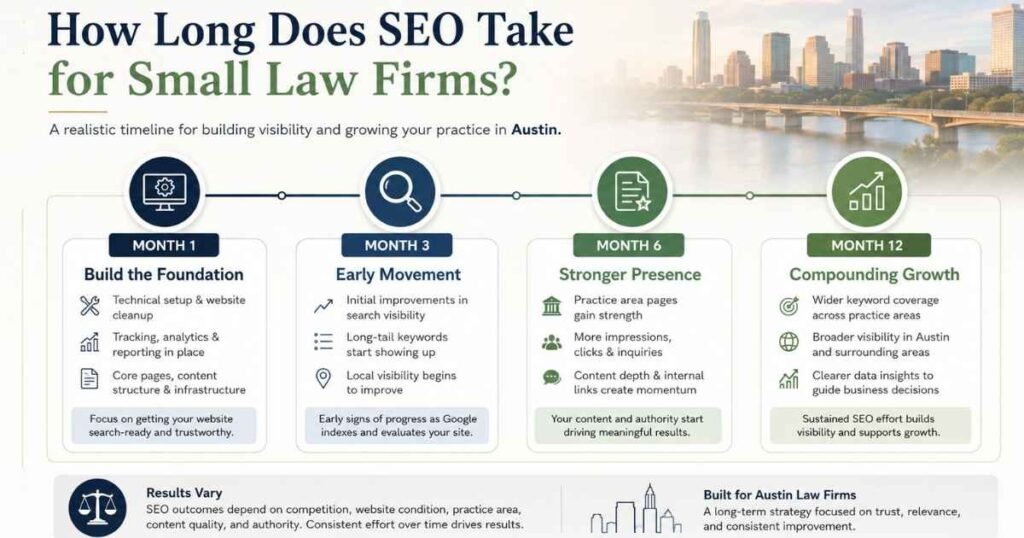
| Timeline | What Happens | Result Type |
| Month 1 | Foundation phase begins | Technical fixes + content infrastructure set up |
| Month 3 | Early movement starts | Long tail rankings begin appearing |
| Month 6 | Real progress shows | Meaningful results across practice area pages |
| Month 12 | Full impact visible | Clear traffic increase site wide |
Most firms need 6 to 12 months for real ranking movement. Nothing dramatic happens in month 1, and that’s completely normal.
Why Timelines Differ by Practice Area
| Practice Area | Timeline Speed | Why |
| Personal Injury | Slowest | Heavy demand, high competition |
| Immigration Law | Medium | Moderate competition |
| Estate Planning | Fastest | Lower competition nearby |
Key factors driving the difference:
- Market competition inside each specialty
- Content cadence: how steadily new content gets published
- Keyword difficulty: harder terms take longer even with strong technical work
- Niche practice areas often see faster wins overall
SEO vs Google Ads for Small Law Firms
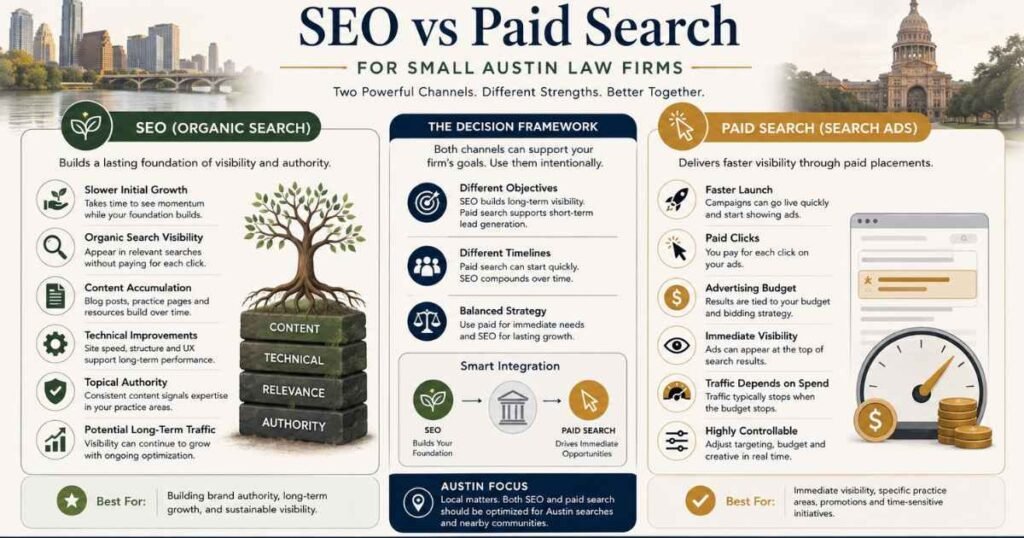
Paid search puts a firm at the top within hours. Organic search takes longer but builds real momentum. Cost per click adds up fast as campaigns scale. Immediate visibility favors ads, while long term growth favors organic content. Pay per click stops working once spending stops. For firms comparing channels, understanding how much does SEO cost in Austin can help set a realistic budget before choosing between organic and paid search.
Which Delivers Faster Results
Google Ads can show a firm’s listing within 24 to 48 hours. That speed creates immediate visibility no organic page can match yet. Pay per click campaigns charge for every single click received. Cost per click varies by practice area and local competition.
Firms chasing quick results often start with a paid search campaign. This route works well for a new firm needing calls fast. Ads fill the gap while organic content builds in the background. We often run both channels together during a firm’s first few months.
Which Creates Long Term Growth
Organic rankings keep working long after a firm stops paying per click. Compounding returns build as each new page adds more visibility. Sustainable visibility grows stronger the longer a firm stays consistent. Price per lead through organic search usually drops over time.
A long term investment in content pays off well past year one. Site authority takes months to build. It lasts for years once earned. Evergreen content keeps pulling in traffic. It works long after it goes live. Firms that stay patient rarely regret it. The wait pays off in the end.
Common Reasons Law Firm SEO Doesn’t Work
Unrealistic expectations make firms quit SEO early. Poor local optimization hides a firm from Google Maps. Guaranteed rankings promises are a red flag. An incomplete profile blocks local pack results.
Unrealistic Expectations
- Guaranteed rankings claims signal a bad agency
- Expecting overnight results leads firms to quit too soon
- A short attention span kills more campaigns than weak strategy
- Patience matters more in SEO than in most other channels
- A realistic timeline keeps a firm calm during slow months
- False promises from agencies set firms up for disappointment
Poor Local Optimization
- An incomplete Google Business Profile hurts rankings before content even matters
- Inconsistent NAP details confuse Google about which listing to trust
- Missing citations across directories weaken local trust signals
- Weak reviews make a strong website look unreliable
- No local content leaves a firm invisible for neighborhood searches
- Small profile fixes often move rankings within a few weeks
Inconsistent SEO Efforts
- Sporadic content publishing confuses both readers and search engines
- Abandoned campaigns waste dollars spent on early momentum
- Inconsistent publishing breaks the steady signal Google rewards
- Stalled momentum often follows a slow month with no new content
- Budget cuts mid campaign cost more than they save
- Steady work beats a strong start followed by silence
Choosing the Wrong Strategy
- Generic keywords attract traffic that rarely turns into cases
- Broad targeting spreads a small budget too thin
- A wrong agency fit means promises that never match delivery
- A template site rarely reflects what makes a firm different
- A misaligned strategy chases rankings instead of real client calls
- The right strategy starts with the firm’s actual practice areas
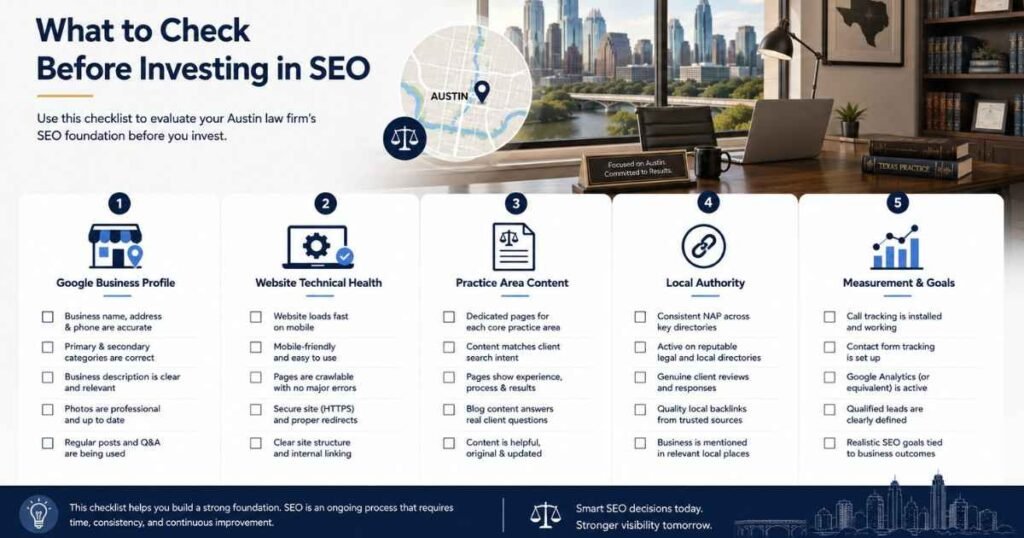
What to Check Before Investing in SEO
A quick profile audit and website evaluation reveal gaps before spending starts. Setting realistic goals and checking baseline metrics keeps expectations grounded. A technical audit catches issues owners rarely notice themselves.
Review Your Google Business Profile
Profile completeness decides how a listing performs in local search. Confirm your business categories match the actual services offered. List accurate business hours so clients trust the listing at a glance. Add fresh photos so the profile looks active and current.
Client feedback builds trust faster than almost any other signal. NAP accuracy across every directory keeps Google confident in your listing. A five minute check here often reveals easy wins. Fix these basics before spending a dollar on content.
Optimize Your Website
Loading speed affects both rankings and how long visitors stay. Mobile friendliness matters since most Austin searches happen on a phone. Content strength shows Google the site deserves to rank well. Weak pages rarely earn trust no matter how fast they load.
Technical condition covers broken links, missing tags, and crawl issues. User experience ties every piece together into one smooth visit. A site that feels clunky loses clients before they even call. We check these five areas on every website review.
Set Realistic SEO Goals
A clear timeline keeps a firm patient through the slow early months. Measurable goals turn vague hopes into numbers worth tracking. Pick one KPI to watch each month closely. Real progress shows up in that number long before it shows in traffic.
Set lead targets based on your firm’s actual case capacity. Track ranking targets for the specific terms that matter most. Goals without numbers rarely survive past the first quiet month. Clear numbers keep everyone honest about real progress.
Frequently Asked Questions
Does SEO really work for small law firms in Austin?
Yes, SEO works when a firm builds a strong technical base first. Results depend on real effort. Conditions apply, but the path stays open to any small firm.
Can a small law firm outrank larger competitors?
Yes, a focused firm can outrank larger competitors on specific search terms. Size rarely wins when a smaller firm targets sharper keywords. This smaller market advantage shows up most in niche practice areas.
How long does SEO usually take?
Most firms see real movement between six and twelve months. Some timeline variation exists based on practice area and competition. Personal injury moves slower than estate planning in most markets.
Should I target Austin or nearby suburbs?
The right choice depends on where most clients actually live. Austin vs suburbs targeting should follow your real service area map. Downtown competition runs heavier than most nearby suburb markets.
Is SEO better than Google Ads for small firms?
Neither wins alone in most cases we have seen. This SEO vs Google Ads comparison usually favors running both together. Ads bring fast calls while SEO builds lasting value.
Build Long Term Visibility for Your Austin Law Firm
Small Austin law firms compete and win with the right SEO plan. Faheem Bhatti SEO helps firms build real visibility across the Austin legal market. Our work focuses on long term success, not quick tricks that fade fast. Every project builds lasting visibility through solid technical work and honest content.
