

Austin law firms need real calls, not just website clicks. A strong Google Business Profile is where that visibility starts. We track GBP ranking shifts monthly for Travis County firms. Small fixes move a firm up the Local Pack on Google Maps, boosting local search visibility.
Law firm SEO only works when the profile and website tell one story. Good attorney marketing treats GBP optimization as a weekly habit, not a yearly chore. A clear local SEO strategy ties reviews, posts, and services to real client searches. Google Search still sends most new clients into a packed Austin legal market.
How Does Google Rank Business Profiles?
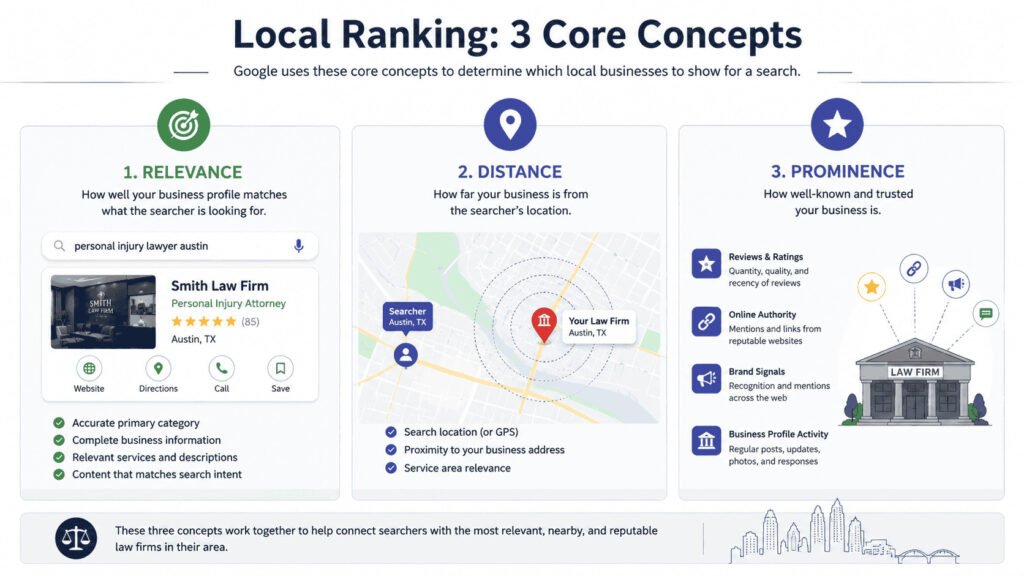
Google Business Profile rankings run on one local ranking algorithm. The Google Business Profile Help Center names three factors behind local results.
- Relevance
- Distance
- Prominence
We check all three ranking factors before touching a client’s listing.
Relevance: Matching User Intent
A search for a lawyer only works when categories match real work. Your primary category tells Google what your firm mainly handles. A secondary category adds extra services without confusing that main signal. We map every client’s practice areas to the exact category Google expects.
A clear business description should use natural keywords tied to real search intent. Strong content signals boost website relevance for every search query match. Firms offering legal services need exact attorney categories, not one broad law firm category. A personal injury attorney, family law attorney, or criminal defense attorney needs its own listing.
Distance: Why Location Still Matters
Your physical office sits inside real Austin geography, and that spot drives rank. Proximity decides how close your firm sits to the person searching. Every service area connects to actual user location data, not guesswork. Google draws a geographic radius around each search, not just driving distance.
A firm’s map pack position and office address decide one distance ranking factor. A service area business still needs real Travis County roots, not fake city boundaries. We build hyperlocal pages using true location signals and strict NAP consistency. One verified location beats ranking near nearby businesses, because distance cannot be optimized.
Prominence: Building Local Authority
Review quantity matters, but review quality matters more for real trust. Review velocity, meaning steady new signals, beats one old batch. Firms with strong online authority show up first in tight markets. Brand mentions across news sites add real weight too.
Local citations on legal sites boost trust signals fast. Fast review responses protect credibility more than a perfect star rating alone. Review recency beats an old five star count every time. Real link building through directory listings, bar association profiles, and legal directories builds lasting authority.
Why Austin Law Firms Face Stronger Local Competition
Austin sits inside a fastest growing city with a booming metro area. Population growth across Travis County has pushed the legal market into a tight, competitive market. More new residents mean higher demand for legal services and steady pressure to acquire clients. Law firms now fight for the same client through direct competition.
Practice Area Competition Across Austin
Downtown Austin carries different rank rules than North Austin or West Lake Hills. Round Rock, Cedar Park, and Pflugerville each hold their own local pack. A firm’s real service area decides its rank, not its street address alone. Travis County spans many small markets, each with its own client base.
Lakeway shows this pattern clearly through tight geographic specificity and low listing overlap. Real hyperlocal pages built for each neighborhood beat one broad city page setup. Neighborhood competition across this metro area rewards firms that build local depth. Strong proximity ranking comes from matching content to the exact area served.
Why Competitive Niches Need Stronger Local Signals
Personal Injury and Criminal Defense sit at the top of Austin’s difficulty curve. Family Law and Estate Planning follow close behind in daily search demand. Immigration law, employment law, and business law stay less crowded by comparison. DWI and DUI cases drive some of the highest CPC keywords in the state.
A competitive practice area needs more than a listing to break through. Local signals carry extra weight once niche competition reaches this level. Review momentum, steady positive feedback over time, separates ranked firms from stalled ones. Backlink authority and real content depth matter more here than in mass tort cases with less search traffic.
Which Google Business Profile Improvements Matter?
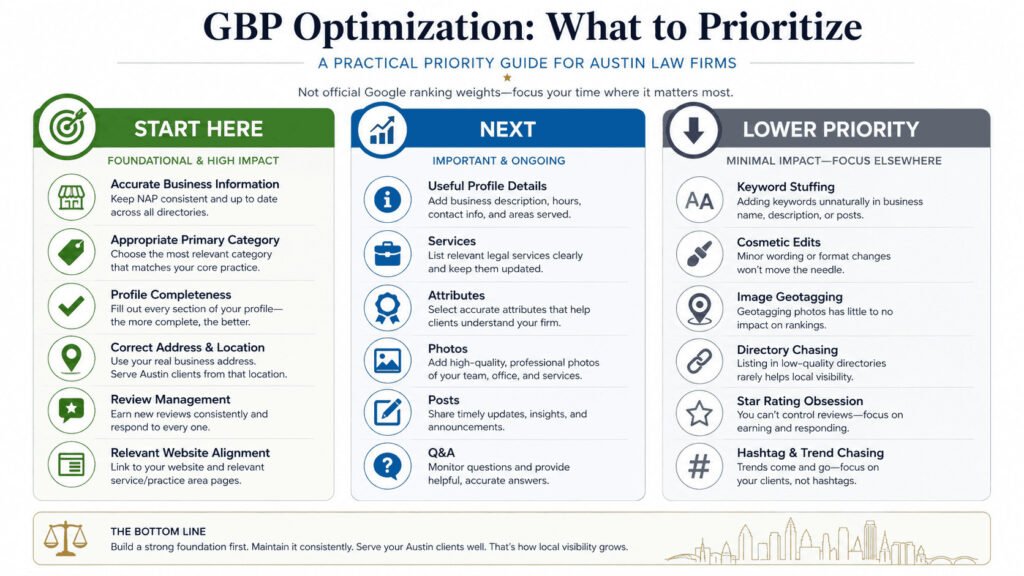
Not every fix carries the same weight on your listing. Ranking priority should guide your optimization sequence from day one. Website relevance, active service pages, and clear conversion signals shape real growth. Posts, photos, and a filled Q&A section add smaller engagement signals on top. Each one acts as its own ranking lever, but not with equal force.
High Impact Ranking Factors
Your primary category decides which searches your firm even qualifies for. An exact business name, matching your legal filing, protects landing page relevance too. Address accuracy stops mismatched listings from confusing Google’s local system. Review quality, paired with steady review quantity, drives real trust fast.
Track review velocity for every client each month. Strong website relevance and full service pages support that same trust signal. Careful category selection avoids costly mix ups down the line. Watch for duplicate profiles, broken NAP consistency, broken links, and any wrong category left unfixed.
Medium Impact Optimization
Posts, photos, and a filled Q&A section keep a profile looking active. Regular services updates and clear secondary categories round out your listing. Correct business hours and detailed attributes help clients pick your firm fast. A sharp description adds context Google uses for smaller queries.
Engagement signals grow through steady profile freshness, not one big edit. Weekly posts and monthly photos build that pattern over time. Proactive Q&A, meaning answers posted before anyone asks, cuts client confusion. Working booking links turn that engagement into a real consultation.
Low Impact Tasks That Shouldn’t Be Your Priority
Keyword stuffing your profile wastes time better spent elsewhere. Keywords in reviews and keywords in posts carry little to no ranking weight. Geotagging images, adding location data to photo files, rarely moves rank either. Padding your business description keywords past a natural sentence won’t help you.
Review responses ranking impact stays low, though replies still help client trust. Many firms chase cosmetic edits while their primary category sits wrong. Fixing one minor attribute feels productive but changes almost nothing. Skip these small tasks until your high impact factors are locked in first.
How Your Website and Google Business Profile Work Together
A listing alone can’t carry a law firm to the top. Website relevance and a strong GBP landing page need to point at each other. Your landing page, ideally matching practice area pages, confirms what your firm actually does. Service pages deepen that proof with real case details Google can read.
Entity alignment, matching your name and services across every page, builds real topical authority. We connect internal linking, local content, and clear entities into one system. Topical relevance and steady on page signals feed straight into website authority over time.
Why Practice Area Pages Influence Local Visibility
Strong practice area pages carry more weight than a generic homepage link. An attorney focused SEO strategy connects these pages with the firm’s practice areas, local searches, and Google Business Profile signals. Entity alignment ties your firm name to one clear practice on every page. Service pages listing specific case types back this signal up further.
A dedicated city landing page often outperforms a single shared homepage relevance setup. Your GBP website link should point straight to that page, not the homepage. Clean on-page SEO and true service area alignment confirm real local presence. Practice page depth, meaning full detail on process and results, builds lasting trust.
Building Local Topical Authority Around Austin
Internal links guide both readers and Google through your firm’s full range of work. Local content, written for real Austin neighborhoods, carries far more weight than generic pages. Entities and topical relevance work best when tied to one central pillar page. Cluster content, smaller pages built around that pillar, fills in the details.
This hub and spoke setup keeps your site organized instead of scattered. Blog posts connected through contextual links and clear anchor text pass authority naturally. We map content across real Austin neighborhoods and matching city pages for tighter semantic relevance. Entity SEO and clean schema markup define your Organization entity, LocalBusiness entity, Person entity, and Service entity for Google.
Common Reasons Austin Law Firms Don’t Rank Higher
Most firms lose rank through small, fixable mistakes, not bad luck. A wrong category, an incomplete profile, or inconsistent NAP data quietly caps your growth. Weak authority signals, stagnant reviews, and no ongoing activity all send the same warning to Google. We see this pattern in almost every new client audit.
Duplicate listings split your reviews and confuse the local algorithm completely. A keyword stuffed name or a hidden virtual office breaks Google’s trust fast. Treating setup as a one time setup leads straight to profile neglect. Fixing these root issues moves rank faster than any single new post.
Choosing the Wrong Primary Category
Your primary category shapes every search you can rank for. Many firms pick Law Firm category when the Personal Injury Attorney category fits their real work better. A Trial Attorney category choice often creates a category mismatch with actual services offered.
We run a full category audit before touching anything else on a profile. A narrow category beats a vague broad category almost every time. Checking competitor categories shows exactly where your firm stands today. Smart secondary categories then fill in the extra services you handle.
Weak Local Authority Signals
Thin reviews, few backlinks, and missing citations all point to one problem. Broken NAP consistency and flat review velocity stall growth even on a complete profile. Brand mentions across news and blog sites still carry real weight. Missing directory listings leave gaps competitors fill first.
Weak trust signals show up fastest in a firm’s online reputation score. Legal directories and bar association mentions confirm real standing within the profession. We check all of these together, not one at a time. A single strong signal rarely fixes a firm with five weak ones.
Treating GBP as a One Time Setup
Ongoing optimization separates ranked firms from stalled ones long term. Small law firms can still compete effectively when their SEO focuses on the right local searches and services. Weekly engagement and monthly updates keep a profile looking genuinely active. Profile freshness depends on active management, not a one day setup session.
Regular posts and fresh photo uploads signal life to Google’s system. Review monitoring catches problems fast, while Q&A seeding answers client questions early. Routine profile audits support real continuous optimization over months, not weeks. We schedule this work monthly for every client we manage.
How to Measure Whether Your Google Business Profile Is Improving
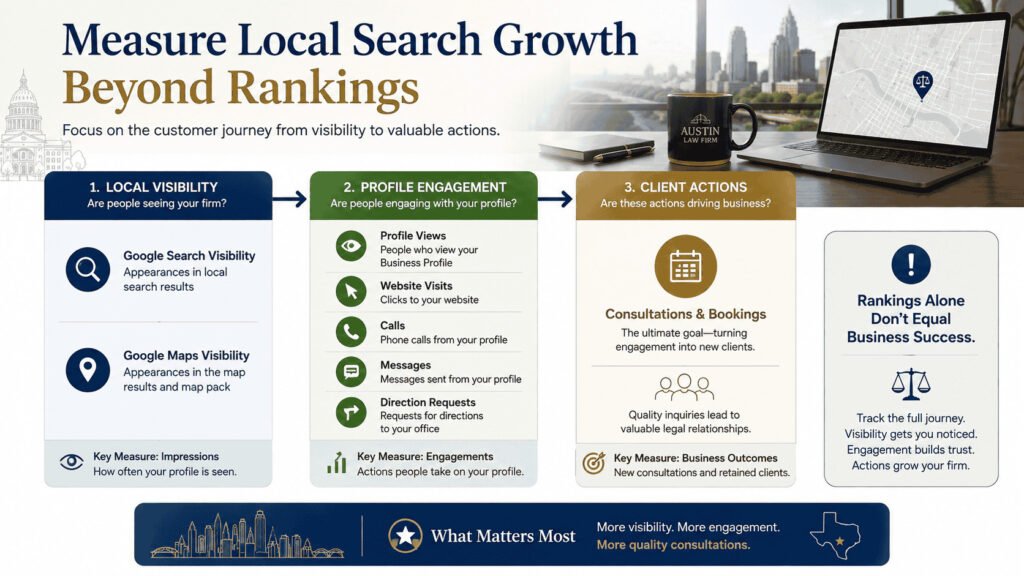
Rank position alone tells you very little about real growth. Insights and the Performance dashboard show what actually moves the needle. Track calls, direction requests, and website visits as your true success markers. Profile views, search queries, and customer actions round out the full picture.
Impressions show how often your listing appeared before anyone clicked. Steady Local Pack visibility matters more than one lucky week at the top. We review these engagement metrics with clients every single month. Numbers going up together beat one metric spiking alone.
Rankings Aren’t the Only Success Metric
A firm ranking first with zero bookings gains nothing real. Messages through your profile often convert faster than a missed call notification. A strong click through rate shows your listing actually earns attention in search. Real conversion actions matter more than raw visibility ever will.
Watch Google Maps engagement alongside Google Search engagement for the full local story. Both channels feed different client habits and search moments. We pull all these signals into one simple monthly report. That full view stops firms from chasing rank while losing real client calls.
Frequently Asked Questions
How long does it take to improve Google Business Profile rankings?
Most firms see early movement within 3 to 5 months, depending on competition level. Tougher practice areas can take 9 to 12 months for full ranking improvement timeline results.
Do reviews matter more than keywords?
Review quality and review quantity carry more ranking weight than stuffed keywords. Strong relevance signals and prominence signals matter far more than a keyword heavy description.
Can I rank outside my office location?
Proximity limits how far you can rank due to the distance ranking factor. A well built service area business helps some, but rarely beats location based search results near your office.
Should every attorney have a separate Google Business Profile?
Only attorneys with a real staffed location should get their own practitioner listing. Otherwise, keep one strong firm listing to avoid a duplicate profile conflict.
Is Google Business Profile enough without SEO?
No, a profile alone can’t fix weak website relevance or missing on page SEO. Real growth needs a website and GBP synergy, not just a listing sitting alone.
Build Sustainable Local Growth With Faheem Bhatti SEO
Real local rankings are earned through consistent optimization, strong relevance, and growing prominence. Focus on long term strategies that increase your local visibility, attract qualified clients, and deliver steady growth instead of short term spikes. Partner with Faheem Bhatti SEO to build a stronger Google Business Profile and a sustainable local presence that keeps generating new client inquiries.
