
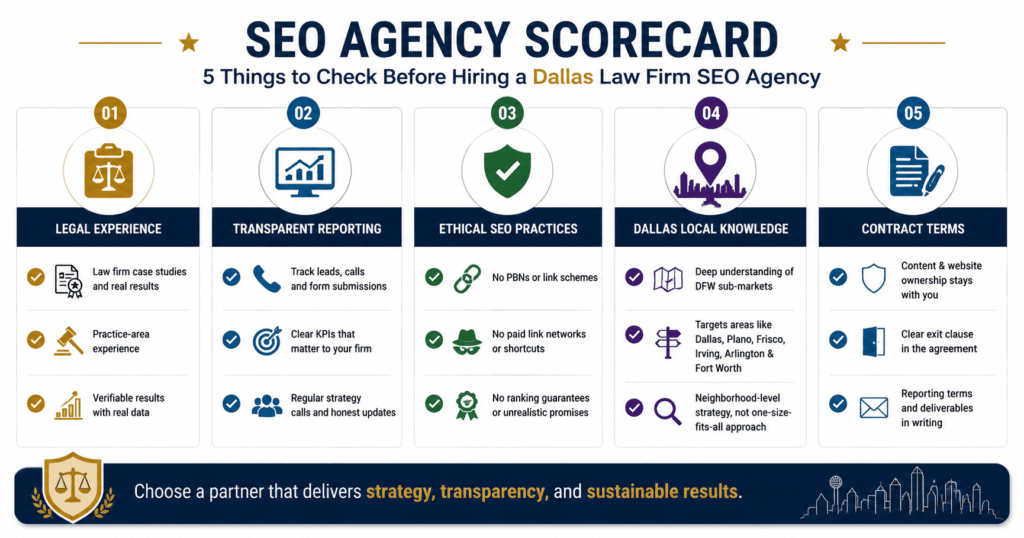
Look for proven legal experience, transparent reporting, ethical practices, and clear contract terms before hiring any SEO agency. Dallas ranks among the most competitive legal markets in the country. Dallas Fort Worth is a highly competitive legal search market, with major firms competing across Dallas and surrounding communities such as Plano, Frisco, Irving, Arlington, and Fort Worth. Competition also varies substantially by practice area and geographic intent. Picking the wrong agency here costs far more than a bad website update.
This guide breaks down what separates a strong agency from a risky one. You will learn the real qualities worth screening for, along with the red flags that signal trouble ahead. You will also see why Dallas specifically demands deep local market knowledge, not a generic national playbook. A practical list of questions follows, ready to use in your very first agency call. By the end, comparing two competing proposals side by side becomes simple.
Understand What You’re Actually Hiring an Agency to Do
Before comparing proposals, shift your evaluation mindset away from price alone. Agency selection works best when a firm understands what it is actually paying for. Real SEO strategy looks completely different from a simple list of deliverables. Deliverables get tasks done, but only strategy connects those tasks to real business outcomes.
SEO Strategy Is Different From SEO Deliverables
A long term SEO strategy sets the direction for where a firm’s visibility should grow. Monthly SEO tasks are the individual steps that move toward that direction. Business outcomes like new cases matter more than a checklist of finished tasks.
Blog posts, backlinks, and technical fixes are common items on that list. Each one means little without a strategic roadmap connecting it to a goal. Tactical execution should always follow strategy, never replace it entirely. Agencies that skip the roadmap usually sell activity instead of actual progress.
Why Legal SEO Requires Industry Knowledge
Legal competition online runs far heavier than most other local industries. Practice area competition adds another layer, since personal injury and family law rank differently. Local search behaviour shifts by city and Dallas clients search differently than clients elsewhere. Ethical marketing considerations matter more in law than in almost any other field.
Legal topics can fall within Google’s YMYL framework because inaccurate information can have significant consequences. That makes accuracy, trustworthiness, expertise, and clear sourcing especially important when producing legal content. Bar association compliance shapes what an agency can even write on a firm’s behalf. Jurisdictional specificity and real legal content standards separate serious agencies from generic ones. Firms that show demonstrated expertise handle keyword difficulty in legal terms far better than a general marketing shop.
Qualities Every Law Firm SEO Agency Should Have
A real legal SEO partner proves experience through case studies, measurable outcomes, and transparent reporting, not just promises. Ethical, sustainable practices protect long term growth. We evaluate every agency against these criteria before recommending them.
Proven Experience With Law Firms
Practice area experience shows an agency understands how personal injury differs from family law. Real case studies from past legal clients carry more weight than generic portfolios. Measurable outcomes and actual ranking data confirm those case studies hold up. Ask about the agency’s specialist to client ratio before signing anything.
A low ratio means your firm gets dedicated attention instead of leftover hours. Look for a bespoke strategy built around your firm, not a copied template. A strong track record across multiple law firms speaks louder than any pitch deck. Firms that skip this check often regret it three months in.
Transparent Reporting and Communication
Clear KPIs tell a firm exactly what success looks like each month. Reports should track leads and calls, not just keyword positions. Set a clear reporting frequency with your agency from the very first meeting. Regular strategy calls matter more than a stack of automated numbers.
Avoid agencies that rely only on automated reports with no real conversation attached. Ask to see real conversion data alongside every report you receive. Monthly updates should cover account management changes, not just raw traffic charts. Track form submissions closely, since that number often tells the real story.
Ethical SEO Practices Instead of Shortcuts
White hat SEO builds rankings the slow, honest way that actually lasts. Black hat risks trade short term gains for long term site damage. Link schemes promise fast results but rarely hold up under scrutiny. Steer clear of any agency that mentions PBNs or paid link networks. Google Search Essentials explains why these practices violate Google’s guidelines.
Guest posting networks sold in bulk usually signal a manipulative shortcut. These manipulative tactics can trigger a serious Google penalty down the road. Full algorithm compliance protects a firm’s site for years, not just months. We have seen firms spend a year recovering from exactly this mistake.
Red Flags That Should Make You Walk Away
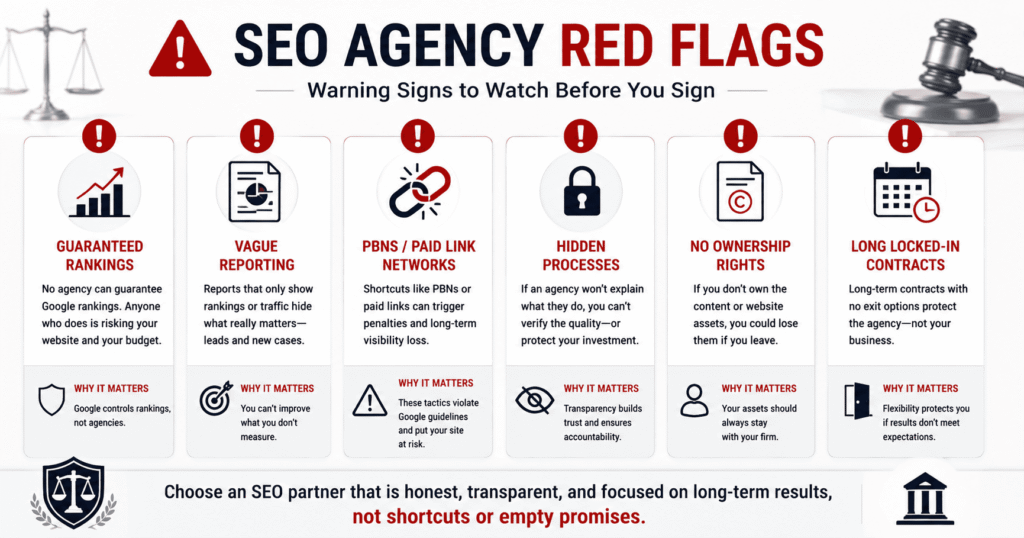
Guaranteed rankings, vague reporting, and hidden processes are instant red flags. Long contracts without ownership rights favor the agency, not you. These dealbreakers rarely improve post signing. Confident agencies welcome hard questions and trust instincts if a pitch feels rushed.
Guaranteed Rankings and Unrealistic Promises
Guaranteed rankings claims are the clearest red flag in this entire industry. There are no secrets here that’ll automatically rank your site first in Google. A money back promise often hides fine print that favors the agency. Watch for agencies chasing low value keywords just to show fast movement.
These unrealistic promises ignore the simple fact that Google alone controls algorithm control. Real progress takes real time, and any ethical provider will say so directly. Learn to recognize a red flag phrase the moment it comes up in conversation. If it sounds too fast to be true, it usually is.
Vague Reporting and Hidden Processes
Vague deliverables like we’ll build links mean almost nothing without real detail. Watch for hidden processes an agency refuses to explain clearly. No explanation of process should never be acceptable from a paid partner. Some agencies offer keyword focus only, ignoring calls and consultations entirely.
Unclear metrics make it impossible to judge real progress month to month. An opaque workflow protects the agency more than it protects your firm. This lack of transparency often shows up long before results ever do. Ask direct questions early, and watch how comfortably they get answered.
Long Contracts With No Ownership Rights
Long term contracts without an exit option protect the agency’s revenue first. Look closely for no exit clause buried in the fine print. Content ownership and website ownership should always stay with your firm. A 12 month commitment signed before any results is a real risk.
Avoid any non refundable contract that locks in payment regardless of outcome. Real performance clauses give your firm leverage if results fall short. A month to month agreement signals real confidence from a serious agency. We only recommend contract terms our own firm would be comfortable signing.
What Dallas Attorneys Search Before Hiring an SEO Agency
Before hiring an SEO partner, most Dallas attorneys search with strong commercial intent. Common search terms include:
- Best SEO agency for law firms in Dallas
- Legal SEO experts Dallas TX
- Local SEO for Dallas attorneys
- Personal injury lawyer SEO company Dallas
- Dallas law firm website ranking services
- Attorney lead generation through SEO in Dallas
- SEO for lawyers near Downtown Dallas
These search behaviors reveal exactly what Dallas legal decision makers want. They want a specialized partner that understands the Dallas legal market, competes against firms across neighborhoods like Downtown Dallas, Uptown, and Preston Hollow, and can generate measurable ROI in a saturated Texas legal advertising
landscape.
What Makes Hiring an Agency in Dallas Different?
Dallas’s metro complexity demands sub market targeting, not national templates. Real local expertise, not just claims, separates true Dallas specialists from generalists. This regional distinction matters more here than in most Texas markets. We’ve seen firms lose months to copy paste strategies.
Texas Bar Rule 7 Compliance Matters
Texas attorneys and law firms must follow Texas rules when discussing legal services. Texas Lawyer Advertising Rules Matter Rule 7.02 prohibits false or misleading communications. It also covers result claims, comparisons, and practice area statements.
An agency without real advertising compliance knowledge can put a firm’s license at risk. Agency awareness of these rules should come up naturally in early conversations. Strong legal content considerations protect a firm from accidental violations in blog content.
Every page should display a responsible attorney name where the rules require it. Firms must also include principal office disclosure on advertising pages, not just the footer. Truthful communications and clear trade name rules keep a firm compliant across every channel. A serious agency understands State Bar Advertising Review and general attorney advertising regulation before writing a single word.
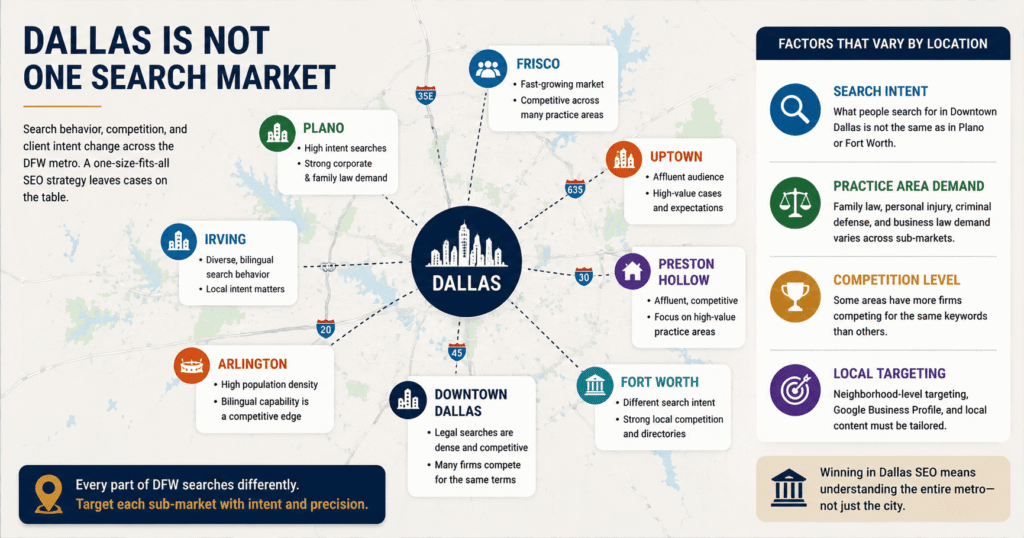
Dallas Is Not One Search Market
Downtown Dallas searches behave nothing like searches from Plano or Frisco. Irving, Arlington, and Fort Worth each carry their own distinct search patterns too. Small firms can still compete effectively with a focused local SEO strategy, rather than trying to compete everywhere at once.
Population density shifts sharply between downtown and the surrounding suburbs. That shift drives real search intent variation across just a few miles. Neighborhood level targeting captures clients a citywide strategy would completely miss. In corridors like Arlington and Irving, bilingual capability often becomes a real competitive advantage.
Questions Every Dallas Law Firm Should Ask Before Hiring
Hiring an SEO agency does not have to feel like a gamble. Before making a decision, review what a professional Law Firm SEO Dallas should include. Turn the process into a simple framework and the stress mostly disappears. Build a shortlist, then run every agency through the same questions so you are comparing apples to apples.
Questions about experience
- Does the agency have proven work in your specific practice area
- Can they share case studies tied to your type of law
- Will they give real names of prior law firm clients, not vague references
- Do they offer industry specific results instead of generic wins
- Does their portfolio actually include legal work
- Are the results shown backed by specifics rather than broad claims
Questions about local strategy
- How would they target Downtown Dallas differently than the suburbs
- What is their specific approach to Plano
- Does their answer reflect real sub market strategy or a generic script
- What is their process for geographic keyword mapping
- Is their answer confident and specific, or vague and rehearsed
Questions about reporting and contracts
- What exact metrics will you receive each month
- Who owns the content after the relationship ends
- Have you read every line of the proposed contract terms
- Is there a clear exit clause built into the agreement
- Is the reporting cadence confirmed in writing, not just spoken
- Does the agency hesitate on any of these questions
What to Expect on the Dallas SEO Timeline
Set realistic expectations before signing any SEO agreement. Dallas is a competitive market, so a fair timeline runs several months, not weeks. Ranking movement builds gradually, and firms who stay patient through the early months are the ones who see real gains later. We share this honest timeline with every client before any contract is signed, so there are no surprises three months in.
- Timeline depends on how crowded your practice area is
- Patience matters more here than in smaller cities
- Upfront honesty about pace avoids disappointment later
Why Competitive Markets Need More Time
Dallas legal search is genuinely crowded, and competition varies sharply across practice areas. Dallas County holds attorneys competing for similar searches, which drives real saturation and high keyword difficulty in the most popular fields.
- Downtown Dallas competition differs from suburban competition
- The competitive index for legal terms confirms how steep the climb is
- Firms need a strategy built for this reality, not a shortcut
What Early Progress Should Look Like
Early wins rarely look like page one rankings right away. Visibility improvements and stronger local presence tend to show up first, well before major ranking jumps and the numbers that matter most to a firm are calls and qualified enquiries.
- Watch rising impressions as an early signal
- Small map pack movement often appears before organic rankings catch up
- Tracking these signs helps firms stay patient instead of panicking too soon
How to Compare Two SEO Agencies Fairly
A clear side by side comparison removes emotion from a high stakes decision. Real evaluation takes more than reading two glossy proposals back to back, and we recommend every client compare at least two agencies before committing. A rushed choice here often costs far more than the extra week takes.
| What to Compare | Weak Agency Signals | Strong Agency Signals |
| Experience | Polished proposal design, confident sales pitch, no real proof | Can rank its own website for competitive legal SEO terms |
| Reporting | Vague deliverables, unclear what is included | Full itemized breakdown, deliverables clearly listed |
| Pricing | Hidden or bundled pricing details | Transparent pricing tied directly to reporting |
| Local Knowledge | Vague answers, big guarantees offered too early | Names specific competitors and gaps across the metro |
| Sub Market Awareness | Generic, one size fits all answers | Specific answers that differ by area of DFW |
- An agency that cannot rank itself rarely ranks a client firm well either
- Hiding pricing details and hiding reporting details tend to travel together
- Real local expertise is hard to fake; it shows up in specific detail, not confidence alone
Frequently Asked Questions
Do I need a Dallas based SEO agency?
Dallas based agency necessity depends more on local knowledge than office location. A remote agency with real DFW experience can still perform well.
How can I verify an agency’s experience?
Start by asking agencies to verify agency experience through real, checkable evidence. Request case studies tied specifically to law firms, not general businesses. Ask for names of past legal clients you can independently research.
Should every agency understand Texas Bar Rule 7?
Yes, real Texas Bar Rule 7 understanding should be non negotiable for any Texas agency. An agency unaware of these rules puts a firm’s license at real risk. Ask directly how they handle advertising compliance in blog and web content.
How long should I expect before seeing SEO results?
A fair expected results timeline runs several months in a market this competitive. Early signs like calls and visibility often appear before major rankings do. Full results typically take longer given Dallas’s crowded legal search landscape.
What should I review before signing an SEO contract?
Careful contract review before signing protects a firm from long term regret. Check for ownership rights, exit clauses, and clear reporting terms first. Read every line twice, and ask questions about anything unclear.
Choose an SEO Agency With Confidence
Real expertise, honest transparency, and genuine local understanding separate strong agencies from risky ones. Set realistic expectations early, and use the framework in this guide during every agency conversation. At Faheem Bhatti SEO, we built our process around exactly these standards for Dallas law firms. Consider this guide a brand resource to return to before any hiring decision. A confident decision comes from asking the right questions, not from trusting a pitch alone.
