

A firm hires an agency. Six months pass. The reports arrive on schedule. They’re full of charts and jargon. The owner still can’t answer one question: what am I actually paying for? That gap is where most Law Firms SEO relationships go wrong. A good SEO strategy closes that gap early. It gives the firm a baseline to start from.
It sets clear priorities and an execution plan. It includes a way to measure progress and a reporting process too. This article covers what each piece should look like. What should happen before work starts. It covers what the first 90 days should include. What belongs in a monthly report. It covers which common SEO claims deserve a second look.
Why an SEO Strategy Is More Than Monthly SEO Tasks
Firms confuse strategy with tactics constantly. That mixup costs them money. A task belongs in the plan only if the firm can answer a few questions. What problem does it address? Which page or practice area does it touch? What evidence justified it? How will success get measured? Skip that test, and the task list is just motion.
Strategy Creates Direction Before SEO Activities Begin
Direction starts before the work does. A firm needs to name its priority practice areas first. It needs to name its priority markets too. This has to happen before content gets written. It has to happen before technical issues get fixed. Without executive commitment on day one, plans stall fast. They stall the moment something else feels urgent.
A real baseline documents where the firm stands. It covers current organic traffic and the queries already driving visits. It covers the practice area pages that matter most. It covers known technical problems and local visibility. It covers existing conversion tracking. It covers the firm’s current backlink or reference profile.
Every SEO Activity Should Support One Larger Strategy
Technical work, content, and local SEO often get planned as separate projects. That’s a mistake. Group related pages under a shared practice area instead. Keep attorney, service, and location details consistent across them. This makes the site easier to follow, for readers and search systems alike. Not because it’s some Google mechanism. Simply because organized information is easier to interpret than scattered information.
Picture one core practice area page. Several supporting pages link out from it, each covering a narrower topic. That’s the hub and spoke model. Internal links connect the hub to its spokes. A visitor, or a crawler, moves naturally between related pages. No dead ends. No orphaned content. Faheem Bhatti’s SEO Case Studies page shows this structure in action.
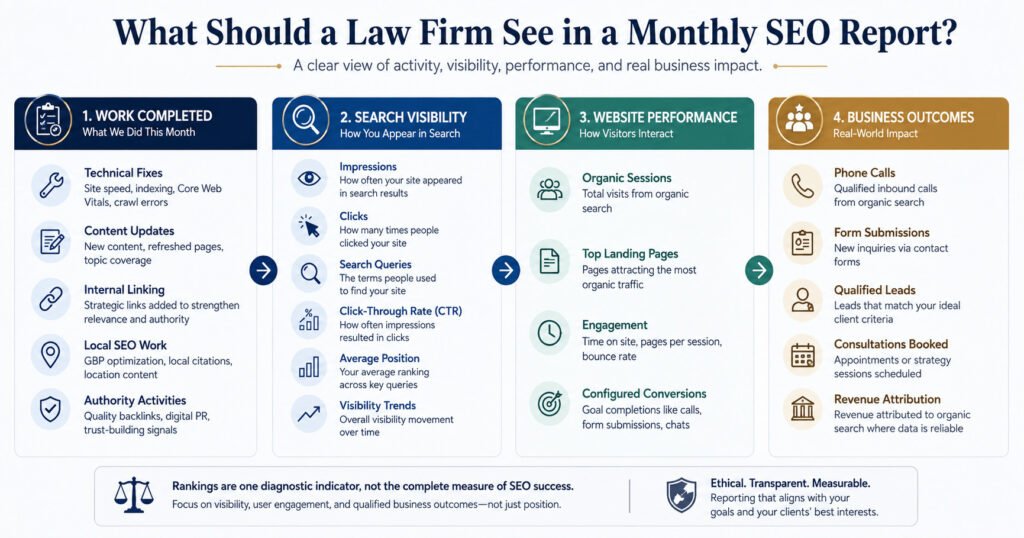
The Core Foundations Every Law Firm SEO Strategy Needs
Four areas hold up a law firm’s SEO program. They are technical SEO, content built around search intent, local SEO, and authority signals. Think of these as a diagnostic framework, not ranking levers. They help a firm prioritize the next round of work. They help track whether anything is actually moving.
Technical SEO Creates the Foundation for Visibility
A search engine has to crawl a page before that page can rank. A poorly structured site can block that step entirely. That means good content sits invisible. Core Web Vitals measure the experience on the other side of that:
- Largest Contentful Paint tracks load speed
- Interaction to Next Paint tracks response time
- Cumulative Layout Shift tracks visual stability
An XML sitemap helps crawlers find pages faster. Google uses mobile first indexing now. That means Google mostly indexes and ranks a site’s mobile version. The mobile site needs the same content the desktop version has. HTTPS protects data moving between browser and server. Google confirmed HTTPS as a ranking signal, though a lightweight one.
Search Intent Drives Every Content Decision
Every search carries a reason behind it. Match content to that reason, and relevance improves. Usefulness improves too. Whether someone converts still depends on other factors. Page design and response time both play a role. Someone researching a legal topic isn’t ready to hire yet. Someone comparing firms is closer. Someone typing “call now” is closer still.
Real client journeys rarely move through these stages in order. Keyword research shows what each stage actually sounds like in a search bar. Content mapping then matches pages to the right stage. Commercial and transactional queries often deserve priority. They tend to sit closer to a hiring decision. Informational content still matters, just earlier in the process.
Entity Based Content Supports Clear Site Structure
Group related content by practice area. Keep attorney and location information consistent across the site. Do both, and the site becomes easier to interpret. That’s the whole idea behind it. It’s a content organization method. It isn’t a promise about how any search engine processes a page.
A firm can use structured concepts to represent itself. Organization, Person, and Service are three examples. Location data ties them to a real office or service area. Keep the attorney’s name the same everywhere. Keep the service description the same everywhere too. Keep the address consistent as well. That reduces the odds of confusing information reaching a reader. It supports clarity on its own. It doesn’t, by itself, cause a ranking change.
What Should a Law Firm Expect During the First 90 Days?
No agency should promise a specific ranking position at day 30, 60, or 90. Google’s ranking systems weigh hundreds of factors, and those factors update constantly. A realistic 90 day plan describes work and review. It doesn’t describe guaranteed outcomes.
Phase 1: Baseline and Diagnosis
- A technical audit of the site
- A review of current organic visibility
- Priority practice areas identified
- Search intent mapped for key topics
- Conversion tracking checked and confirmed
- The local profile reviewed, where relevant
- Existing content and references assessed
Phase 2: Priority Implementation
- Technical fixes for the issues found
- Improvements to the pages that matter most
- Content mapping across priority topics
- Internal linking between related pages
- Local profile updates
- Reference building, where the goals justify it
Phase 3: Measurement and Refinement
- What changed since the baseline
- What improved, and what didn’t
- Which pages and queries deserve continued attention
- What shifts heading into the next quarter
By day 90, a firm should have two things. A documented starting point, and a clear record of completed work. A settled competitive position takes longer than that. It depends on where the site started. It also depends on how competitive the market already is.
How Local SEO Fits Into a Texas Law Firm Strategy
A firm’s statewide strategy only matters if it connects to real cities. Houston isn’t Dallas. Austin isn’t San Antonio. Competition shifts from market to market. Service demand shifts too, and so does search behavior. A strategy built for one city rarely transfers cleanly to the next.
Google Business Profile Supports Local Discovery
A complete Google Business Profile is a starting point, not a finish line. It’s one of the main ways Google surfaces local information. Keep it updated: correct hours, correct categories, correct service descriptions. That supports how the listing appears. It’s one input among several that Google’s local systems weigh.
Name, address, and phone number need to match everywhere. That means the website, directories, and every profile the firm touches. Mismatched details create confusing signals. A clearly defined service area should reflect where the firm genuinely serves clients. It should not reflect an aspirational map. Google’s own guidance treats an accurate, complete profile as baseline. It’s not extra credit.
Practice Area Pages and Genuine Local Relevance
What makes a city specific practice area page worth building? Real service availability there, for one. Relevant attorney or office information helps too. So do local details a visitor would find useful. Filler dressed up to look local doesn’t count. A page written for a neighborhood’s actual concerns beats a generic one every time.
So don’t build duplicate city pages that only change the city name. Google’s spam policies call this out directly. They call it doorway content. It means pages built to rank for a location, not to serve a real visitor. They flag it as a pattern to avoid. A useful location page includes a clear next step too, like scheduling a consultation.
When a Firm Should Create a City Specific Page
Not every city on the map needs its own page. Only the ones the firm can back up with something real. That means actual service there. It means meaningful client demand, too. It means a relevant practice area, and enough unique local information to matter.
Houston, Dallas, Austin, San Antonio, each one is different. Competition level and search behavior shift between them. Expanding into a new market is its own decision. It isn’t a copy paste exercise. Choosing the right SEO agency also means checking whether its strategy accounts for the firm’s actual markets, practice areas, and competitive landscape. A firm needs something beyond just the city name. Without that, the market isn’t ready yet.
Why Authority and Credibility Matter
Ranking position measures one thing. It’s not the only thing worth watching. Content quality adds context too. So do professional reputation, outside references, and demonstrated expertise. A ranking number alone can’t capture all of that.
Content Demonstrates Legal Expertise
What counts as evidence of expertise on a page? Attorney authored or attorney reviewed content, for one. Legal terminology used correctly, not just dropped in for effect. Jurisdiction specific explanations matter too. So does a real attorney biography. References to primary legal sources help. So do dates updated whenever the underlying law changes.
A page built on vague “years of experience” claims gives readers little to go on. Any claim about case outcomes needs real support behind it. This matters for search quality reasons. It also matters because Texas attorney advertising rules require it, covered in more detail below.
External References and Relevant Links
Other credible, relevant sites linking back can help. They support a firm’s discoverability. They support its broader reputation online too. Legal directories and bar association listings connect to the same professional world. A law firm operates in that world too. That makes them naturally relevant sources.
Media mentions in legal or local publications add outside context. It’s something a firm’s own site can’t generate alone. One caution here: third party metrics like Moz’s Domain Authority are useful for comparison. But they aren’t Google ranking factors. Google hasn’t confirmed using them. No client should be told otherwise.
EEAT and Texas Legal Marketing Considerations
EEAT stands for Experience, Expertise, Authoritativeness, and Trustworthiness. The term comes from Google’s Search Quality Rater Guidelines. Google’s documentation gives these concepts extra attention on certain pages. Specifically, pages that could affect a reader’s health, finances, safety, or legal standing. Google calls this category YMYL. It stands for Your Money or Your Life. EEAT isn’t a single ranking factor, though. Google hasn’t published any specific penalty for a missing attorney credential.
Here’s what the guidance does support. YMYL content benefits from clear signals about who wrote it. It benefits from signals about why they’re qualified. Real credentials in an author bio add transparency about authorship. They don’t prove a human wrote the page, though. They don’t guarantee any ranking outcome either. Separately, Texas attorney advertising falls under the State Bar of Texas. Its rules require marketing claims to be accurate.
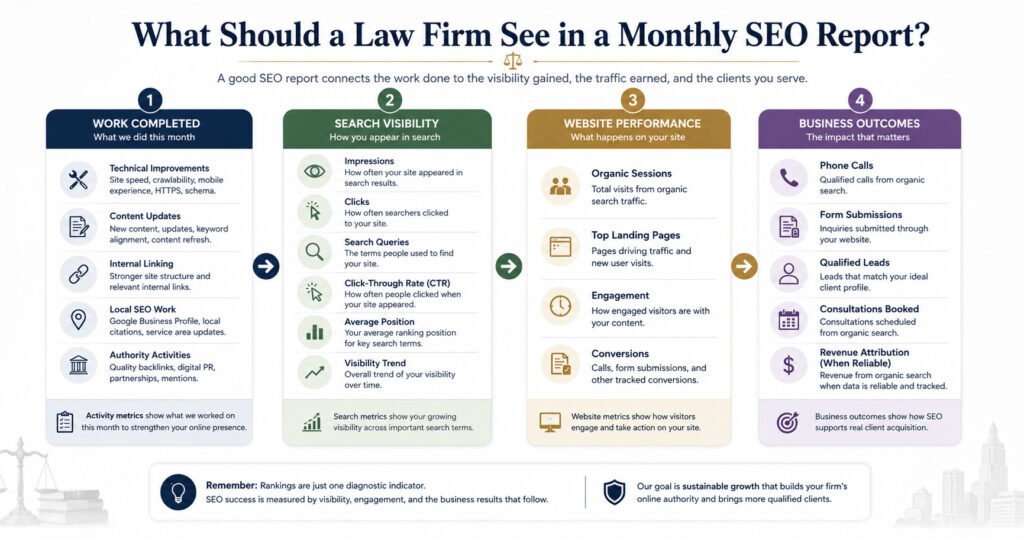
What Should a Law Firm See in a Monthly SEO Report?
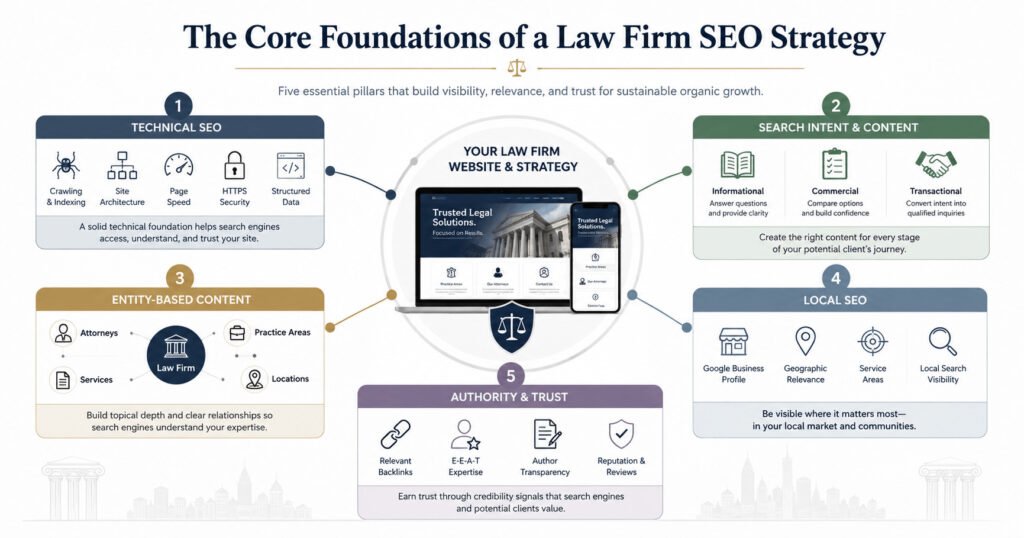
A useful report separates each stage of the funnel. It doesn’t blend everything into one vague summary.
Rankings Are One Performance Indicator
Average position, impressions, clicks, click through rate, landing page performance. Each one answers a different question. They mean more read together than apart. High impressions paired with a low click through rate might signal something. Maybe the title or snippet needs work. It’s a reason to look closer. It’s not a diagnosis on its own. The Search Console Performance report breaks this down by query and page. That beats a single average position number for precision.
| Source | What it shows |
| Google Search Console | Queries, impressions, clicks, CTR, average position |
| GA4 | Sessions, landing pages, engagement, configured conversions |
| CRM or intake system | Calls, forms, qualified leads, consultations, revenue where attribution is reliable |
Neither Search Console nor GA4 confirms whether the firm gained a client. That’s what the CRM layer is for.
Visibility Should Connect to Qualified Leads
Traffic that leads nowhere doesn’t help a growing practice. A mature reporting setup connects organic visits to qualified inquiries. This includes phone calls, form submissions, and consultation requests. Where tracking allows it, the connection goes further. It reaches downstream outcomes through the firm’s intake system. If a report doesn’t show this connection, ask for it directly.
Watching leads alongside traffic and rankings paints a fuller picture. Any single number, on its own, can’t do that. A rankings report with no lead data attached tells a firm almost nothing. It can’t confirm whether the work is paying off.
When the Data Says the Strategy Needs to Change
Search demand shifts over time. Competitors change tactics too. Business priorities move as well. And sometimes the underlying law changes, which means legal content needs updating regardless of SEO. A quarterly review is a reasonable cadence. It checks whether current priorities still make sense.
Change direction when a quarterly review reveals a real gap. That means a gap between the roadmap and the actual lead or ranking numbers. Don’t change direction on a fixed schedule regardless of results. Budget should also reflect the amount of work the strategy actually requires, rather than being based only on a standard monthly package. Rankings rising while leads stay flat is worth investigating on its own. It can mean a mismatch between ranking pages and buyer ready intent.
Common Misconceptions About Law Firm SEO
A few assumptions keep guiding decisions that don’t hold up once someone looks closely.
More Content Does Not Automatically Mean Better SEO
More pages don’t beat fewer, stronger ones. Not automatically, anyway. Spread content across too many overlapping topics, and the site’s overall value gets diluted. Google’s guidance on helpful content is clear here. Usefulness to the reader is the point, not sheer volume.
AI assisted writing isn’t the problem by itself. Google’s guidance focuses on whether content is helpful and reliable. It doesn’t focus on how the content got written. Generic, thin, unhelpful content is the real issue. That’s true whether a person wrote it or a machine did. A publishing schedule earns its keep under one condition. Each new piece needs to fill a real gap. It shouldn’t exist just because regular publishing feels productive.
Rankings Without Business Outcomes Need Investigation
A page one ranking that produces zero calls doesn’t say much. It doesn’t confirm the SEO program is actually working. Here’s the better question: is search visibility reaching the right audience? Are visitors taking any meaningful action once they land? High volume for a broad term isn’t automatically valuable. Not if the people searching it aren’t close to hiring anyone.
Terms closer to a hiring decision tend to matter more for the bottom line. High volume informational terms matter less, though this varies by practice area. Firms serious about growth track qualified leads directly. They use call tracking and form submissions for that. They don’t rely on rankings alone as proof.
SEO Requires Ongoing Review
SEO leaves something behind. Published content stays useful. Technical improvements stay in place. Reference relationships don’t disappear once the work wraps up. But none of that runs on autopilot. Search engines change their systems constantly. Content that stays static eventually falls behind.
Paid search stops the moment the budget does. Organic content keeps generating visits after it’s published. That difference is real. It doesn’t mean returns compound automatically, though. It doesn’t mean competitors can’t catch up either. Maintenance still matters. Market response still matters too.
Frequently Asked Questions
What should a law firm expect during the first 90 days of SEO?
A documented baseline, completed priority work, and the first data on visibility and traffic. Not a guaranteed ranking outcome on a fixed timeline.
What should an SEO agency include in a monthly report?
Completed work, Search Console data, GA4 traffic data, and qualified leads where tracking exists. Not just a ranking snapshot.
What if rankings improve but qualified leads do not?
Worth investigating directly. It can point to a mismatch between ranking keywords and buyer intent. Or friction somewhere in the conversion path.
Should a Texas law firm prioritize local SEO?
Yes, a Texas law firm should absolutely prioritize local SEO, as the vast majority of legal clients look for representation near their city or county. However, the exact balance depends entirely on the firm’s physical locations and practice areas.
How can a law firm tell whether an SEO agency is doing meaningful work?
Look for specific monthly deliverables. Look for reporting tied to qualified leads, not just rankings. Look for a documented plan connecting each task to a business reason.
When should an SEO agency change its strategy?
When a quarterly review shows the roadmap isn’t matching the data. Not automatically, on a fixed calendar, regardless of results.
Set the Right Expectations From Day One
A good SEO strategy gives a law firm evidence backed priorities. It gives them a clear execution plan too. It includes a measurement system tied to actual leads. It includes honest reporting too. And a way to adjust course when the data calls for it. Hold an SEO program to that standard. It becomes much easier to tell if the work is producing clients. Or just producing activity. Faheem Bhatti SEO builds strategies around this same framework.
