

Law firms often compare SEO and Google Ads using cost per click or plain lead volume. Neither number, by itself, shows what a channel costs to produce a signed case. A cheap click means little if that click never becomes a signed case. Traffic counts and lead totals alone cannot answer the question firms actually need answered.
Cost per signed case measures the attributable cost associated with producing one signed case, not the cost of a click. A fair comparison needs the same cost definitions applied to both SEO and Google Ads. Both channels need a shared signed case definition and a clearly defined measurement period. Attribution must stay transparent too, or credit can end up assigned to the wrong channel. This comparison does not declare a winner before checking each firm’s own numbers first.
Why Cost Per Lead Is Not Enough
Lead Quality Shifts The Real Cost Of Acquisition
Search intent can affect whether a click becomes a real client. Practice-area relevance matters as well, since a criminal-law search may be irrelevant to a family law firm. Geography can filter out clicks from cities a firm does not serve. Case eligibility can further determine whether a local inquiry fits the firm’s intake criteria.
A Lead Is Only A Stop Along The Way
A click starts the journey, but it does not guarantee anything past that moment. That click can turn into a lead, then a qualified lead if it fits the firm’s criteria. From there, a consultation can be booked before any case is signed. A lead is an intermediate outcome between interest and an actual signed case.
Three Costs Measure Three Completely Different Things
CPC shows the cost associated with a click. CPL shows the cost associated with inquiries, meaning raw interest before any screening happens. CPSC shows the attributable cost associated with signed matters, connecting the measurement to the agreed client-acquisition outcome.
Cost per signed case measures what a channel spends to produce a signed case, not a click. A fair comparison requires the same cost definitions, the same signed case definition, and transparent attribution for both channels.
How to Calculate Cost Per Signed Case
To calculate CPSC from your own data, you need three things: consistent cost definitions, a clear signed case definition, and a defined measurement period. Use this framework for both SEO and Google Ads equally.
Only One Outcome Belongs In The Final Count
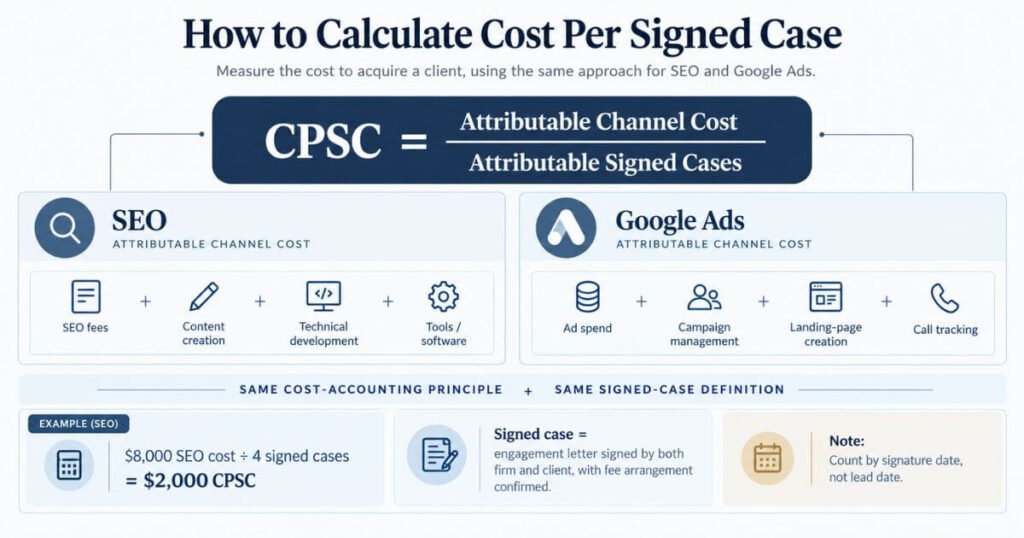
For CPSC, count only signed cases. For this framework, define a signed case as: engagement letter signed by both firm and client, with fee arrangement confirmed. Count by signature date, not lead date. Do not count consultations, qualified leads, or inquiries.
A qualified lead moves closer, since it fits the firm’s real intake criteria. A consultation narrows things further, showing a prospect has taken a further step toward hiring a lawyer. Only the signed engagement counts as the agreed outcome in the denominator.
Both Channels Need The Exact Same Cost Rules
SEO costs include SEO fees, content, technical work, development, and other attributable costs tied to the channel. Google Ads costs include ad spend, campaign management, landing page work, tracking, and other attributable costs as well. Consistent cost accounting keeps the comparison consistent between two different channels. Mixing unrelated expenses into only one side can distort the final number.
Cost Definition Template
SEO Costs: Monthly SEO fees + content creation + technical development + tools/software
Google Ads Costs: Ad spend + campaign management + landing-page creation + call tracking
Use the same categories for both. Don’t include firm overhead, attorney salaries, or general website maintenance. Include costs that are directly attributable to each channel according to the firm’s chosen measurement rules.
One Formula, Applied The Same Way Twice
Cost per signed case equals attributable channel cost divided by attributable signed cases.
Hypothetical example: a firm spends $8,000 on SEO and signs 4 cases that same month. That works out to $2,000 per signed case for the SEO channel alone. Running Google Ads through the identical formula shows the corresponding CPSC for the Google Ads channel.
Why Time Horizon Changes The Comparison
SEO Value Can Extend Beyond The Month It Was Paid For
SEO content and technical improvements can continue generating traffic after the month in which the work was performed. Organic visibility can deliver visitors beyond the month of creation. Conversely, paid traffic from Google Ads depends on ads continuing to run. This timing difference affects which measurement period is appropriate for the comparison.
Google Ads Spending Maps Directly To Results
Google Ads works through paid advertising. The cost is tied to campaign spending. That spending can produce clicks, and those clicks can produce leads. Google Ads can produce traffic and leads during the period in which campaigns are running. When ads stop running, the associated paid traffic from those ads stops as well.
The Measurement Window Changes What The Numbers Show
Monthly CPSC shows performance within a shorter measurement period. Annual CPSC captures a longer period and can show a different picture. Multi-year measurement can shift results again. Choose your measurement window to match your firm’s actual decision timeline, not to make one channel look better.
How Attribution Changes the Cost Calculation
Different Models Assign Credit In Different Ways
Google Analytics 4 currently provides data driven attribution and paid and organic channels last click for paid and organic channel reporting. Data driven attribution uses account data to distribute credit for a key event across relevant touchpoints. Paid and organic channels last click assigns credit to the last eligible channel interaction before the key event. Google removed the first click, linear, time decay, and position based attribution models from GA4 in November 2023.
For a fair SEO vs. Google Ads comparison, use the same attribution approach for both channels where the same measurement system is being applied. Last click is simpler but can give more credit to the final touch point. Datadriven attribution distributes credit using the property’s data rather than assigning all credit to a single touch point.
One Client Can Touch Both Channels Before Signing
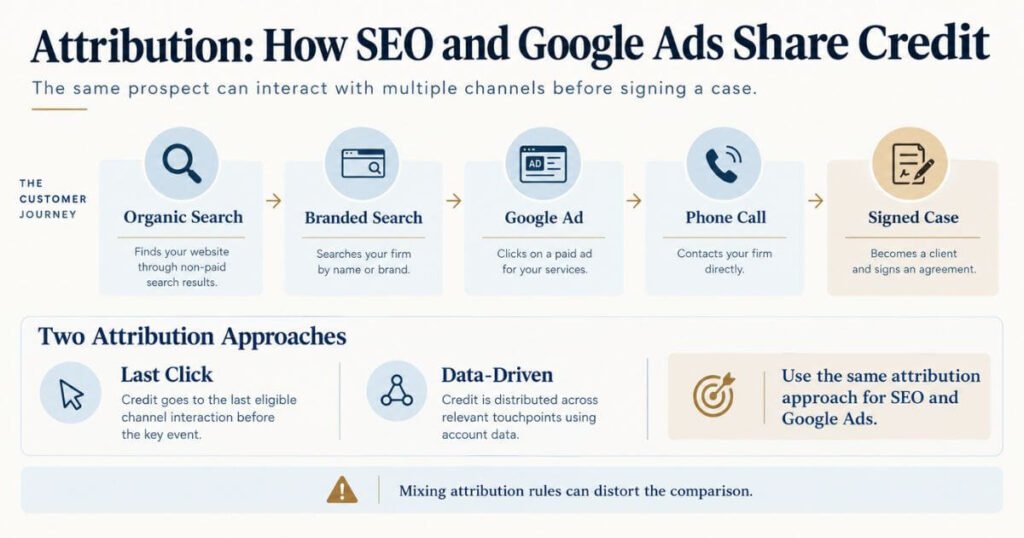
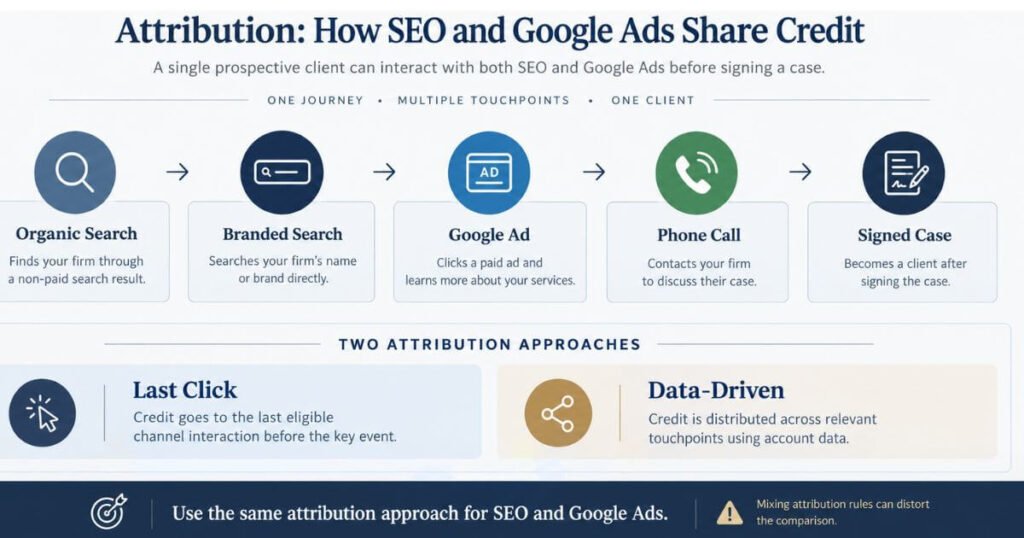
A prospective client might start with an organic search result on Google. That same client returns later through a branded search after remembering the firm’s name. A Google Ad click follows, then a phone call, then finally a signed case. Crediting only one channel here can leave other touchpoints without attribution.
Fair Comparisons Need The Same Attribution Rule Everywhere
Consistent attribution matters more than choosing a model simply because it produces a preferred result. A firm using last-touch attribution for Google Ads should apply the same attribution approach to SEO when making the comparison. Mixing attribution approaches between channels can make one channel look stronger than the other.
Choose One Rule And Apply It To Both SEO And Google Ads
- If you choose last-click: Credit goes to the last eligible channel interaction before the key event. This is simpler but can favor the final touchpoint.
- If you choose data-driven: GA4 uses account data to distribute credit across relevant touchpoints.
Whatever approach you choose, apply it consistently to SEO and Google Ads.
Why Practice Area And Location Matter
A Big City Market Changes The Whole Equation
In metropolitan markets, CPC and acquisition costs can differ from smaller markets because competition, targeting, practice area, and other campaign conditions vary. However, this varies significantly by practice area and keyword. Firms should compare their own CPC against relevant competitors in their specific market rather than relying on a single national average.
Practice Area Shapes Demand, Competition, And Urgency
Search demand, competition levels, and conversion speed can vary by practice area. Personal injury searches can reflect urgent needs, while estate planning searches can involve more planning before a decision. This can affect CPC and the time between inquiries and consultations. Comparison between practice areas requires accounting for these differences.
A Lower Cost Does Not Always Mean A Better Result
CPSC is only part of the picture. A channel producing 10 cases at $500 each (CPSC = $500) might be less valuable than a channel producing 3 cases at $2,000 each (CPSC = $2,000) if those 3 cases are worth $50,000+ each. Calculate case value alongside cost before deciding which channel is better.
How To Evaluate Published Cost Benchmarks
Not Every Data Source Carries The Same Weight
Separate independent research from paid promotion before trusting any published number. Compare industry benchmarks against a single firm’s first party agency data carefully. Case studies show one specific result, not a guaranteed outcome for every firm. Hypothetical calculations sit apart from all of these, since they model numbers rather than measure real ones.
Ask These Questions Before Trusting Any Number
A published benchmark needs real scrutiny before it shapes a firm’s decision.
- What practice areas were included in that benchmark?
- What location does that benchmark actually represent?
- What period did the researchers measure across?
- What sample size backs up that published figure?
- What counts as a lead in that specific study?
- What counts as a signed case in that same study?
- Which costs were included in the final calculation?
A Benchmark Sets Context, Not An Expectation
A published CPSC figure describes what happened for a different firm, in a different market. That number is not a promise about what another firm should expect. Practice area, location, and cost accounting can shift the real number for every firm. Treating a benchmark as context works better than treating it as a target.
How Law Firms Can Compare Both Channels
Calculate CPSC The Same Way For Each Channel
Total attributable cost divided by attributable signed cases gives each channel its calculated CPSC. Make the calculation period explicit every time, whether that means one month or one full year. A firm skipping this step can end up comparing numbers that were not calculated on the same basis. Consistency here matters more than picking the fanciest measurement method available.
Your CRM Must Tag These Fields
- Lead source: ‘SEO’ OR ‘Google Ads’
- Lead date: When the inquiry arrived
- Qualified date: When it met your criteria
- Consultation date: When it was booked
- Signed date: When the engagement letter was signed
- Case value: Revenue generated
Without these tags, you cannot calculate CPSC using this framework. Start with these fields before running any analysis.
Every Channel Follows The Same Conversion Path
Traffic and clicks start the journey for both SEO and Google Ads. That traffic can turn into a lead, then a qualified lead worth pursuing further. A consultation can come next, followed by the agreed outcome: a signed case. Tracking both channels through these stages keeps the comparison consistent.
Case Economics Turn Marketing Numbers Into Business Decisions
Acquisition cost connects to signed cases, which connects to case value next. Case value then provides another basis for evaluating the economic result of that spending. This step moves the reader from marketing measurement into real business evaluation. A cheap acquisition cost means little without checking what that signed case was actually worth. Firms evaluating SEO as a long term acquisition channel can also review Law Firm SEO for US Firms to understand how search visibility connects with qualified leads and signed cases.
Why The Lower CPSC Is Not Always Better
Different Goals Call For Different Evaluation Windows
Immediate demand capture through Google Ads can suit a firm seeking short-term case volume. Long term organic acquisition through SEO can suit a firm building visibility over a longer period. Those different evaluation periods and priorities can shape which channel looks stronger on paper. Comparing both channels fairly means matching the evaluation window to each firm’s actual marketing objectives.
A Higher Cost Can Still Be The Better Deal
A higher CPSC can remain economically viable when the resulting cases carry greater value. One channel producing fewer, larger cases can outperform another producing many smaller ones. Cost alone does not tell a firm which channel generated the greater economic value. Case value has to sit next to cost before a conclusion makes sense.
The Firm’s Own Numbers Beat Any Outside Comparison
There is no universal SEO versus Google Ads winner based solely on cost per signed case. The most useful comparison follows a firm’s own path from investment through qualified opportunities. That path continues into signed cases, then finally into case economics for that firm. A firm’s own data can be more relevant to its decision than an outside industry benchmark.
FAQs
How should I count a case touched by both SEO and Google Ads?
Apply your chosen attribution approach consistently. If the selected approach assigns the final eligible touchpoint, the channel receiving that touchpoint receives the credit. If data-driven attribution is used, GA4 distributes credit across relevant touchpoints based on its data-driven model.
Should I measure CPSC by lead date or signed date?
Use signed date for this framework. CPSC should measure the attributable cost associated with producing a signed case, not simply a lead. Leads that never become signed cases should not be included in the signed case denominator.
What if my intake response time is slow?
Slow response time can reduce the number of leads that progress to signed cases, which can affect CPSC. The issue may involve the intake process rather than the channel cost itself. Fix response-time problems before using the resulting CPSC to judge channel performance.
Why does my CPSC differ from industry benchmarks?
Practice area, location, intake speed, and case qualification can all affect CPSC from firm to firm. Your CPSC reflects your specific market and process. Use benchmarks for context rather than as targets.
Should I calculate CPSC monthly or annually?
Use monthly CPSC to monitor shorter-term trends. Use annual CPSC to evaluate a longer period that can capture differences in how SEO and Google Ads perform over time. Both can be useful when they are calculated consistently.
Three Questions That Reveal Your Real CPSC
Your firm’s own numbers matter more than industry numbers. Do not compare your CPSC to published benchmarks without considering the differences between the firms. Every firm is different. Your location is different. Your practice areas are different. Your costs are different. Your case values are different.
Calculate your own CPSC. Use your own cost data. Use your own rules. Use your own definition of a signed case.
The Most Important Next Step
Answer three questions:
1. How will you tag leads in your CRM?
Tag every lead: source = ‘SEO’ or source = ‘Google Ads’. Do this from day one. Without this tag, you cannot calculate CPSC using this framework.
2. What counts as a signed case for your firm?
Signed case = engagement letter signed by both the firm and the client. Count by signature date. Do not count consultations or qualified leads. Only the signed engagement.
3. Which attribution approach will you use?
Use the same approach for both SEO and Google Ads. Current GA4 reporting for paid and organic channels provides data driven attribution and paid and organic channels last click; the first-click model is no longer available in GA4.
Once you answer these three questions, your numbers will provide a clearer basis for comparison.
- You will know what SEO costs to produce signed cases under your chosen measurement rules.
- You will know what Google Ads costs to produce signed cases under the same rules.
Then you can decide which channel works better for your firm.
Need Help Setting Up This Measurement System
Many firms struggle with CRM tagging or attribution definitions. If you want guidance on how to structure this in your specific systems, we’ve worked through this process with law firms across different practice areas and markets. Visit faheembhatti.com to see how we help firms calculate their CPSC.
