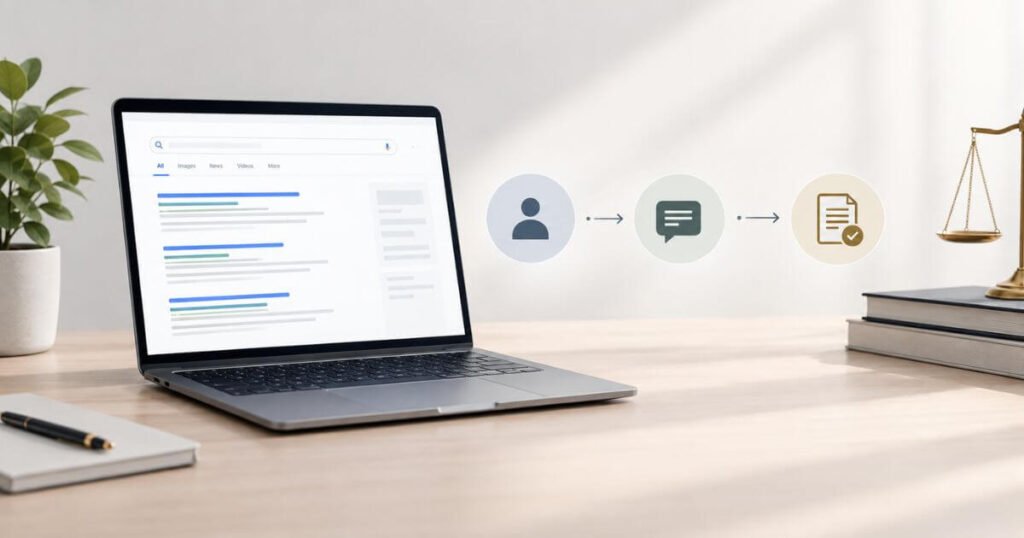
A law firm’s website traffic can climb every single month without new clients. Visitors can arrive from the wrong city, wrong practice area, or wrong intent. Traffic feels good on a dashboard. Growth like that rarely turns into a real signed case for the firm. Search engine optimization only creates the chance to get found by a client. How law firms turn organic traffic into signed cases depends on what happens next.
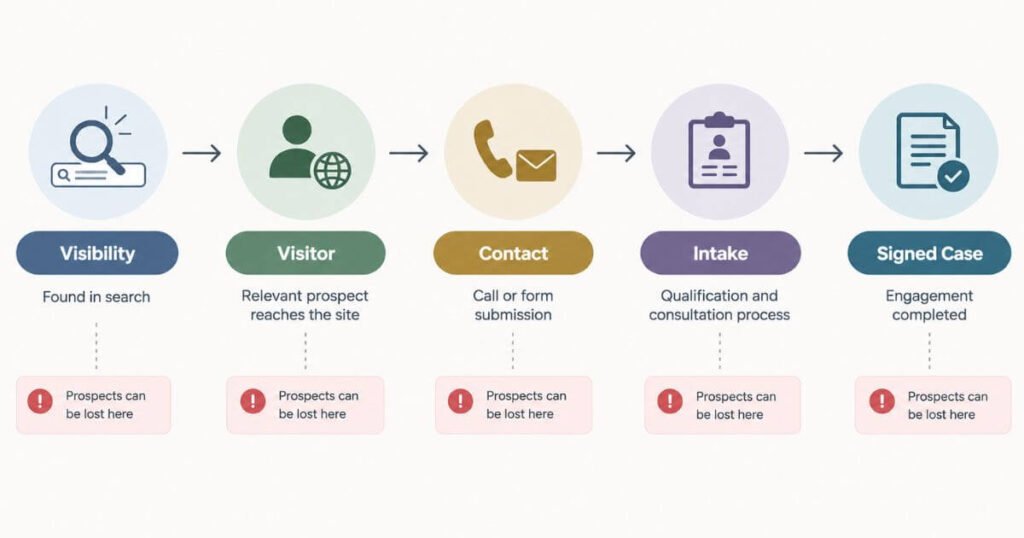
The path runs: visibility → visitor → contact → intake → signed case. But each stage has failure points that break the chain. Understanding these failure points is the first step toward measuring whether SEO actually produces cases.
Why Organic Traffic Does Not Equal Case Volume
Search Intent Shapes Who Actually Calls
Search intent matters because visitors at different stages of discovery have different expectations. Early stage visitors type broad questions (‘How long does a personal injury case take?’).
As their problem becomes clearer, some searches become more specific and closer to hiring intent (‘Personal injury attorney near me’), while others remain informational (‘How to file a wrongful termination claim’). A page optimized for one stage may not satisfy the needs of visitors at other stages.
Visitor Counts Hide The Real Story
Raw visitor counts hide the real problem. A law firm tracking only overall traffic sees growth without understanding whether that growth attracts qualified prospects. Traffic from the wrong geography, practice area, or search intent can convert at different rates.
A page pulling significant traffic from unqualified visitors may show low engagement and low contact submissions. A smaller page pulling focused traffic from qualified prospects will book consultations consistently. The difference isn’t the traffic volume; it’s traffic quality.
Location And Practice Area Decide What Happens Next
Geography and practice area fit determine whether a visitor can become a qualified lead at all. A search for custody law in Ohio adds no value to a Texas immigration firm. A prospect contacting your firm about a case type you don’t handle isn’t a qualified lead. They’re a wrong fit inquiry. Qualified traffic must match both your service area and your actual practice areas. Everything downstream contact rate, intake acceptance, consultation scheduling, and case signing. They all depend on this match happening upstream.
Where Organic Visibility Fails Before the Click
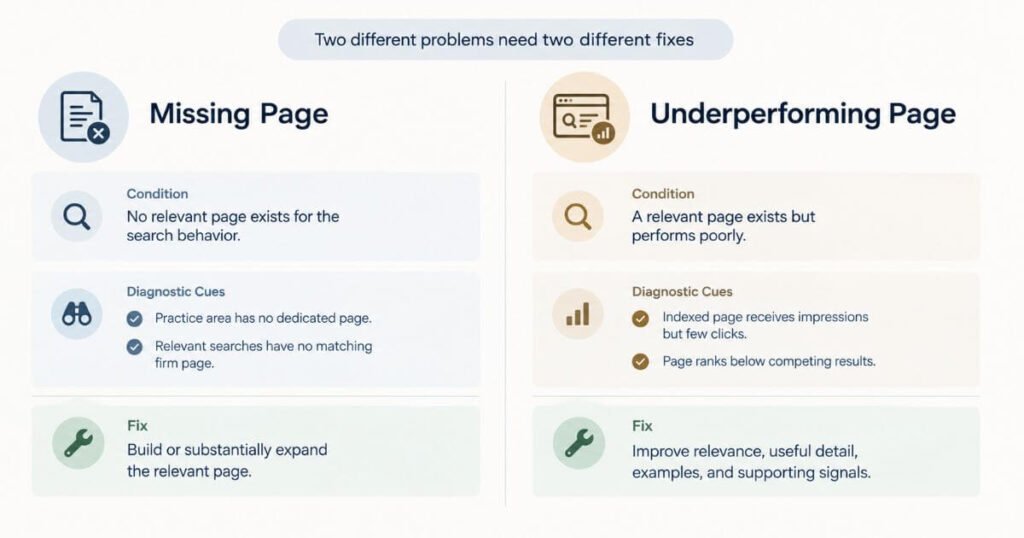
Visibility failures happen in two distinct ways. Understanding which type you have determines what to fix. The first is absence. You have no content ranking for the search behavior at all. The second is suppression. You have content that should rank but underperforms. These require completely different fixes.
No Page Exists For What The Client Types
Absence means no page exists targeting the search behavior your prospects are actually using. A firm offering wrongful termination representation but with no dedicated page about that practice area may miss relevant searches. The searcher finds a result from a competitor instead.
How to diagnose absence:
- Search your practice areas in Google and note which topics have no firm pages in the top 10 results
- Check Google Search Console for queries generating impressions but zero clicks, which can help identify searches for which your pages are appearing without receiving clicks
- Map your major practice areas and verify each has a dedicated page with substantive content
Absence usually requires creating or substantially expanding a page to address the search behavior, rather than simply optimizing an unrelated existing page.
The Right Page Exists But Still Underperforms
Suppression is different: Your page exists. Your page is indexed. But it ranks below competitors. It ranks lower than it should. There are several possible causes.
Indexation Issues
Google cannot crawl your page. Google cannot index your page. This is a technical problem. Your robots.txt file blocks Google. Your noindex tag blocks Google. Your page is buried too deep in your site. Google may not be able to crawl or index it. The page exists, but it may not be available to appear in Google Search.
Cannibalization
You have two pages. Both pages target the same search query. Google may select one page as the more relevant result, while the other page receives less visibility for the overlapping query. Your general employment law page ranks. Your wrongful termination page stays hidden.
Thin Authority
Your page is indexed. Google knows about it. Google does not rank it high. The page may lack sufficient depth, relevant supporting evidence, or authority signals compared with competing results. It may rank below the firm’s target positions.
How to Diagnose Suppression
- Check Google Search Console. Look for pages with impressions. These pages show in search results. They get few clicks. Your page exists. Searchers do not click it.
- Search your target keywords. Look at the top 10 results. Which competitors rank above you? How deep is their content? How many backlinks do they have?
- Compare your pages to competitors. Your page is shorter. Their page is longer. Your page has no examples. Their page has examples. Your page has no backlinks. Their page has backlinks.
Two Different Problems Need Two Different Fixes
Missing pages need different fixes. Underperforming pages need different fixes.
- Missing page: You have no page. Solution: Build a new page. Write content. Optimize it.
- Underperforming page: You have a page. Google finds it. It does not rank well. Solution: Improve this page. Add useful detail. Add examples. Strengthen relevant supporting signals.
Why this matters:
Treat underperformance as missing, and you fail. You create a second page. Now two pages fight each other. Both rank worse. Treat missing as underperformance, and you waste time. You optimize a page that does not exist. Nothing happens. Know your problem first. Then fix it right. This can reduce wasted work.
How an organic visitor becomes a signed case
Discovery and Relevance
A visitor finds your firm through search. But discovery alone does nothing. The landing page must answer their exact question immediately.
They ask: “Does this firm handle my problem? In my location? Can I reach them now?”
If they searched “wrongful termination attorney Houston” but land on your general employment law page, they may leave without taking the next step. Geographic match matters equally. A prospect in Dallas seeing “Austin only” leaves immediately.
Trust and Contact
Proof can give visitors more specific information than unsupported claims. Show case results with numbers, not just credentials. One detailed example beats a checklist of titles. Phone number visible on every page. Simple contact form with only the information needed at this stage. Detailed screening happens after contact, not before.
Intake and Closure
Fast response can help reduce the chance that leads go cold. A missed call may give the prospect a reason to contact another firm. Qualification happens during intake. A signed engagement letter is the key downstream outcome. Everything before that is just movement. The entire chain has failure points. Find which stage loses your leads. Fix that stage.
Where The Case Acquisition Chain Leaks
Visibility Leaks
Your firm has no chance to be found because the right pages don’t exist or don’t rank.
What to investigate:
- Are you ranking for significant searches in your practice areas?
- Check Google Search Console. Are most impressions on pages 2+?
- Compare your local rankings to competitors in the same city.
Fix: New content (missing pages) or content improvement (suppressed pages).
Page Leaks
Visitors reach your site but bounce because pages don’t answer their specific need.
What to investigate:
- A high bounce rate can be a reason to investigate engagement, page relevance, and conversion behavior.
- Test your pages: Do they answer the searcher’s exact question in the first paragraph?
- Check attorney pages: Credentials only, or actual case examples and results?
- Mobile test: Can visitors find your phone number within 3 taps?
Fix: Improve content depth, add case examples, restructure for mobile.
Contact And Intake Leaks
Warm leads go cold because of friction, delays, and process failures. If your firm is losing potential clients because of gaps in its search and intake process, a free consultation can help identify where the case acquisition chain is breaking.
What to investigate:
- Call answer rate during business hours?
- Response time for web forms? (Track response time and compare it with your firm’s own conversion data.)
- Intake form: How many fields? (Review whether the number of fields creates unnecessary friction.)
- Does booking a consultation require multiple calls or one?
- Is your phone number visible above the fold on mobile?
Fix: Answer calls, respond fast, simplify forms.
Qualification Gaps
Not every inquiry is a qualified lead.
Define what qualifies for your firm:
- Right practice area (you take this type of case)
- Right geography (client is in your service area)
- Right timeline (client is ready to hire, not just researching)
- No conflicts
- Right case value (worth your intake investment)
Screen during intake. Many inquiries aren’t qualified leads. They are correctly filtered out.
How AI Search Changes Discovery
An AI citation names your firm without guaranteeing traffic. When ChatGPT or Google’s AI features mention you, a mention itself is not the same as a website visit recorded in Google Analytics. Google Search Console now provides reporting for visibility in Google’s generative AI features.
Influence (being named) is not the same as traffic (being visited).
AI can change where discovery starts, but many of the same conversion considerations still apply after a prospect reaches your site. Once a prospect lands on your page, from AI, organic, or paid search, they still need proof: credentials, case examples, response speed.
What Makes An Organic Visitor Trust Your Firm
Attorney expertise needs proof. A bar admission establishes licensure, but additional information can help visitors understand relevant experience. Show: years practicing + cases handled + results achieved.
Strong: “Jane Smith: 12 years wrongful termination law. Recovered $2.1M+ for clients in retaliation cases.”
Weak: “JD from Yale. AV rated.”
The page must match the exact search. A visitor searching “wrongful termination claim” bounces from a general employment law page. They searched narrow; you answered broad. Reviews and results need honest framing. Show results as examples, not promises. Include the disclosure: “Past results do not guarantee future outcomes.”
Attorney Advertising Rules
Attorney advertising is regulated. Violations can be costly. But compliant pages still convert. These rules vary by state. Verify your state bar’s specific requirements before publishing.
ABA Model Rule 7.1 (americanbar.org): Communications about a lawyer’s services must not be false or misleading. The Rule’s commentary explains that reporting past results can be misleading if it creates an unjustified expectation that similar results could be obtained without considering the specific facts and legal circumstances of each case. Appropriate disclaimer or qualifying language may help prevent that.
State variation matters:
- California: Attorney advertising is subject to rules against false or misleading communications, including restrictions on claims that can create unjustified expectations about results.
- Texas: Attorney advertising is subject to state-specific rules governing misleading communications and claims about legal services.
- New York: Certain testimonials or endorsements are subject to specific conditions, including written informed consent and disclosure requirements where applicable.
If you operate in multiple states, review the advertising rules applicable in each jurisdiction before publishing.
How To Measure Organic Search Beyond Traffic
Stop reporting rankings and traffic. Start reporting conversions at every stage.
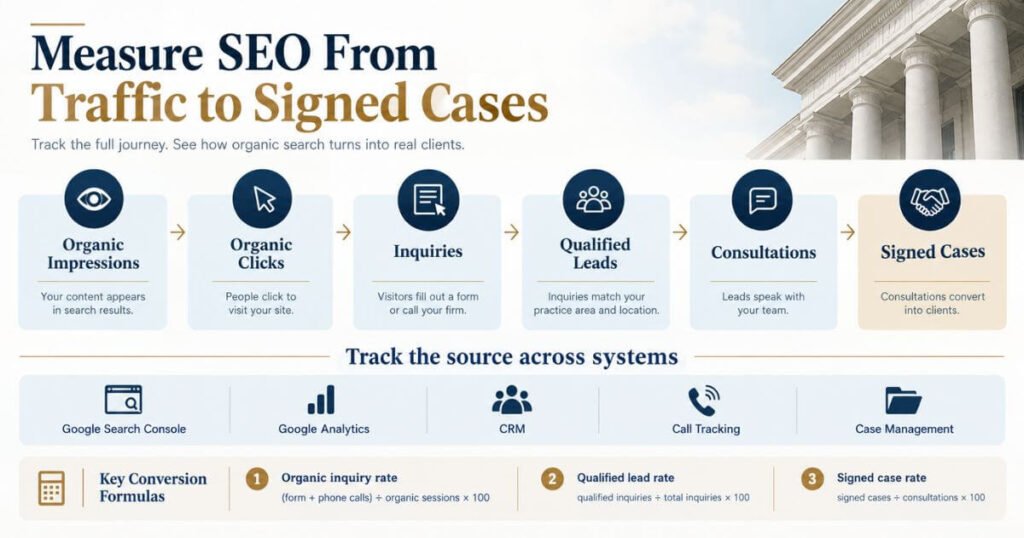
Define Your Framework
Leading indicators (early momentum):
- Organic impressions
- Organic clicks
- Form submissions
- Phone calls
Downstream indicators (business results):
- Qualified leads
- Consultations booked
- Signed cases
- Case value
Track Systems That Connect Them
Tag ‘organic’ in every system:
- Google Search Console: impressions, clicks
- Google Analytics: sessions, traffic source = ‘organic’
- CRM: lead source = ‘website’ or ‘phone call’
- Call tracking: source = ‘organic’
- Case management: original source = ‘organic’
Without tagging, you can’t connect traffic to cases.
Key Formulas
Organic inquiry rate = (Monthly form + phone calls) ÷ (Monthly sessions) × 100
Track this rate over time and compare it with your firm’s historical performance.
Qualified lead rate = (Qualified inquiries) ÷ (Total inquiries) × 100
Track this rate over time and compare it with your firm’s historical performance.
Consultation rate = (Consultations) ÷ (Qualified leads) × 100
Track this rate over time and compare it with your firm’s historical performance.
Signed case rate = (Signed cases) ÷ (Consultations) × 100
Track this rate over time and compare it with your firm’s historical performance.
Cost per case = (Monthly SEO spend) ÷ (Signed cases)
Example: $5,000 ÷ 3 cases = $1,667 per case
The Diagnostic Framework
| Problem | Investigate |
| Impressions flat | Rankings, search coverage, page existence |
| Clicks up, inquiries flat | Page relevance, clarity, mobile experience |
| Inquiries up, qualified leads flat | Intake screening, lead quality |
| Qualified leads up, consultations flat | Response time, scheduling process |
| Consultations up, signed cases flat | Consultation quality, fee discussion |
Example: Organic sessions up 40%, signed cases flat. Move down the chain:
- Are inquiries up? If no → page conversion is the problem.
- Are inquiries up but qualified leads flat? → intake screening is the problem.
- Are qualified leads up but consultations flat? → response time is the problem.
- Are consultations up but cases flat? → sales process is the problem.
What Organic Search Cannot Guarantee
Organic traffic drives visibility. But visibility alone doesn’t guarantee cases because downstream factors escape your control:
- Whether the prospect actually needs your services
- Whether you’ll accept the case (conflicts, capacity, fees)
- Whether they hire you (they may choose a competitor)
- Case economics (even signed cases may be unprofitable)
This is why “organic traffic = signed cases” is incomplete. Organic handles discovery. Your firm’s intake and sales processes handle conversion.
FAQs
How long does it typically take for organic visibility to turn into signed cases?
The time required for organic visibility to contribute to signed cases varies by practice area, geography, competition, website, search demand, and the firm’s intake process. There is no reliable universal timeline that applies to most firms.
Does a high volume of leads always mean the organic strategy is working?
No, high lead volume means little without matching intake capacity behind it. A firm that can’t respond fast still loses those leads to competitors.
Can a firm rank well and still generate no signed cases?
Yes, strong rankings alone never guarantee a signed case at the end. Weak page relevance, slow response times, or poor intake can break that chain.
Does a firm’s state bar affect what organic content can say?
Yes, each state bar sets its own rules on disclaimers and claims. Content compliant in one state can still violate another state’s advertising rules.
Should organic strategy differ by practice area?
Yes, search intent and buyer timelines shift heavily between different practice areas. A personal injury strategy rarely fits a family law or estate planning firm the same way.
Ready to turn your firm’s organic traffic into signed cases?
Every stage in this chain, from search to a booked consultation, decides whether that visibility pays off. Firms that track the full path can see more clearly where organic leads are being lost than firms watching rankings alone. Ready to find where your firm’s chain leaks? Visit Faheem Bhatti SEO at faheembhatti.com for a straightforward site review, and we’ll show you exactly what to fix first.
