

A prospect searches for a personal injury lawyer near them. Your firm’s address appears in different ways on different websites. This causes problems. An address mismatch can make it harder for potential clients and search platforms to identify the correct office. Especially when important business details differ across listings. Local citations are online mentions. They mention your firm’s name, address, and phone number. Together, these three pieces are called NAP. They show up on legal directories, map platforms, and general business sites.
Law firms don’t need every directory that exists. Some listings are more relevant to a firm’s practice area, location, professional audience, or potential clients than others. The goal is to prioritize sources that have a clear purpose rather than create profiles everywhere. This guide breaks down which directory types matter, how to prioritize them, and how to keep your information accurate across the ones you choose.
What Are Local Citations for Law Firms?
Local citations are online mentions of a law firm’s name, address, and phone number, known as NAP. They appear across legal directories, map platforms, and general business sites. Accurate business information across online sources can make it easier for users and search platforms to identify a firm’s name, location, and contact details.
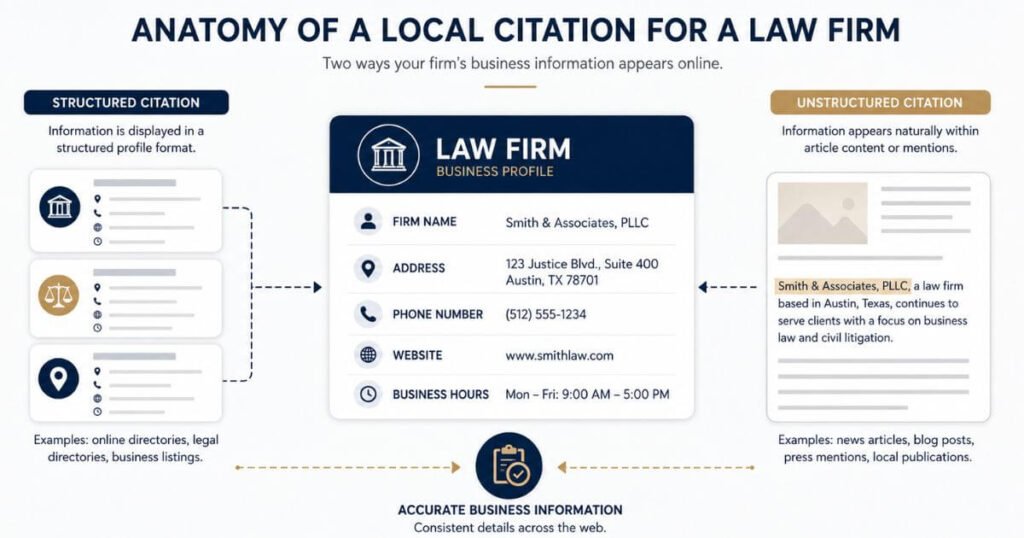
What information makes up a citation?
Local citations are one part of a firm’s broader online presence. Accurate listings can help potential clients find the firm’s correct contact and location information. Keeping a firm’s name, address, and phone number accurate across relevant directories helps maintain consistent public facing business information. Search platforms can use information from multiple sources when compiling business information. Google, for example, says Business Profile information can come from the business itself, public web sources, third party data, user contributions, and Google’s own interactions with a place.
Consistent firm information across web sources may help search engines recognize your business and contribute to prominence in local search results. However, Google’s official local ranking factors are relevance, distance, and prominence, not citation matching specifically. Geographic relevance grows stronger when your address appears the same way on every site. Google uses information from multiple web sources when building Business Profiles. Accurate information helps search engines. Search engines confirm your firm details. This may help you appear higher in local search results. But consistency alone is not an official ranking factor. Google has not confirmed this as a ranking signal.
Why accurate citations matter for local visibility
A citation holds your firm’s core details in one place. That includes your firm name, address, and phone number, often called NAP. Some listings add your website URL and hours, forming a full business listing. A directory profile works differently than a backlink, so don’t confuse the two.
Structured citations live inside formatted directory fields, like Google or Avvo. Unstructured citations show up in blog posts or news articles mentioning your firm by name. Both types feed your contact details into the wider web. Each one adds another data point search engines use to confirm you’re real.
Which Citation Sources Should Law Firms Prioritize?
Not every directory deserves the same attention. Google Business Profile anchors your search and map presence and comes first for every firm. Legal specific sites like Justia, Avvo, and FindLaw support legal discovery for people searching by practice area. State bar directories confirm professional information through an official source.
Google explains that local business information can come from the business itself, publicly available information, and other sources across the web. Its official guidance on how Google sources and manages business information provides useful context for understanding why accurate business information matters across the web.
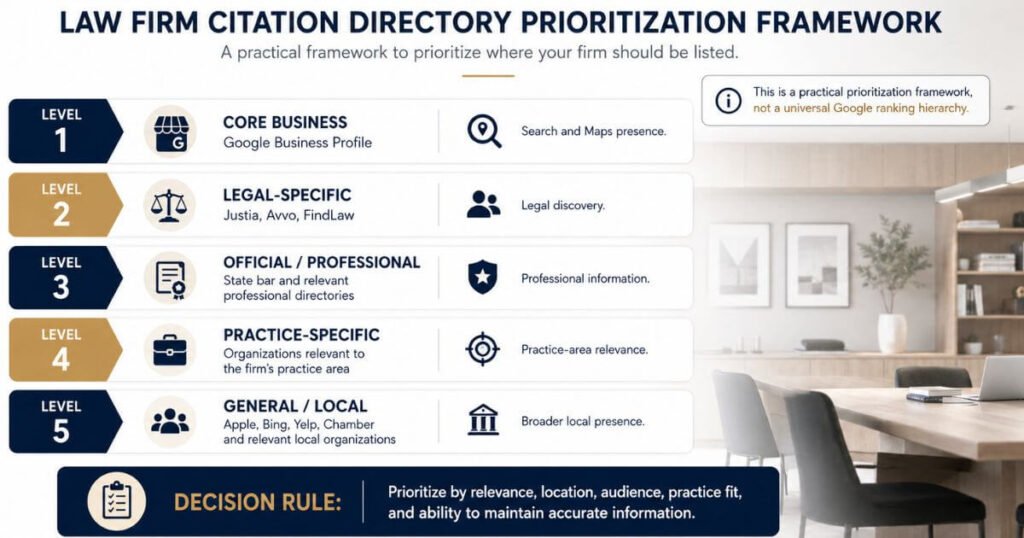
| Citation Type | Examples | Priority | Main Purpose |
| Core business | Google Business Profile | Essential | Search and Maps presence |
| Legal specific | Justia, Avvo, FindLaw | High | Legal discovery |
| Official/legal | State bar directories | High | Professional information |
| Practice specific | AILA, NACDL, AAJ | Relevant | Practice area relevance |
| General/local | Apple, Bing, Yelp, Chamber | Relevant | Broader local presence |
We have seen firms treat this list as a fixed ranking, and that’s not how it works. Practice specific citation value shifts based on your practice area and client base. A family lawyer gains more from AAJ than a criminal defense firm would. Broader local presence through Yelp or your local Chamber still helps, just less than the sources above it.
Which Legal Directories Matter Most for Attorneys?
Justia, Avvo, and FindLaw
Justia
A legal discovery platform many firms overlook.
- Free attorney profile with case summaries and blog syndication
- Strong for online visibility in organic legal searches
- No paid tier required to appear
Avvo
Built around client discovery and lawyer ratings.
- Client reviews sit front and center on every firm profile
- Paid features exist, but a complete free profile still works
- Rating system adds trust signals for new visitors
FindLaw
One of the oldest names in legal directory listing.
- Wide reach across search results for practice area terms
- Profile completeness directly affects how often you show up
- Works best paired with an active Find Law hosted website
A law firm with outdated suite information on one major directory may miss referral calls if prospects can’t locate the correct office. A complete profile on any platform (with full business name, address, phone, hours, and description) generally performs better than a partial profile on a more prestigious platform.
Martindale Hubbell, Lawyers.com, Nolo, and HG.org
| Directory | Best For | What To Complete |
| Martindale Hubbell | Peer reviewed legal relevance | Ratings, bio, practice areas |
| Lawyers.com | General client discovery | Contact info, service list |
| Nolo | Legal education traffic | Bio and linked articles |
| HG.org | International and niche searches | Firm summary, jurisdiction |
Each one adds attorney information to a different corner of the web. Professional visibility grows fastest when a legal specific platform profile matches your main website exactly.
State and local bar directories
Checklist for these listings:
- State bar listing claimed and verified
- County bar association profile checked
- City bar association membership confirmed where available
- Local legal organization listing added if relevant
Each of these adds a professional listing tied to your specific community. Rules and jurisdiction specific rules vary a lot here. Always confirm availability with your own state bar before assuming a listing applies to you.
Which Directories Matter for Specific Practice Areas?
Immigration, criminal defense, and family law
A practice specific organization often carries more weight than a general legal directory. Someone searching for immigration help trusts a specialized source over a broad one.
| Practice Area | Organization | Why It Matters |
| Immigration | AILA | Members are vetted immigration attorneys |
| Criminal defense | NACDL | Recognized authority in criminal law circles |
| Family law | AAML | Signals advanced family law credentials |
Practice relevance beats directory size in these cases. For immigration law practices, an AILA listing reaches practitioners and professionals familiar with specialized immigration work. This targeted relevance typically matters more than appearing in general business directories that don’t serve immigration focused searches.
Personal injury and other specialized practices
The same rule applies outside these three practice areas. A specialized practice area benefits most from a directory built around it, not a generic one.
Checklist before adding a specialty listing:
- Confirm the organization is active and verifiable
- Check that the member list function actually works
- Verify the directory matches your exact practice area
- Skip directories with no clear membership standards
Directory volume means nothing if the sources aren’t relevant. A verified organization listing in your specific field does more work than dozens of unrelated ones.
Do General Business Directories Still Matter?
Google, Apple, Bing, and Yelp
Yes, general platforms still matter, even with legal specific directories in place. These sites handle a different job than Avvo or Justia.
| Platform | Main Role | Why It Helps |
| Search and Maps visibility | Most clients start their search here | |
| Apple | Business discovery on iPhone Maps | Growing share of mobile searches |
| Bing | Secondary search visibility | Still used by a meaningful client segment |
| Yelp | Client reviews and access | Builds trust outside legal specific sites |
Accurate firm information across these platforms keeps your client access wide. A gap on any one of these sends potential clients somewhere else. Business discovery doesn’t stop at legal directories, so treat these as equally important.
Local chambers and community directories
Smaller directories earn their place through local relevance, not size.
Checklist for community listings:
- Confirm your local Chamber of Commerce membership is active
- Check listings on any local business association site
- Verify your firm appears correctly on city or county directories
- Review relevant professional organizations tied to your area
- Skip community organization listings with little to no traffic
We’ve seen a single Chamber listing bring in referral traffic a bigger directory never touched. A small community organization page still counts, as long as real people actually visit it.
How Should Law Firms Choose Which Directories Matter?
A simple five point framework cuts through directory overload fast. Instead of chasing every listing available, check each one against these questions first.
Check relevance, location, and practice fit
Ask these three questions before adding any directory:
- Is it relevant to legal services specifically?
- Is it relevant to the firm’s location?
- Is it relevant to the firm’s practice area?
Directory relevance starts here, not with how popular a site looks. A directory built for restaurants adds nothing to legal service relevance, no matter how much traffic it gets. Firm location and practice area fit narrow the list fast once you’re honest about them.
Check audience, credibility, and maintenance
Two more questions round out the framework:
- Are potential clients or relevant professionals likely to use it?
- Can the firm keep the listing accurate and updated?
Potential client audience matters more than raw traffic numbers on a directory’s homepage. Directory credibility shows up in who actually uses the site, not how it markets itself. Listing maintenance takes real time, so a directory nobody can keep updated becomes a liability. This beats chasing an arbitrary citation count every time.
How Can Law Firms Avoid Citation Problems?
Most citation problems come from old information sitting untouched for years. Catching these early saves a firm from confusing search engines and potential clients alike. A useful way to evaluate citations is to look carefully. Look beyond how many directories list you.
Consider other factors. Is the source relevant? Is the audience right? Is the source credible? Is it well maintained? Does the location match? These factors matter when you build a law firm search strategy. Citations and other online mentions form part of your overall search presence.
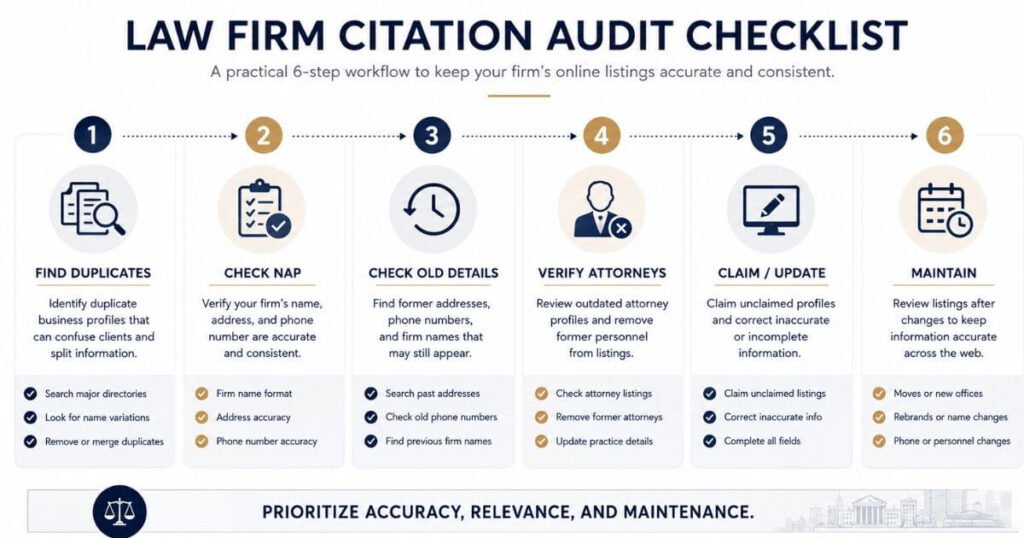
Check existing listings first
- Before you add anything new, audit what already exists. Look at what is already out there
- Search for duplicate profiles on the same directory
- Check for an old address still showing on any listing
- Look for a former firm name still attached to your NAP
- Confirm no incorrect phone number appears anywhere
- Find and claim any unclaimed listing under your firm’s name
- Flag outdated attorney profiles that need updating
- Remove or update listings tied to a former attorney no longer with the firm
Keep firm information consistent and current
Certain events always call for a citation update. Build a habit around checking listings after any of these:
- Office relocation
- Phone number change
- Firm rebranding
- Firm name change
- New office opening
- Office closure
- Attorney change
Listing accuracy slips fastest right after a move or a rebrand, when everyone’s focused elsewhere. NAP consistency across every directory protects the ranking progress a firm already earned. Listing maintenance works best as a routine check, not a one time fix after something breaks.
Do Law Firms Need Hundreds of Citations?
No, there is no universal number of citations every law firm needs. A firm doesn’t need to submit to every available directory that exists.
- Relevant listings beat a long list of random ones
- Accurate, up to date listings help search engines and potential clients find the right contact information.
- Useful listings actually bring in client calls, not just backlinks
Why citation quality matters more than volume
Citation quality should guide the decision, not a target number pulled from a blog post. Chasing an arbitrary citation number, like fifty or a hundred, wastes time on sources nobody checks. Citation building works best when it supports the firm’s actual market and practice area.
A relevant listing on a legal specific directory is typically more valuable than an unrelated general business listing. It reaches clients searching for legal services specifically. However, the volume and traffic of the general directories also matter; a single listing on a low traffic site may not outperform listings on multiple high traffic general platforms. Market relevance decides the outcome here, not raw citation volume. An accurate listing on a site real clients actually use will always do more work than volume alone.
Frequently Asked Questions
What are the best citation directories for law firms?
Start with Google Business Profile, then add state bar and legal specific directories like Justia or Avvo. Practice specific sources come next, based on your practice area. Local and general directories round out the list last.
Is Google Business Profile a local citation?
Google Business Profile is a core citation and your most important one. It differs slightly from traditional third party citation directories. Both types confirm your firm’s NAP to search engines.
Do law firms need legal specific directories?
Yes, legal specific directories give clients trusted attorney information in one place. They support client discovery better than general business sites alone. Completing these profiles adds real search value.
How many citations does a law firm need?
There’s no universal number every firm should hit. A handful of accurate, relevant listings beats dozens of random ones. Focus on relevance over directory volume.
What matters more: citation quality or quantity?
A smaller number of relevant, accurate citations on directories where your target clients are. Search typically provides better results than many citations on unrelated platforms. However, the number of citations still matters; both quality and volume contribute to discoverability.
Getting Your Citations Right Way
Consider conducting a citation audit quarterly, especially after any firm changes (address, phone, name, or personnel). Many firms benefit from professional help with this process. If you also want professional help contact Faheem Bhatti SEO is worth a conversation.
