
A one-star Google review lands, and the instinct is to fight back. Law firms face a problem ordinary businesses don’t: attorney ethics rules limit what a firm can say in public. Model Rule 1.6 of the ABA Model Rules of Professional Conduct restricts lawyers from disclosing information related to a client’s representation, even to defend the firm’s reputation. That duty doesn’t end just because a client posted a bad review.
The American Bar Association issued Formal Opinion 496. This came from the Standing Committee on Ethics and Professional Responsibility. The opinion addresses a key issue. How should lawyers respond to negative reviews online? They must protect client privacy. This article explains the rules. It tells you what lawyers can say. It tells you what to avoid. It shows how to build a response policy that follows the rules.
Why Standard Reputation Management Does Not Work for Law Firms
A restaurant can post a public reply and clear the air fast. A law firm carries attorney-client confidentiality duties an ordinary business never faces. Model Rule 1.6 stops lawyers from sharing information. The information is about the case. Do not share it. There are two exceptions. The client can permit sharing. Or a valid exception may allow sharing. That rule guards confidential information and representation details most people overlook.
Most firms confirm a client relationship and trigger new confidentiality obligations. Posting case facts in a public forum can expose protected information fast. This ethical limitation is why generic reputation advice fails law firms. Real professional duties go beyond obvious client secrets, covering reputation management tactics too.
What ABA Formal Opinion 496 Actually Says About Reviews
ABA Formal Opinion 496 sets the confidentiality limits on lawyer responses to negative reviews. It confirms Model Rule 1.6 blocks lawyers from disclosing client information even after a public attack.The opinion recommends a restrained response that does not disclose information relating to the representation. It does not override state bar rules, which can differ.
Why a negative review is not self defense
A negative review does not trigger the self-defense exception under Rule 1.6. ABA Formal Opinion 496 confirms that a review alone does not constitute a ‘controversy’. An applicable Rule 1.6 exception may permit limited disclosure when its specific requirements are met.
A negative online review, by itself, does not create the type of controversy that permits disclosure under Rule 1.6(b)(5). Model Rule 1.6 imposes a confidentiality duty that persists regardless of reputational concerns.
What the ABA recommends
The ABA recommends caution before any public response. First, ask whether responding is actually necessary. Avoid revealing information relating to the representation. Keep any reply restrained and short.
Consider private communication instead of a public reply. A firm can invite the reviewer to talk by phone or email. The situation may be unclear. Contact bar counsel. They can give guidance. Move the discussion offline. This reduces the risk. You will not share sensitive information in public.
How State Bar Rules May Differ
State ethics bodies do not all agree with the ABA’s cautious stance. North Carolina’s 2020 FEO 1 allows a proportional, restrained public response. Los Angeles County Bar Opinion 525 and the San Francisco Bar’s 2014-1 opinion take a similar view.
Some states have no formal guidance on this topic. Pennsylvania has no published opinion. Texas has no published opinion. New York has no published opinion. Do you work in these states? Consult your state bar. Talk to disciplinary counsel. Get guidance before you respond to online reviews.
Decision Framework: Before Responding to a Negative Review
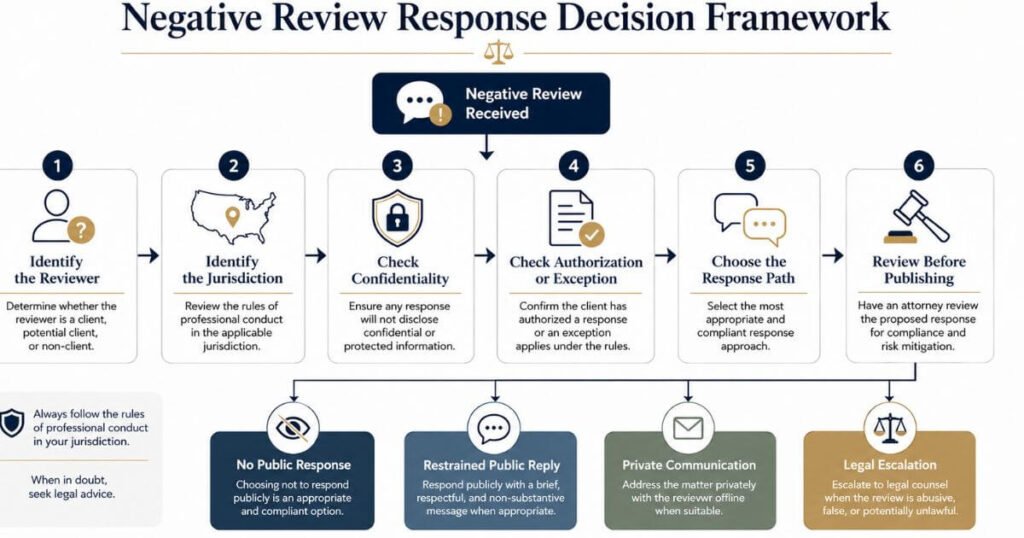
Follow these steps before you write a public response.
Step 1: Identify the Reviewer
Who wrote the review? Is this a current client? A former client? A prospective client? Someone else?
Step 2: Identify the Jurisdiction
Which state bar rules and professional conduct standards apply?
Step 3. Check confidentiality
Would your response reveal information relating to the representation?
Step 4. Check authorization and exception
Do you have written permission from the client? Does Rule 1.6 have an exception that applies? Is this a fee dispute? Is this a malpractice claim? Is this a disciplinary proceeding?
Step 5. Choose the response path
No response / Restrained public acknowledgment / Private communication / Legal escalation
Step 6. Review before publishing
Have a qualified attorney review any response beyond a generic acknowledgment before it goes live.
Does The Review Come From A Client or Non-Client?
The reviewer’s relationship to the firm changes what a lawyer can safely say. Current client information is protected under Model Rule 1.6; former clients under Rule 1.9(c). Non-client reviewers don’t trigger the same protections, but you still cannot disclose any client information. Informed, written consent may authorize specific disclosures only; one consent doesn’t permit all disclosures.
Why the reviewer’s relationship matters
A current client’s review demands the most caution. The representation is still active, and disclosure risk is high. A former client still holds confidentiality rights under Rule 1.6. Those rights don’t expire just because the case closed.
A non-client reviewer does not automatically trigger the same confidentiality protections. However, the response still cannot disclose confidential information about any other client or former client. A firm cannot confirm or deny the existence of any unrelated representation. The safest move is to keep every public reply general and avoid confirming any client relationships.
When informed, written client approval helps
Informed consent from a client can widen what a lawyer may say publicly. The client must understand exactly what will be shared. Written consent can document the scope of the client’s authorization.
Consent doesn’t grant unlimited permission to disclose everything. A lawyer still owes duties to former clients and to the court. State specific requirements may add extra steps before publishing anything. Always confirm the scope of consent before writing a single word.
How To Write A Public Response Without Violating Ethics
A safe response acknowledges the review. Do not confirm details. Use neutral words. Do not reveal the reviewer’s identity. Move detailed discussion to private channels. This protects confidentiality. Every word in a public reply should assume anyone could read it.
Acknowledge without confirming the relationship
- Neutral wording keeps a firm out of trouble.
- A response can say: “We take all feedback seriously.”
- That sentence doesn’t confirm or deny anyone was a client.
- It also avoids discussing the underlying case at all.
- Never state whether the reviewer worked with the firm.
- Confirming or denying client status can itself leak information.
- Stick to short, general statements about professionalism.
- Discussing specific facts belongs nowhere in a public reply.
Move the conversation offline
- Invite the reviewer to call or email the firm directly.
- This keeps sensitive details away from public view.
- Don’t ask the reviewer to post more information publicly.
- That request often makes the situation worse.
- Keep the public message brief and professional.
- Avoid arguing about facts in the comment section.
- Never promise a specific outcome or resolution.
- Confidentiality duties apply whether the talk happens online or offline.
Response examples based on ethics guidance
These are examples only. They are not official scripts. Change the words to match your firm’s style.
- Neutral acknowledgment: “Thank you for sharing your experience.”
- Private contact: Please reach out directly so we can address your concerns.
- No public details response: Professional rules limit what we can discuss here.
- These are illustrations, not officially approved scripts.
- Adapt the wording to match your firm’s voice.
- Every version avoids case facts and confirms nothing.
- Consistency across platforms builds a defensible response pattern.
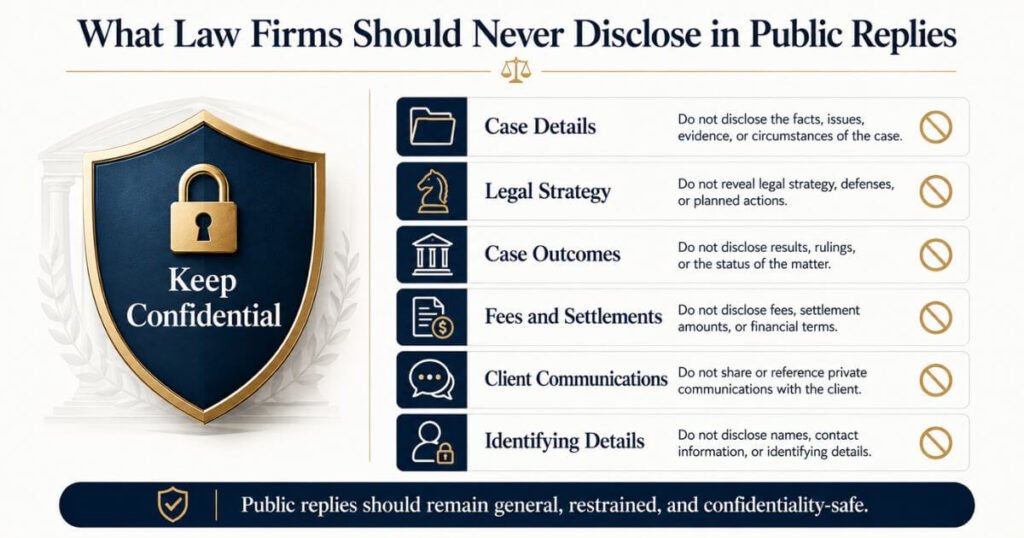
What Information Should Never Appear In Public Responses
Confidential client details never belong in a public review reply. Potentially confidential information can include case facts, strategy, outcomes, fees, personal details, and communications relating to the representation. Disclosing confidential client information may create professional discipline risk under Model Rule 1.6. The scope of that risk depends on what information is disclosed and which jurisdiction’s rules apply
Case details, outcomes, and fee disputes
Avoid mentioning legal strategy or how a case was handled. Avoid discussing case outcomes, wins, or losses. Settlement information may constitute information relating to the representation and should not be disclosed publicly unless disclosure is authorized or otherwise permitted.
Client communications and client conduct also stay confidential. So does anything that could identify the client indirectly. A name isn’t required to reveal someone’s identity. Location, case type, and timing can do that too.
When Is It Better Not To Respond To Reviews?
Silence is often the safest and smartest response to a bad review. Not every review needs a public reply. Responding can sometimes reveal protected information by accident. A firm should weigh the ethical risk against any reputational benefit.
Why a confrontational reply often backfires
Arguing with a reviewer usually makes things worse. It draws more attention to the original complaint. More comments and shares often follow a defensive reply. This pattern is sometimes called the Streisand effect.
The Streisand effect happens when a reaction spreads content further than staying quiet would. A calm non-response avoids that outcome. An emotional reply risks saying something the firm regrets. Silence protects both the client and the firm’s reputation.
What Can Happen When Law Firms Respond Incorrectly
Suing or overreacting to a bad review has cost real law firms real money. Courts have dismissed several attorney defamation claims against reviewers. Some firms ended up paying the reviewer’s legal fees instead. These cases show why restraint matters more than retaliation.
The defamation lawsuit that backfired: Lento v. Estrada (July 2026)
A suspended Pennsylvania attorney’s firm, Lento Law Group, sued a former client over negative online reviews. The former client, Kris Estrada, fought back in Philadelphia federal court. On July 21, 2026, the federal court dismissed all claims, finding that the reviews were protected opinions or truthful statements under the First Amendment. Most importantly for other firms: the court awarded attorney fees, costs, and litigation expenses to Estrada, the defendant, rather than to the firm. Estrada’s attorneys had
sought more than $108,000 to cover their defense costs. The court ordered the firm to pay these fees, with the exact amount to be determined after further documentation of legal expenses. In this case, the court held that Estrada was entitled to attorneys’ fees, court costs, and litigation expenses under Pennsylvania’s anti-SLAPP law. [Source: Lento Law Group PC v. Estrada, No. 2:25-cv-02763 (E.D. Pa., July 21, 2026)]
Why suing over a review rarely works out
Litigation over reviews gets expensive fast. Defamation standards vary by state and are hard to meet. A negative opinion is not automatically defamatory. Courts protect honest opinions under free speech principles.
Some jurisdictions have anti-SLAPP statutes that can create procedural mechanisms and fee related risks for certain defamation claims involving protected speech. These statutes vary significantly by jurisdiction. A losing firm may be ordered to pay the defendant’s attorney fees in qualifying cases.
What Legal Options Exist For Fake Or Defamatory Reviews?
Fake and defamatory reviews are different problems with different remedies. A negative review reflects a real but unhappy opinion. A fake review comes from someone with no real experience with the firm. A defamatory review contains false statements of fact, not opinion.
How platform removal works
Start by checking the platform’s specific review policy. Google and Yelp both prohibit fake or policy violating content. Preserve screenshots and evidence before reporting anything. Submit the report through the platform’s official process.
Removal is never guaranteed, even for clear violations. Platform policies vary. Google and Yelp provide mechanisms for reporting policy violations and responding to court orders. Check each platform’s current policy for specific procedures and expected timelines.
Where federal law fits
The Consumer Review Fairness Act of 2016 protects honest reviewers from being silenced. It voids contract clauses that punish customers for leaving reviews. The FTC enforces this law against businesses that try to suppress feedback. It does not force platforms to remove reviews a business dislikes.
This law protects reviewers, not the businesses being reviewed. It doesn’t create a removal process for law firms. Firms should not assume federal law will erase a bad review. Platform policies and state defamation law remain the real tools here.
CRFA vs. FTC Consumer Reviews and Testimonials Rule
The Consumer Review Fairness Act of 2016 voids contract clauses that penalize customers for leaving reviews or restrict review content. The FTC’s Consumer Reviews and Testimonials Rule (effective October 21, 2024) addresses deceptive and unfair conduct involving consumer reviews, including fake reviews, review suppression, and undisclosed incentives.
These are distinct regulatory frameworks. The CRFA focuses on contractual restrictions; the FTC Rule addresses conduct and disclosure standards.
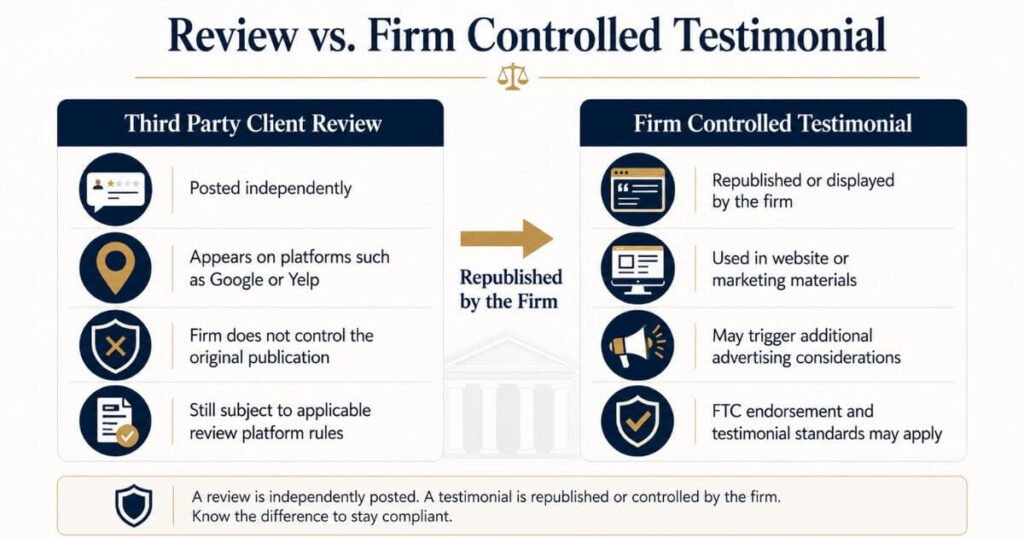
When Reviews Become Testimonials
A consumer review published on a platform (Google, Yelp) is distinct from a testimonial. If a law firm republishes a customer review in its own marketing materials or website, that republication may constitute a testimonial subject to additional FTC scrutiny.
Republished reviews require disclosure of any material connection between the reviewer and the firm and must comply with FTC testimonial and endorsement standards.
How Law Firms Should Build A Review Response Policy
A written review response policy prevents rushed, risky replies. The process should follow one path every time. Monitor reviews, classify the reviewer, then check confidentiality and jurisdiction. Draft, review, approve, and only then respond or decline.
Assign clear roles for each step. One person monitors new reviews daily or weekly. Another drafts any proposed response using approved language. An attorney reviews every draft before it goes live, and serious allegations get escalated immediately. Document every decision, including the choice not to respond. This review process can also form part of a broader law firm SEO strategy focused on reputation, local visibility, and accurate business information.
Frequently Asked Questions
Can a lawyer legally respond to a negative review?
A lawyer can respond to a negative review in most cases. Model Rule 1.6 limits what information the response can include. The reply must avoid confidential client details. State rules may allow more or less room than the ABA’s guidance.
Is defending yourself against a bad review an ethics violation?
Defending your reputation is not automatically an ethics violation. The problem starts when the response discloses protected information. ABA Formal Opinion 496 treats the disclosure, not the defense, as the issue. State-specific rules can shift this analysis slightly.
How quickly should a law firm respond to negative reviews?
There is no fixed ethics deadline for responding to a review. Speed matters less than accuracy and confidentiality. A rushed emotional reply creates more risk than a short delay. Taking time to review the situation is often the smarter move.
What is the best response to negative feedback?
The best response depends on who posted it and what it says. A short, neutral reply often works better than a detailed defense. Check whether the reviewer was ever a client first. Sometimes no public response is the safest option.
How do you respond to an unfair negative review?
Unfair reviews still don’t justify revealing confidential information. Separate unfair opinions from factually false or fake claims. Private contact often resolves misunderstandings better than a public argument. Platform reporting and legal review remain options for false statements.
Can a law firm get a fake review removed?
A fake review can sometimes be removed if it breaks platform rules. Document the evidence and use the platform’s official reporting process. Not every negative review qualifies as fake. Removal is possible, but it’s never guaranteed.
Protect Your Firm’s Reputation The Right Way
Confidentiality, not confrontation, protects both the client and the firm long term. Building a strong, ethical online presence takes that same care. Faheem Bhatti SEO helps law firms approach search visibility with that mindset.
