

Law firms ask clients for reviews. But this is not like other businesses. Lawyers have special rules. These rules cover ads, confidentiality, and consumer protection. The rules vary by jurisdiction.
A practice permitted in one state may require different treatment in another. Google also applies its own review policies separately from professional conduct and federal consumer protection requirements. This guide explains how those layers fit together and provides a practical review process for law firms.
The Three Rule Layers That Affect Law Firm Reviews
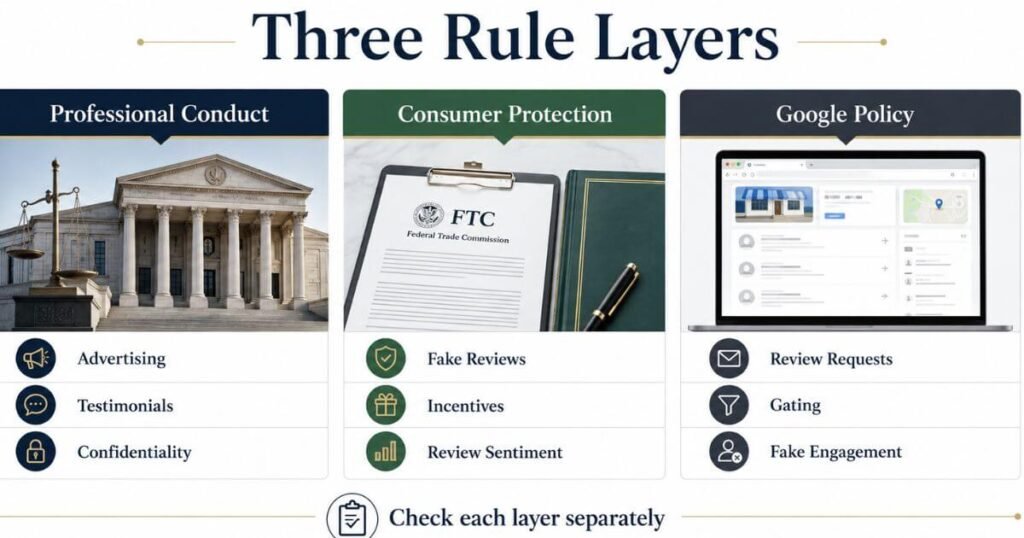
Three separate systems govern law firm reviews at once: state professional conduct rules, the FTC’s Consumer Review Rule, and Google’s platform policy. Following one does not satisfy the other two.
| Rule layer | Primary authority | What it governs | Applies to |
| Professional conduct | State bar (e.g., Florida Bar, New York courts, State Bar of California) | Advertising, testimonials, confidentiality | Lawyers and law firms only |
| Consumer protection | FTC, 16 C.F.R. Part 465 | Fake reviews, incentives tied to sentiment | Any business, including law firms |
| Platform policy | Google’s Prohibited and Restricted Content policy (Fake Engagement) | Requesting, gating, and displaying reviews | Any Google Business Profile |
- LEGAL REQUIREMENT describes what a bar rule or the FTC rule actually requires. PLATFORM POLICY describes what Google permits or removes.
- RECOMMENDED PRACTICE describes risk management advice beyond either one.
A firm that satisfies its bar rules can still violate Google’s policy on incentives. A firm that avoids incentives entirely can still miss a bar rule on testimonial disclaimers. Check every layer separately.
Review vs. Testimonial: Why the Distinction Matters
A client review and a firm testimonial are different types of content. Different advertising rules apply to each one. A review lives on a third-party website. The client writes it. The client controls what it says. A testimonial appears in the firm’s marketing. The firm picks it. The firm may change the words.
Ask two questions before treating any client statement as either one. Is the client speaking independently on a platform the firm doesn’t control? That’s a review; Google’s policy governs how the firm can ask for it. Is the firm selecting, editing, or republishing that statement in its own marketing? That’s now a testimonial, and state advertising rules apply in addition.
| Third party review | Firm controlled testimonial | |
| Who controls the wording | Client | Firm |
| Where it appears | Review platform (e.g., Google) | Firm’s website or ads |
| Governing layer | Google policy, confidentiality | State advertising/testimonial rules |
| Main risk | Gating, incentives, public response | Editing, selection, missing disclaimers |
Reusing a review as a testimonial
A firm that copies a client’s five star Google review onto its homepage has converted a review into a testimonial. LEGAL REQUIREMENT: at that point, the firm’s state testimonial rule applies to the reused text. Qualification of the reviewer, accuracy, and any required disclaimer, even though the words originated on Google. Get the client’s consent before republishing their review elsewhere.
How to Request Client Reviews
A sound review-request process should be voluntary, neutral, and consistent. The firm should ask the right clients for honest feedback. Do not push them toward a certain rating. Do not tell them what to write. Do not suggest an outcome.
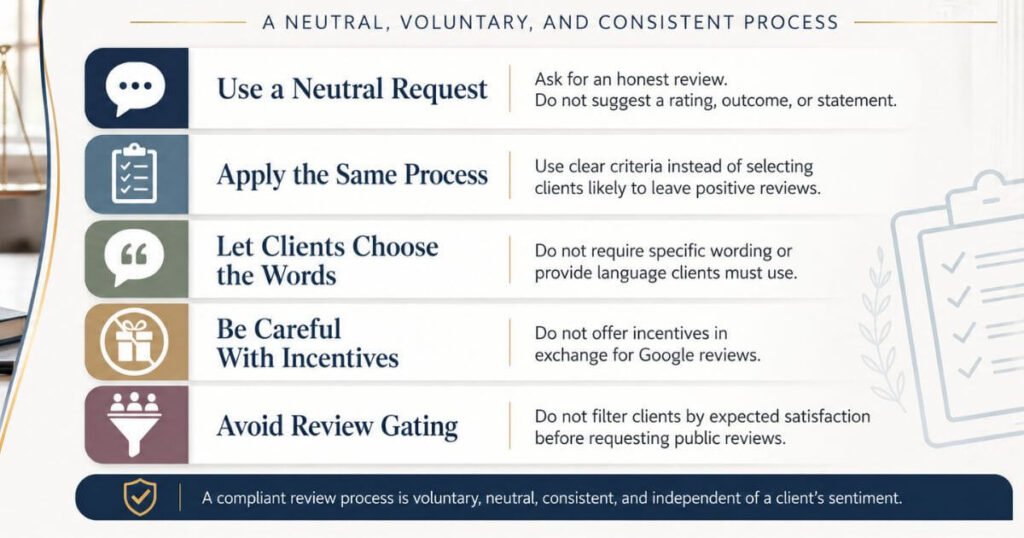
For Google reviews, follow these rules. Do not use prohibited incentives. Do not discourage negative feedback. Do not ask only positive clients for reviews. Do not ask for specific content. A documented process helps prevent individual staff members from creating different standards for different clients.
Use a Neutral Request
Ask clients for an honest review based on their experience. Do not suggest a particular rating, outcome, or statement.
Apply the Same Basic Process
Establish clear criteria for when appropriate clients receive review requests. Avoid selecting clients simply because they appear likely to leave positive feedback.
Do Not Require Specific Wording
Clients should decide what to say and how to describe their experience. The firm should not provide language that clients must use in a review.
Be Careful With Incentives
Google prohibits incentives for posting, changing, or removing reviews. The FTC rule separately prohibits incentives conditioned on particular review sentiment, such as requiring a positive review. For Google reviews, the practical approach is not to offer an incentive in exchange for a review.
Avoid Review Gating
Review gating involves filtering clients according to expected satisfaction and directing only expected positive reviewers toward a public review platform. Google prohibits discouraging negative reviews and selectively soliciting positive reviews.
How Bar, FTC, and Google Review Rules Differ
These three systems are not interchangeable, and following one does not guarantee compliance with the others. Professional conduct rules apply specifically to lawyers and law firms, covering advertising and client communication.
Consumer protection rules, including the FTC’s Consumer Review Rule, apply broadly to businesses and marketers regardless of profession. Google’s policies apply to activity on its own platform, covering how reviews are requested and displayed. See the FTC’s Consumer Reviews and Endorsements Rule and Google’s Prohibited and Restricted Content policy for the current requirements governing reviews and testimonials.
| Authority layer | Primary concern | Applies to |
| Professional conduct rules | Attorney conduct and advertising | Lawyers and law firms |
| Consumer protection rules | Deceptive or misleading practices | Businesses and marketers |
| Google policies | Review activity on the platform | Google Business Profiles |
A firm that follows bar rules alone can still violate Google’s policy on incentives. A firm that avoids incentives can still violate a bar rule on testimonial disclaimers. Check all three layers separately rather than assuming one covers the rest.
How Staff and Attorneys Should Handle Reviews
Many people can help with reviews. This includes attorneys, paralegals, intake staff, marketing staff, and outside providers. The firm should set clear rules. Define who can request reviews. Define who watches them. Define who writes responses. Define who approves difficult responses. Define who reports problems.
The goal is consistency. Everything should work the same way. Staff should not have to make ad hoc decisions when a review identifies a client, legal matter, sensitive fact, active representation, or potential advertising issue. This broader approach can be explored further through our guide to content marketing services, which covers how consistent content can support a firm’s online visibility and reputation.
Build the Firm’s Review Workflow
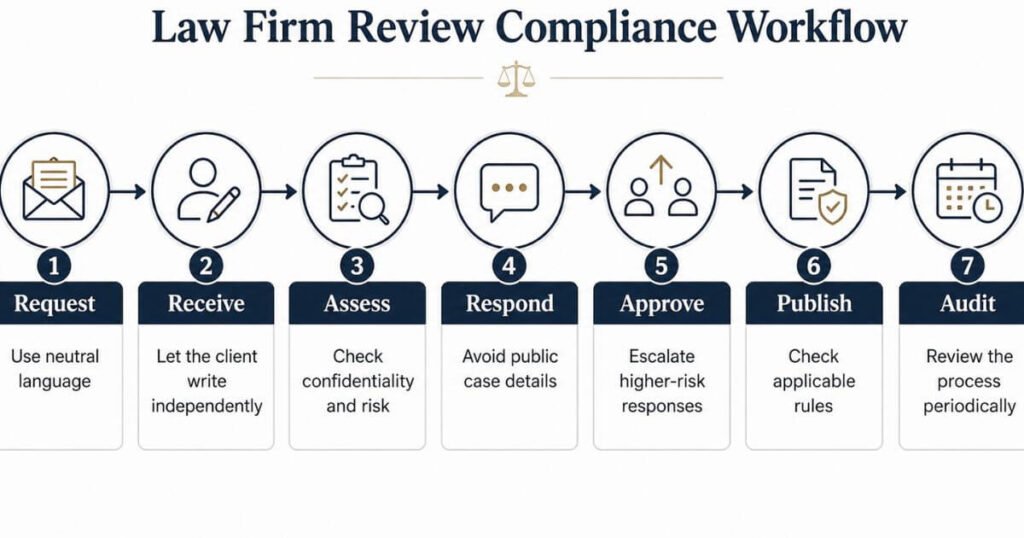
A documented workflow gives the firm a consistent process from the initial request through periodic review. It should identify responsibilities, approval points, and situations requiring escalation.
The core workflow is:
Request → Receive → Assess → Respond → Approve → Publish → Audit
Step 1: Establish the Request Process
Define when an appropriate client may receive a request, who sends it, which platform is used, what neutral language is approved, and which practices are prohibited.
Step 2: Keep the Request Independent
Let clients decide whether to participate and what to say. Do not request a particular rating, require specific language, or selectively direct expected positive reviewers to a public platform.
Step 3: Classify Incoming Reviews
Use simple internal categories:
Low risk: General feedback without sensitive information.
Review required: The review mentions a specific matter, legal advice, dispute, or sensitive fact.
Escalation: A review may create a problem. It may raise confidentiality concerns. It may raise advertising concerns. It may raise professional conduct concerns. Report these to leadership.
Step 4: Draft the Response
Write a response when it makes sense. Keep it professional. Do not discuss the case details in public. Offer a private communication channel when appropriate.
Step 5: Approve Higher Risk Responses
Require designated review when a response identifies a client or legal matter, discusses confidential information, concerns an active representation, alleges professional misconduct, or may require a legal or regulatory response.
Step 6: Audit the Process
Review your process often. Check the words used to request reviews. Check who you ask for reviews. Check what you offer clients. Check staff instructions. Check who approves responses. Check how you use testimonials. Check Google’s rules. Check state rules.
Pre-Publish Review Compliance Checklist
Use the checklist as a final go/no-go review rather than repeating the article’s explanations. If a material question cannot be answered, pause publication and escalate it through the firm’s approved process.
Before Requesting a Review
- Applicable jurisdiction identified
- Current professional conduct requirements checked
- Neutral request language approved
- No selective solicitation of positive reviews
- No prohibited Google incentive
- Client remains free to write independently
Before Responding to a Review
- Client or legal matter identified, if applicable
- Confidentiality risk assessed
- Sensitive information excluded
- Higher risk response escalated
- Public discussion limited to appropriate information
Before Publishing a Testimonial
- Statement confirmed as genuine and accurate
- Firm controlled advertising status identified
- Applicable jurisdiction identified
- Testimonial requirements checked
- Required disclaimer or disclosure checked
- Past result claims verified
- Presentation reviewed for misleading implications
Before Republishing a Client Review
- Original statement represented accurately
- Meaning has not been changed
- Firm controlled advertising requirements checked
- Applicable disclosures or disclaimers checked
- Additional context verified
Before Finalizing the Process
- Current Google policies checked
- Current state rules checked
- Review request owner assigned
- Response owner assigned
- Escalation process documented
- Periodic review date established
FAQ
Can a law firm offer a discount for leaving a review?
No. Google’s policy bans any incentive tied to a review, and the FTC’s Consumer Review Rule bans compensation conditioned on review sentiment. Check both professional conduct and consumer protection rules before considering any incentive.
Does every client testimonial need a disclaimer?
No single rule works everywhere. Different states have different rules. New York requires a disclaimer. Use it when a testimonial describes a result or outcome.
Can a lawyer respond to a negative review naming the case?
Naming case details in a public response raises a confidentiality risk. Confirming that someone was a client, or adding facts about the matter, can expose protected information depending on the situation.
What happens if a law firm gets caught reviewing gating?
Google can remove affected reviews and restrict the profile under its Fake Engagement policy. Selective solicitation can also raise consumer protection concerns separate from any platform penalty.
Can paralegals ask clients to leave a Google review?
This depends on the firm’s internal process and supervision, not on the paralegal’s job title alone. The attorney overseeing the process stays responsible for how the request gets made.
CTA
If your firm is building or reviewing its client review process, use the checklist above as a starting point. Then verify the specific requirements that apply to your jurisdiction before publishing anything. Need help reviewing your law firm’s online review strategy? Contact Faheem Bhatti SEO Services to discuss a compliance conscious review and local visibility approach.
