

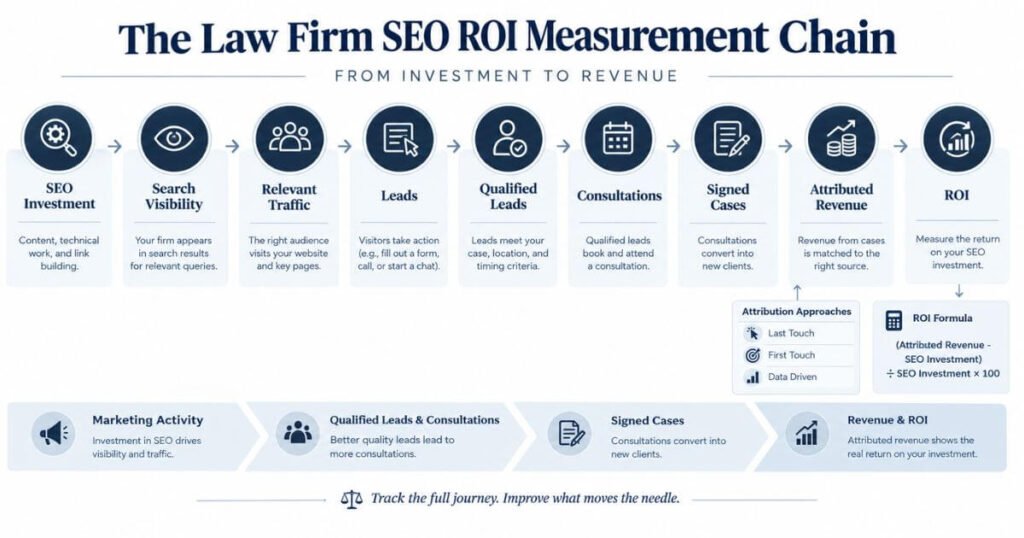
A law firm invests real money into SEO. Rankings improve fast. Traffic grows too. Revenue often takes much longer to show up. The actual measurement chain runs through several stages. It moves from SEO investment to search visibility, then relevant traffic, leads, qualified leads, consultations, signed cases, and finally revenue. It moves from SEO investment to search visibility, then relevant traffic, leads, qualified leads, consultations, signed cases, and finally revenue.
No single ROI number fits every law firm. Practice area, location, competition, website strength, case value, and intake quality all shape the final result. This guide teaches you to measure SEO results beyond rankings. You’ll learn the true journey from investment to signed cases.
What Law Firm SEO ROI Actually Measures
ROI means something different than rankings or traffic alone. It measures actual business return, not just visibility on Google. Several separate things need tracking here. SEO traffic shows visitors. SEO leads show inquiries. Qualified SEO leads show real fit. Consultations show progress. Signed cases show outcomes. Revenue generated and SEO cost complete the full picture.
The basic formula looks like this:
ROI equals revenue attributable to SEO minus SEO investment, divided by SEO investment, times 100.
Understanding revenue attributable to SEO:
This means revenue from signed cases that were tagged in your CRM as originating from organic search, using your firm’s chosen attribution rule. Your attribution rule determines how credit is assigned when a prospect touches multiple channels:
- Last touch: Credit goes to the channel right before contact (usually what CRM systems default to)
- First touch: Credit goes to where the prospect first discovered you (organic search)
- Data driven: Google Analytics assigns credit based on machine learning (requires GA4 + CRM integration)
The attribution model you choose materially affects your calculated ROI. Document your methodology before publishing any ROI figure.
Why SEO ROI Looks Different Across Law Firms
No two firms should expect the same return from SEO. Too many factors shift the outcome.
| Factor | How it can affect SEO ROI |
| Practice area | Case value and search demand differ |
| Geographic market | Competition and search demand vary |
| Website strength | Starting authority affects growth |
| Competition | Competitive SERPs may require more investment |
| Intake process | Good leads can still be lost |
| Case value | Revenue per signed case varies |
| SEO investment | Budget affects scope and execution |
| Starting visibility | A new site has different expectations |
A personal injury firm in a large city faces different math than a small estate planning firm. Both firms need separate expectations built around their own market. That is why law firm SEO in the USA needs to be evaluated against the firm’s practice area, geographic market, competition, and starting visibility rather than against a universal ROI benchmark.
How Long Does Law Firm SEO Take to Produce ROI?
SEO builds in measurable stages, though timing varies by firm.
Measurement milestones (not calendar promises):
- Foundation: Technical setup and tracking complete
- Early visibility: Initial pages indexed and visible
- Lead data available: Enough organic inquiries to measure quality
- Conversion data: Enough consultations to see conversion rates
- Revenue attribution: Sufficient signed cases to calculate ROI
Treat this as a measurement framework, not a fixed schedule. Your timeline may differ based on market, practice area, and starting position.
What Law Firm SEO ROI Benchmarks Really Tell You
Published benchmarks report figures for ROI, break even timing, conversion rates, and cost per lead. Many of those widely repeated figures trace back to just one or two original studies. Secondary sites often repeat those same numbers without checking them again. A reported ROI figure from one study does not guarantee the same result for every firm. That number may reflect one specific practice area, one market, or one particular campaign length.
It may use its own definition of conversion or its own attribution model. Client value and SEO cost can shift the number too. Any figure worth citing should name its source directly, along with the scope it actually covers.
Example: If a benchmark claims ‘average law firm SEO ROI is 300%,’ verify:
- What practice area was studied?
- What geographic markets?
- What measurement period?
- How was ‘signed case’ defined?
- What attribution method was used?
- How many firms were in the sample?
Without these details, the benchmark number is unreliable for your firm’s prediction.
Why SEO Traffic Is Not the Same as ROI
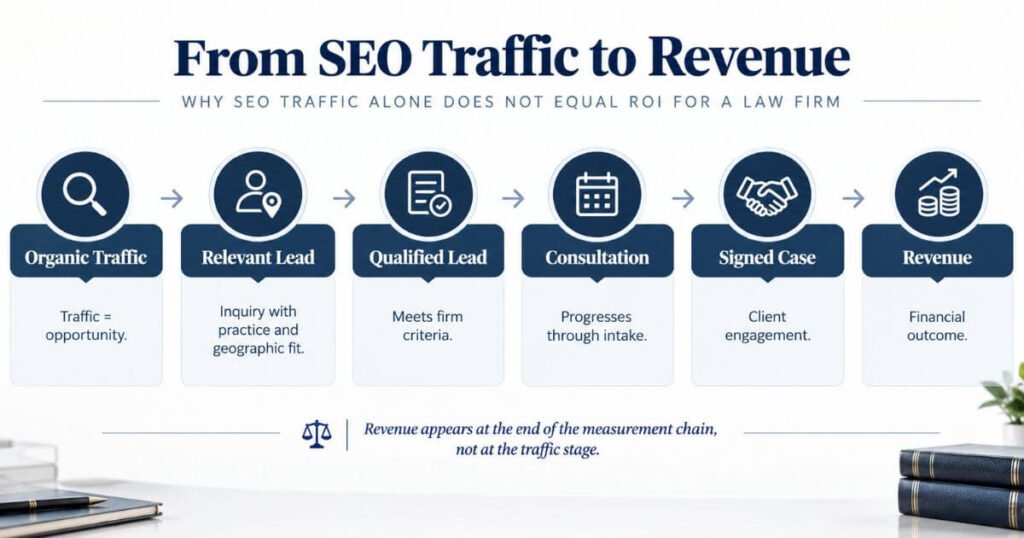
Traffic creates opportunity. It does not create revenue by itself. Organic visitors don’t automatically become clients. A visitor becomes a relevant lead first. That lead becomes an inquiry. Some inquiries become qualified leads. Some qualified leads book a consultation.
Only a portion of those consultations become a signed case. Revenue sits only at the very end of that entire chain, several steps past the original traffic number. Treating traffic itself as revenue skips over every one of those steps.
How to Calculate the Value of SEO Cases
A simple model helps illustrate the concept:
Projected case value calculation:
SEO attributed signed cases × average projected case value = projected revenue
Example (for illustration only, not a benchmark):
- 3 signed cases × $10,000 projected case value = $30,000 projected revenue
- SEO investment during period = $10,000
- Projected ROI = ($30,000 – $10,000) ÷ $10,000 × 100 = 200%
Important: Projected case value differs from:
- Actual fee earned (may be lower)
- Revenue recognized under accounting rules
- Revenue actually collected
Your firm’s actual revenue depends on fee arrangements, payment terms, and case outcomes.
What Can Make Law Firm SEO ROI Look Better
Several factors push ROI in a positive direction over time.
- Target higher intent searches
- Improve practice area relevance
- Focus on the right geographic markets
- Build pages around actual client needs
- Improve conversion paths on the website
- Track phone calls and forms consistently
- Connect marketing data with intake records
- Follow up with leads quickly
- Measure signed cases directly
- Improve targeting around case value
Improving lead quality typically increases ROI more efficiently than increasing traffic volume alone. Better targeting, faster response, and stronger qualification convert more leads to cases.
What Can Make SEO ROI Look Worse
Some patterns quietly damage ROI over time, even when traffic keeps rising.
- Targeting search demand outside the firm’s real focus
- Competing for broad terms with no strategic value
- Generating traffic from outside the service area
- Weak alignment between landing pages and search intent
- Poor or slow intake response
- Missed calls going unanswered
- Weak or inconsistent follow up
- Incomplete attribution across channels
- Measuring leads only, without checking outcomes
- Stopping SEO before collecting sufficient conversion data to measure outcomes reliably
SEO and intake work as connected systems. They remain two separate systems, each with its own weak points.
When Should a Law Firm Expect SEO to Break Even?
Break even depends on several variables working together:
Faster break even when:
- Average case value is high
- Search demand for your practice area is strong
- Intake response is fast and consistent
- Qualified lead rate is high
Slower break even when:
- Average case value is low
- Search demand is limited
- Intake process is slow
- Lead quality varies
Break even time is specific to your firm’s economics, not a universal metric.
How Law Firms Should Report SEO ROI
A useful report connects every stage of this journey into one place. Broader marketing measurement frameworks also emphasize connecting KPIs with business outcomes rather than evaluating individual metrics in isolation.
| Category | Track |
| Visibility | Rankings, impressions |
| Acquisition | Organic traffic |
| Leads | Calls, forms |
| Quality | Qualified leads |
| Intake | Consultations |
| Conversion | Signed cases |
| Economics | Cost per signed case |
| Revenue | Attributed case revenue |
| ROI | Return on SEO investment |
These reporting categories blend marketing metrics and financial outcomes. Legal intake also requires separate tracking for conflict checking and prospective client screening which are not included in this marketing ROI report
FAQs
What is a realistic ROI for law firm SEO?
No universal percentage applies to every firm. Published benchmarks offer reference points, but the real number depends on market, practice area, investment, and attribution.
How long does law firm SEO take to generate ROI?
SEO and paid ads operate on different timelines. Paid ads can generate traffic and leads within weeks; ROI measurement requires longer evaluation. SEO visibility builds more slowly but can compound over time. Your measurement window should match your campaign’s maturity.
Is law firm SEO worth the investment?
The answer depends on the firm’s own economics, not a blanket yes. Search demand, case value, competition, and intake quality all factor into that decision.
How do law firms calculate SEO ROI?
Revenue attributable to SEO gets subtracted from SEO investment. That result gets divided by the investment, then multiplied by 100. Accurate attribution matters more than the formula itself.
The formula is straightforward, but the accuracy depends entirely on:
- How you define ‘signed case’ in your CRM
- Which attribution model you use (last touch, first touch, data driven)
- What you include in ‘SEO investment’ (agency fees, tools, internal time)
- How you measure ‘revenue’ (projected case value, actual fees, collected revenue)
Document these definitions before calculating.
What should law firms track to measure SEO ROI?
Track organic traffic, qualified leads, consultations, and signed cases together. Add cost per signed case, case value, and attributed revenue to complete the picture.
Ready to see what your firm’s SEO investment is really producing?
The most important next step: Define your SEO attribution rule (last touch, first touch, or data driven), connect your CRM to your analytics, and track signed cases back to their source. Once you have 90 days of data under consistent attribution, you’ll have a defensible ROI number for your firm. Visit Faheem Bhatti SEO at faheembhatti.com for a realistic, honest review of your numbers. We’ll help you trace the full path from search visibility to signed cases, not just report on rankings.
