

A law firm sees more leads than ever before. Signed clients never rise at the same pace. Why? Lead volume means nothing by itself. It does not tell you if inquiries matched your practice area. It does not tell you if they matched your location or case type. It does not tell you if you had capacity to take them.
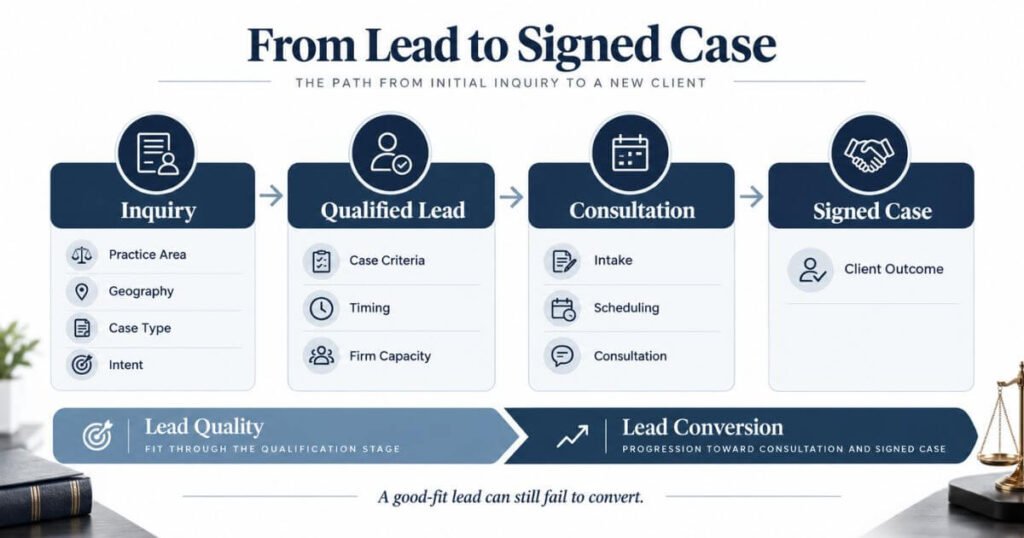
The actual path matters. It starts with search visibility. Then comes a website visit, an inquiry, a qualified lead, a consultation, and finally a signed case. Marketing asks one question: How many leads did we generate? A better question is: How many valuable cases did those leads create? Both volume and quality matter. They answer different questions.
Lead Volume and Lead Quality Measure Different Things
Lead volume counts total inquiries, phone calls, contact forms, and consultation requests by source. It answers a simple question: how many people reached out this month. Lead quality measures something else entirely: whether those inquiries actually fit the firm’s real criteria.
Correct practice area, correct geographic market, and genuine case viability all factor into quality. Client intent, timing, and a realistic ability to hire round out the rest. One firm might see steady volume growth while quality quietly declines behind that number.
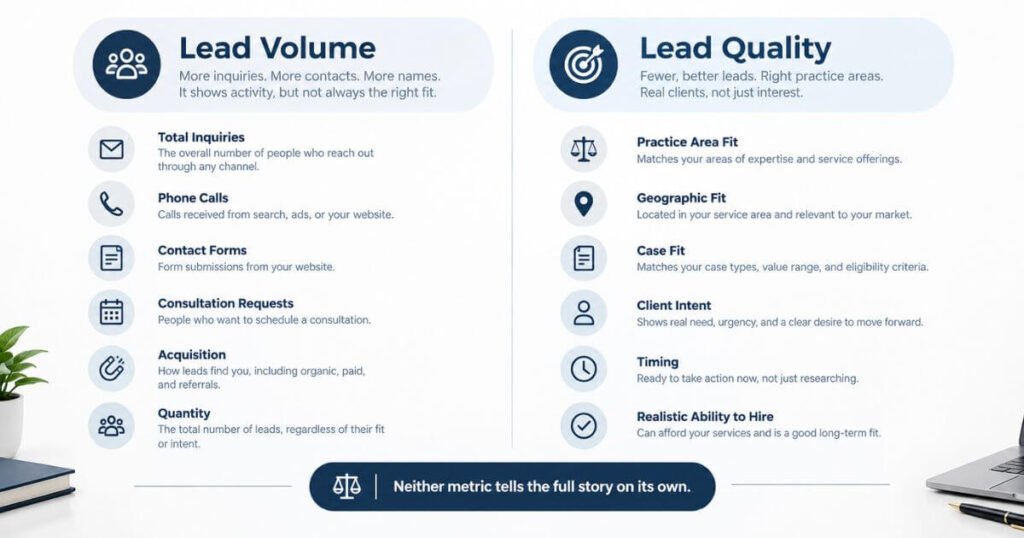
| Metric | Lead Volume | Lead Quality |
| Main question | How many? | How relevant? |
| Focus | Quantity | Fit |
| Useful for | Acquisition | Qualification |
| Limitation | Can hide poor fit | Can hide insufficient volume |
| Business outcome | More opportunities | Better opportunities |
Neither metric tells the full story sitting on its own.
What Makes a Law Firm Lead High Quality?
A high quality lead matches the firm’s own case criteria, not some generic industry definition. Quality is defined by what a specific firm can actually take on and ethically handle.
A lead worth pursuing usually checks these boxes:
- Matches the firm’s actual practice area
- Comes from the firm’s target geography
- Involves a case that fits the firm’s criteria
- Reflects a genuine legal need
- Shows real intent behind the contact
- Carries a realistic timeline
- Could reasonably become a signed client
A lead can check every one of those boxes and still never sign. Lead quality (does it fit?) and lead conversion (does it progress?) are not the same thing. A perfectly relevant inquiry can still fall apart during intake, scheduling, or follow up.
Important: Legal Requirements for Lead Intake
The ABA recommends that law firms conduct conflict checks early in the intake process, before providing legal advice. Prospective client information collected during initial contact, whether by phone or form, can create conflict implications that require professional screening.
A high quality lead must therefore include:
- Prospective client identification
- Matter type and jurisdiction
- Ability to perform conflict check
- Firm capacity to handle matter
These are legal requirements, not just marketing preferences. Lead quality includes whether the firm can ethically and practically take the case.
Source: American Bar Association. How the Legal Client Intake and Conflict Check Process Works.
More Leads Can Hide the Real Growth Problem
A rising lead count looks great on a dashboard sitting in front of a managing partner. That same number can hide a shrinking share of leads that ever become real cases.
The table below is illustrative only, meant to show the relationship, not to state fixed industry figures:
| Scenario | Leads | Signed Cases | Lead to Case Rate |
| Higher volume (illustrative) | 100 | 8 | around 8 percent |
| Lower volume (illustrative) | 40 | 10 | around 25 percent |
The lower volume scenario produced fewer total leads but more actual signed cases. This doesn’t mean every firm should chase fewer leads on purpose. It means lead volume needs checking against downstream outcomes, not celebrated by itself. Rising traffic, rising leads, and a falling cost per lead can look like progress. If signed cases fall at the same time, that pattern deserves real investigation, not applause. This is illustrative only. Your firm’s actual conversion rates depend on practice area, intake capacity, and case fit.
Where Low Quality Leads Enter the Funnel
Poor lead quality rarely starts inside the intake department itself. It often starts much earlier, with the search or targeting that generated the inquiry in the first place. A strong law firm SEO strategy should align search intent, practice area, and geographic relevance before the visitor ever becomes a lead. A broad or ambiguous search intent can pull in people who were never looking for this firm’s actual services. Geographic targeting that’s too wide brings inquiries from outside the firm’s real service area.
A practice area page aimed too broadly attracts people needing a related, but different, legal service. A landing page promising one thing while the firm delivers another creates a mismatch before intake even begins. Third party lead sources, directories, and aggregators operate with different qualification standards than your firm. They add volume, but that volume may not match your specific case criteria. Measure third party lead quality separately from owned channels.
Lead Quality and Lead Conversion Are Not the Same Problem
A good lead can still fail to become a client, and that failure rarely means the lead itself was bad. A bad lead points back to an acquisition problem, meaning the wrong person reached out in the first place.
A good lead that was lost points somewhere else entirely, usually intake, response speed, or scheduling. Confusing these two situations leads firms to blame marketing for a problem that actually started downstream. Separating them clearly is what makes any real fix possible later on.
Measure Lead Quality by Marketing Source
Total lead numbers hide which sources actually produce the cases a firm wants most. Organic search, paid search, referrals, and directories rarely perform the same way for every firm. Different lead generation strategies can attract different types of prospects, so measure each source through to signed cases.
Channel performance varies by market, practice area, geographic targeting, and intake process. No single channel performs the same for every firm. Measure your own channels through to signed cases. The useful question becomes which sources produce the cases this specific firm actually wants, not which channel ranks best in general.
Connect SEO Lead Quality to Signed Cases
SEO shouldn’t stop at keyword rankings turning into traffic turning into leads. A more useful path runs from search intent, to relevant search visibility, a matching landing page, an inquiry, a qualified lead, a consultation, and finally a signed case.
Google’s own Search Central guidance describes ranking systems built around rewarding original content that genuinely helps the person searching, not content built only to attract clicks. A page built around real search intent, clear practice area focus, and honest geographic relevance can improve both rankings and lead relevance.
Which Metrics Should Law Firms Use for Growth?
A firm doesn’t need every possible metric sitting inside one report. It needs the right handful connected to real business outcomes.
| Metric | What It Tells the Firm |
| Lead volume | How many inquiries arrived |
| Qualified lead rate | How many fit the firm’s criteria |
| Lead to consultation rate | How many qualified opportunities progress |
| Consultation to signed rate | How effectively consultations become clients |
| Cost per qualified lead | Acquisition efficiency |
| Cost per signed case | Business efficiency |
| Average case value | Potential revenue quality |
| Response time | Intake responsiveness |
The goal is connecting marketing activity to actual business outcomes, not tracking numbers for their own sake. These metrics are recommended for tracking marketing performance. Legal intake also requires conflict checking and prospective client screening, separate from these marketing metrics.
How to Know What Your Firm Should Fix First
Every firm’s funnel breaks in a slightly different place. This table shows where to look based on what’s actually showing up in the numbers.
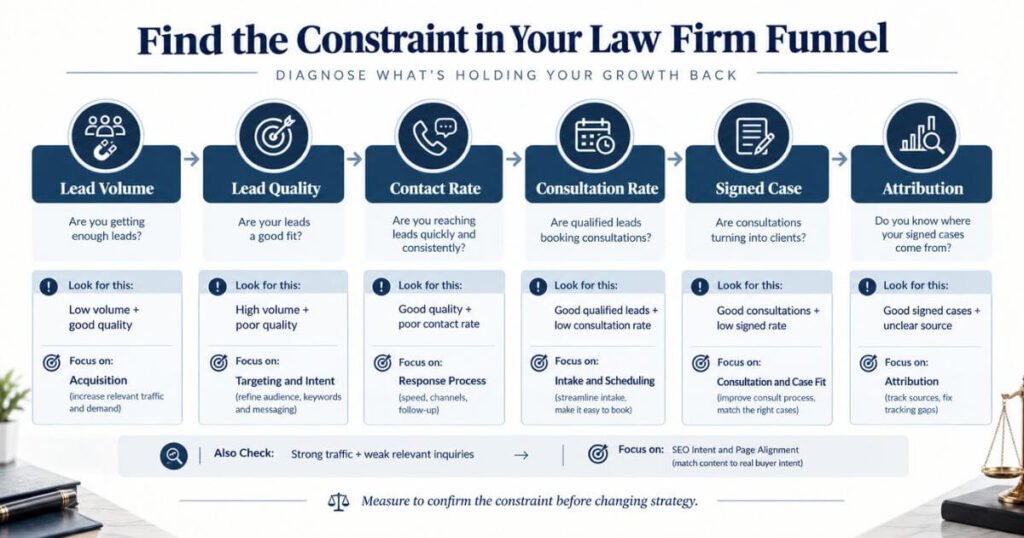
| If you see this | Investigate this first |
| Low lead volume, good lead quality | Acquisition |
| High lead volume, poor quality | Targeting and intent |
| Good lead quality, poor contact rate | Response process |
| Good qualified leads, low consultation rate | Intake and scheduling |
| Good consultations, low signed rate | Consultation and case fit |
| Good signed cases, unclear source | Attribution |
| Strong traffic, weak relevant inquiries | SEO intent and page alignment |
This table represents diagnostic hypotheses based on typical law firm operations. Your specific constraint may be different. Measure to confirm, rather than assuming. The key point is finding the exact constraint restricting growth and fixing that one specific thing.
FAQs
Is lead quality more important than lead volume?
Neither works alone. A firm needs enough volume to create real opportunities, but those opportunities still need to meet case criteria and progress toward signed cases.
What is a good quality lead for a law firm?
A lead matching the firm’s practice area, geography, case criteria, timing, and a realistic intent to hire.
Why do law firms get many low quality leads?
Common causes include broad search intent, weak targeting, geographic mismatch, unclear service positioning, third party lead sources, and thin qualification.
How should law firms measure lead quality?
Track qualified lead rate, consultation rate, signed case rate, source performance, response time, and cost per signed case together.
Should law firms focus on generating more leads?
Only after understanding how current leads actually perform downstream. Adding volume on top of a targeting or intake problem usually makes that same problem worse.
Can a firm have high quality leads but still not sign cases?
Yes. A high quality lead (good fit, right practice area) can still fail to convert due to: slow response time, complicated intake, poor scheduling, weak consultation, case economics, or capacity constraints. If consultations are strong but cases are low, investigate case fit, fees, conflicts, or consultation quality, not lead quality.
What if a firm attracts high quality leads from one source but low quality from another?
This is normal. Different channels (organic search, paid ads, referrals, directories) serve different visitor intentions and awareness stages. Measure and report by source. Optimize high performing sources and investigate why low performing sources don’t match your criteria.
How long should a firm measure lead quality before deciding to change strategy?
Measure for at least 90 days to account for seasonality and longer legal sales cycles. For practice areas with longer engagement timelines (family law, immigration), measure for 6+ months.
Stop Guessing and Start Measuring
Measure your firm’s actual path from inquiry to signed case. Track qualified lead rate, consultation rate, signed case rate, and cost per signed case for each marketing source. Within 90 days, your numbers will reveal exactly which stage is constraining growth.
The most important next step: Measure your firm’s actual path from inquiry to signed case. Track qualified lead rate, consultation rate, signed case rate, and cost per signed case for each marketing source. Within 90 days, your numbers will reveal exactly which stage is constraining growth. Visit Faheem Bhatti SEO at faheembhatti.com to measure your firm’s actual path from inquiry to signed case.
