
A law firm has to decide how easy it should be to call, fill out a form, or do both. Some firms push callers toward the phone, while others lean hard on a simple contact form. Neither channel wins automatically, since a phone call creates instant conversation while a contact form removes friction and collects structured detail. The path runs from contact → response → qualification → consultation → signed client.
The better channel is the one that produces more qualified clients, not the one that generates more inquiries. It was never the one bringing in the most inquiries. It’s the one turning those inquiries into qualified opportunities and real signed clients. That single idea shapes everything else in this article.
Phone Calls and Contact Forms Serve Different Purposes
A phone call starts with immediate conversation, where information gets collected as the two people talk. A contact form works differently, gathering details through fixed fields before anyone speaks at all. Availability separates them too, since a call depends on someone actually picking up the phone. A form sits ready anytime, day or night, waiting for whoever wants to reach out.
Qualification can begin the moment a call connects, based on tone and detail shared live. A form’s qualification starts only once someone reads what was submitted. Some visitors clearly prefer talking things through, while others feel more comfortable writing first.
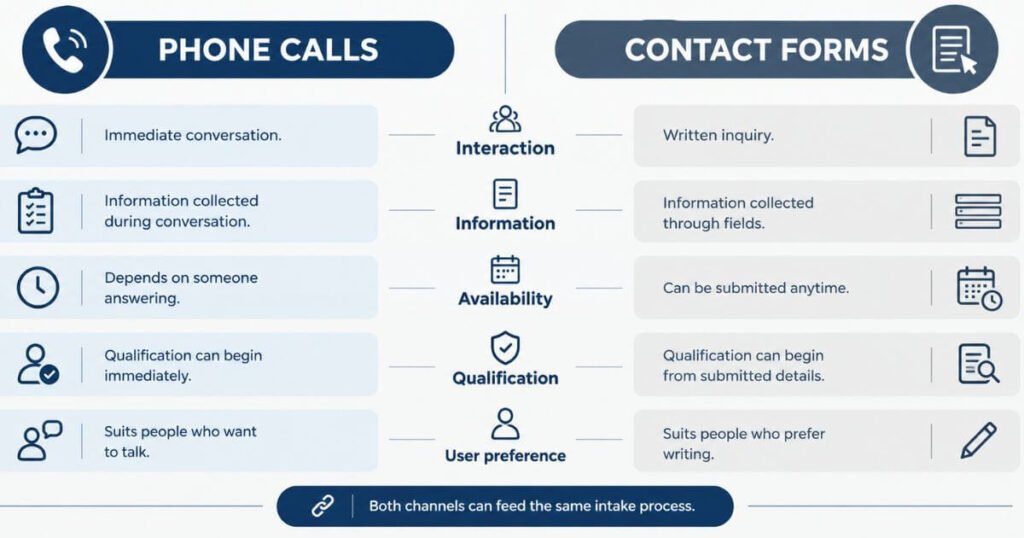
| Factor | Phone Calls | Contact Forms |
| Interaction | Immediate conversation | Written inquiry |
| Information | Collected during conversation | Collected through fields |
| Availability | Depends on someone answering | Can be submitted anytime |
| Qualification | Can begin immediately | Can begin from submitted details |
| User preference | Suits people who want to talk | Suits people who prefer writing |
| Follow up | May happen during the call | Requires a response process |
When Phone Calls Make More Sense for Legal Intake
An urgent legal matter rarely waits well for a written response to arrive later. Speaking live works best here, since complex situations often need clarification a form field can’t provide. Some prospective clients want immediate interaction, not a delayed reply sitting in an inbox. Qualification through conversation lets an intake person hear the full story as it unfolds.
- Urgent legal matters needing a fast, real response
- Complex situations that raise follow up questions
- Questions requiring back and forth clarification before intake begins
- Prospective clients who clearly want to talk right away
- Matters where fit depends on hearing the full picture live
A phone first approach still depends heavily on answering calls and following up consistently after that first conversation.
When Contact Forms Make More Sense for Legal Intake
A contact form stays useful even for firms that strongly prefer picking up the phone. After hours inquiries would otherwise disappear completely without some way to capture them overnight. Some visitors simply prefer written communication over speaking with a stranger right away.
- After hours inquiries with nowhere else to go
- People who prefer writing over calling
- Visitors who aren’t ready to call yet
- Structured lead routing based on submitted details
- Lower pressure first contact for someone still deciding
A short form only starts communication. A complete intake workflow collects the deeper details later, once contact is already underway.
A Longer Contact Form Does Not Mean Better Intake
Each additional field on a form can add friction. Following form design best practices can help firms keep forms focused and easier to complete. That friction can cost a firm a lead who simply gave up halfway. Useful information matters, but only when it actually helps intake move forward faster.
Before adding another field, we check it against a simple checklist:
- Does it help identify the practice area?
- Does it help determine basic case fit?
- Does it help route the inquiry correctly?
- Is this information actually needed at this stage?
- Can the firm reasonably act on it right away?
More fields never automatically mean better qualification. A short form focusing on practice area, basic fit, and routing works better than a long form asking for details intake can collect later.
Response Time Can Matter More Than Contact Method
Both channels can fail in completely different ways once contact actually happens. A phone call either gets answered, leading straight into intake and qualification, or it goes to voicemail instead.
Phone: Call → Answered → Intake → Qualification
Missed call: Call → Voicemail → Callback → Intake
Form: Submission → Notification → Response → Intake
A missed call needs a callback before intake can even start moving forward. A form submission depends entirely on someone noticing the notification and replying promptly. Neither channel survives a slow, inconsistent response process for very long. A firm that responds quickly to both channels typically has better outcomes than one with slow, inconsistent responses. Response speed directly affects whether leads stay warm.
Both Channels Need the Same Intake Process
Conflict Checking and Legal Intake
The ABA recommends that law firms conduct conflict checks early in the intake process, before providing legal advice. Information obtained during initial contact, whether through a phone call or form, can create conflict implications. Both phone and form inquiries should route to a process that includes:
- Client/opposing party identification
- Matter type and jurisdiction
- Conflict screening
- Firm capacity and case fit
This is a legal requirement, not just a marketing step.
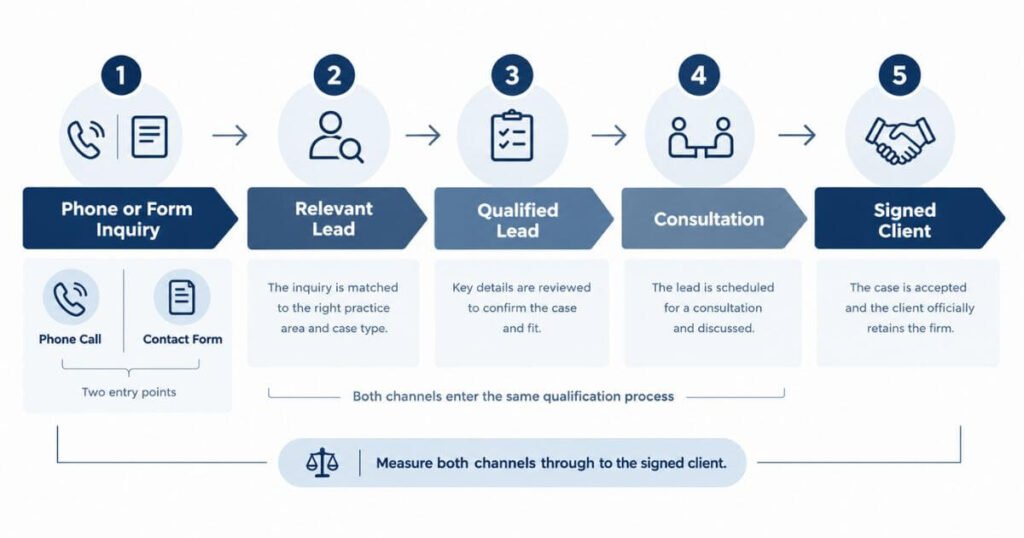
One Funnel, Two Entry Points
A phone call and a contact form should both lead into the same system from here on. That funnel runs from either entry point straight into a lead record, then qualification, a consultation, and finally a signed client. Splitting these into separate processes just creates confusion about which lead came from where. This intake data can also show whether your law firm SEO is generating inquiries that actually move through qualification and toward signed clients.
What Every Lead Record Needs, Regardless of Source
Marketing/Reporting Fields (for measurement):
- Lead source (phone or form)
- Practice area
- Location
- Case type
- Consultation booked (yes/no)
- Signed client (yes/no)
Legal Intake Fields (for conflicts and case fit):
- Prospective client name
- Opposing party/counsel (if applicable)
- Matter jurisdiction
- Firm capacity to handle
Don’t confuse the two. Marketing fields measure channel performance. Legal fields determine whether the firm can and should take the case.
Which Channel Produces Better Legal Leads?
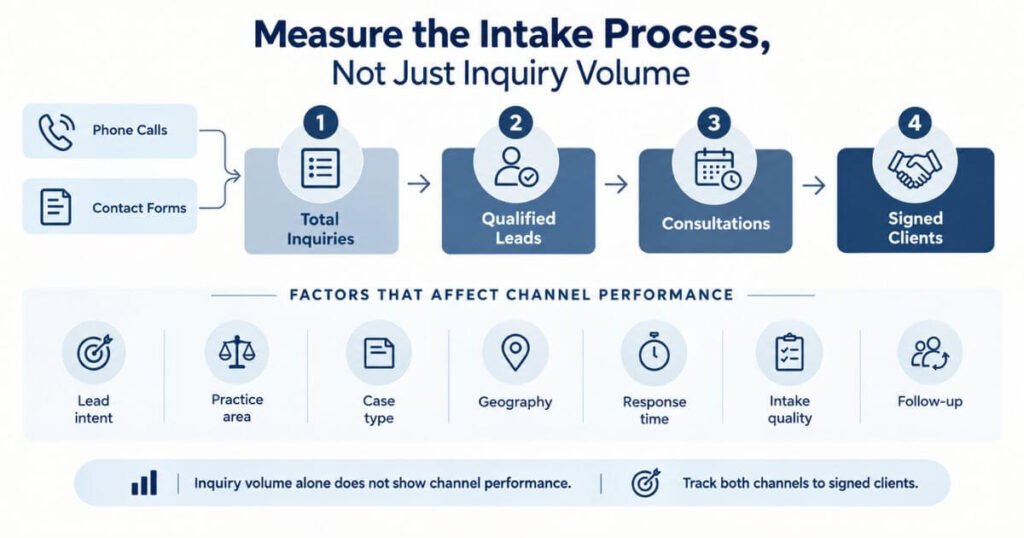
Channel performance depends on lead intent, practice area, case type, geography, response time, intake quality, and follow up. No single channel wins universally. Lead intent, practice area, case type, and geography all shape whether that lead turns into anything. Response time, intake quality, and follow up matter just as much as the channel itself. The table below is illustrative only, meant to show which factors actually decide the outcome, not to state fixed results:
| Metric | Phone calls (illustrative) | Contact forms (illustrative) |
| Total inquiries | Often higher volume | Often lower volume |
| Qualified leads | Varies by intake handling | Varies by form design |
| Consultation rate | Varies by response speed | Varies by response speed |
| Signed client rate | Depends on case fit | Depends on case fit |
| Average case value | Depends on practice area | Depends on practice area |
| Cost per signed case | Depends on all of the above | Depends on all of the above |
Comparing channels by inquiry volume alone misses the actual point. A channel bringing in fewer inquiries can still perform better if those leads are more qualified. This measurement assumes both channels receive equal attention. A firm neglecting one channel will naturally see worse performance from it. Fair comparison requires equal resource allocation to both.
Measure Intake From First Contact to Signed Client
The Outcome Funnel
The real measurement starts at first contact and ends at a signed client, not somewhere in between. That path moves from a phone or form inquiry to a relevant lead, a qualified lead, a consultation, and finally a signed client.
What to Measure at Each Stage
| Stage | Phone calls | Contact forms |
| First contact | Calls answered | Forms submitted |
| Lead | Relevant callers | Relevant submissions |
| Qualification | Qualified calls | Qualified forms |
| Consultation | Consultations booked | Consultations booked |
| Outcome | Signed clients | Signed clients |
The real question was never which channel generates more leads. It’s which channel produces more qualified opportunities and more signed clients over time.
Common Law Firm Intake Mistakes to Avoid
- Relying entirely on phone calls
- Relying entirely on contact forms
- Making contact forms unnecessarily long
- Sending submissions to an unattended inbox
- Letting calls go to voicemail with no callback process
- Treating every inquiry as a qualified lead
- Keeping phone and form leads in separate systems
- Measuring inquiries without measuring consultations
- Measuring leads without measuring signed clients
- Ignoring the source of the inquiry
FAQs
Is it better for a law firm to use phone calls or contact forms?
Neither channel wins by default for every firm. The better choice is whichever one produces more qualified, signed clients for that specific practice.
Do phone calls convert better than contact forms for law firms?
That depends on the firm’s intake process, response speed, and practice area. Both channels can perform well or poorly depending on implementation. Focus on measuring both through to signed clients rather than assuming one converts better.
Should a law firm use both phone calls and contact forms?
Yes, offering both meets different visitor preferences. Both should feed into the same intake and qualification process afterward.
What should a law firm include on its contact form?
Include only fields that identify practice area, confirm basic case fit, and support proper routing. Anything beyond that risks adding friction without adding real value.
How should law firms measure phone and form leads?
Track both channels through to consultations and signed clients, not just raw inquiry counts. Volume alone tends to hide which channel is genuinely working.
What information should a form collect before routing to intake?
Only collect: practice area, basic location match, and case type. Do not ask for detailed legal facts, opposing party names, or sensitive information on a public form. Route the inquiry to intake staff, who can collect deeper details confidentially once conflict screening is complete.
What if a caller and form submission come from the same prospective client?
Tag both with the same lead source identifier. Count both interactions but attribute the outcome (consultation or signed case) to whichever contact occurred first. This is a data handling decision, not a measurement failure.
Ready to see which channel is actually working for your firm?
The most important next step: Set up your intake system to track both phone and form leads through to signed clients. Tag every inquiry with its source and route both to the same qualification process. Within 90 days, you’ll have real data showing which channel performs better for your firm. Visit Faheem Bhatti SEO at faheembhatti.com for a straightforward review of your calls and forms side by side. We’ll help you trace both channels through to signed clients, not just count what comes in.
