A law firm can rank well and still have no real idea which calls actually turned into clients. Rankings, impressions, and clicks look great sitting on a dashboard. None of them show what happened after someone picked up the phone.
The real chain runs from organic search to a website or GBP visit, then a phone call, a qualified lead, a consultation, and finally a signed case. This article shows how to measure every stage of that chain, not just the parts that are easy to count.
Why Phone Calls Matter in Law Firm SEO Measurement
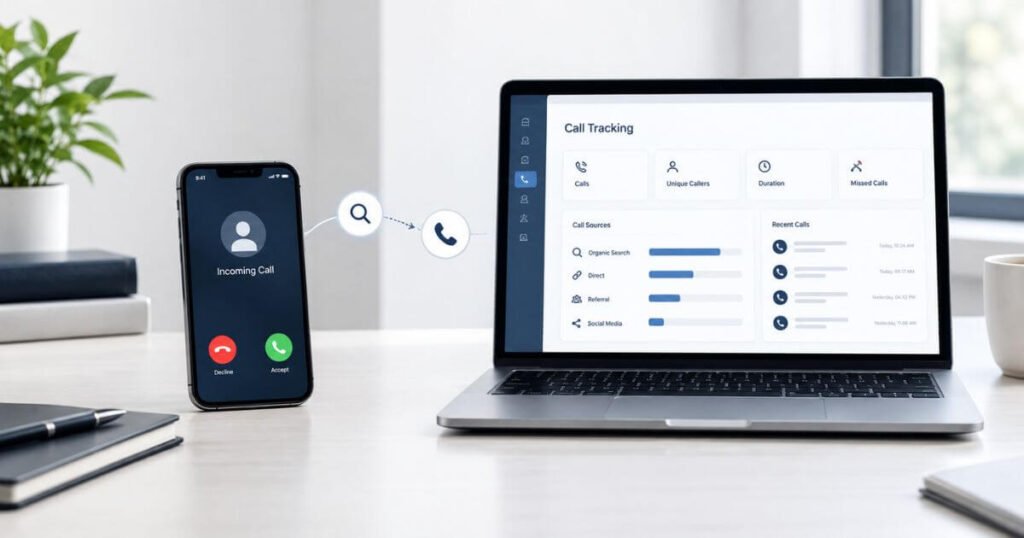
A phone call often carries far more weight than a form submission ever will. Someone dialing a firm directly usually needs help right now, not later. Website analytics alone frequently miss these calls completely, since a phone conversation leaves no digital trail on its own. That gap hides real conversions behind a screen that never sees them.
Traffic and calls still are not the outcome a firm should care about most. A call can end in silence, a wrong number, or a real signed case. That difference is exactly why a search for a signed case measurement model matters here. The real measurement treats every stage between search and signature as one connected chain. Track it together, not as five separate reports.
What Call Tracking Actually Measures
Call tracking reveals far more than just how many calls came in during a given month. It shows the call source, meaning exactly which channel or page produced that specific call. It also shows the marketing channel, the landing page or campaign involved, and basic caller and session information tied to it.
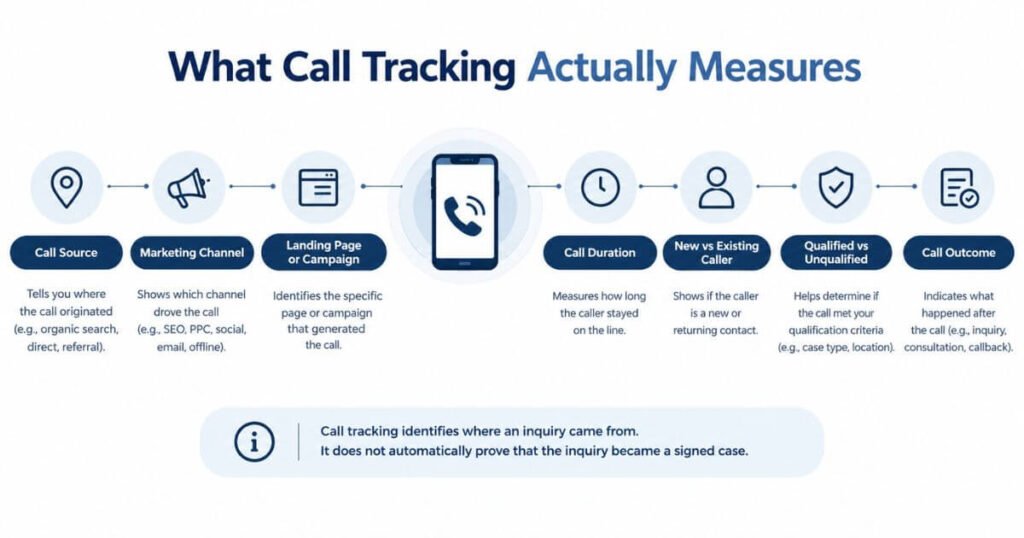
Call duration tells its own story, since a thirty second call rarely signals the same intent as a five minute one. Tracking whether a caller is new or existing helps separate fresh opportunities from repeat contacts. Marking each call as qualified or unqualified, along with its final call outcome, completes the picture. Call tracking identifies where an inquiry came from. It does not automatically prove that the inquiry became a signed case.
Example: A visitor finds your firm through organic search for ‘personal injury attorney Houston.’ They land on your injury page (tracked with a unique phone number). They call. Call tracking tags that call as: source = ‘organic search’, page = ‘/injury attorney’, campaign = ‘organic’, call duration = 4 minutes, new client = yes.
How to Attribute Calls to Organic Search
Organic attribution follows a specific path from search results down to an actual phone call. A person searches on Google, lands on an organic result, and reaches a page carrying a tracked number. That tracked number is what connects the eventual call back to the exact page that produced it.
Landing page attribution shows which specific page earned the call, not just the domain overall. Dynamic number insertion swaps that displayed number based on where the visitor came from. GA4 call events and CRM source data together confirm the full picture once a call comes through. Keyword level attribution has real limits, and no honest system promises every call ties back to one exact search term.
Website Calls and Google Business Profile Calls Differ
These two paths look similar on the surface but behave very differently underneath. A website call follows search, then the website itself, then the actual phone call placed from there. A Google Business Profile call follows a completely different path, moving from search or maps straight into a profile’s built in call button.
Google’s own profile reporting treats that second type as an interaction with the call button itself. That data should never be treated as identical to a tracked website session, since the two paths capture different signals. Google’s official Business Profile documentation defines calls as interactions with the call button on your profile, not phone conversations tracked on your website. (Source: Google Business Profile Help)
| Call source | What it measures | What it can miss |
| Organic website | Search driven website inquiry | Requires attribution setup |
| Google Business Profile | Profile call interaction | Website session data may not be available |
| Paid search | Ad driven call | Belongs to paid attribution |
| Referral or direct | Other acquisition sources | Source may need additional tracking |
How Dynamic Number Insertion Fits Into SEO Tracking
Dynamic number insertion, often shortened to DNI, swaps the displayed phone number based on where a visitor came from. Someone arriving through a paid ad sees one number, while an organic visitor sees a different one entirely. That swap happens through code that runs only for human visitors, not search engine crawlers reading the page. Your real business number should appear in your Google Business Profile, your website HTML, and major directory listings. This consistency matters for both rankings and user trust. DNI (dynamic number insertion) swaps the display number for tracking purposes, but your actual business number remains the anchor for citations.
Tracking implementation and primary business information are two separate things, and mixing them up causes real problems. DNI implemented correctly. Where the true number remains consistent in your GBP, website HTML, and major directory listings, it should not harm rankings. However, if your tracked number accidentally leaks into citations or GBP, consistency breaks and ranking risk increases.
Connect Call Data With Law Firm Intake
A call means very little on its own until it connects to what happens right after. The real progression moves from a call to a new lead, then a qualified lead, a consultation, and finally a signed case. Marketing sees the call happen, but intake decides what that call actually becomes.
Every call needs sorting by whether the caller is a new or existing client first. Practice area qualification and geographic qualification filter out calls that were never a real fit anyway. Missed calls, consultation booking, and current intake status all need tracking in one place, not scattered across separate tools. Syncing this data with the firm’s CRM or case management system closes the loop between marketing and actual case outcomes.
Measure Qualified Calls Instead of Call Volume
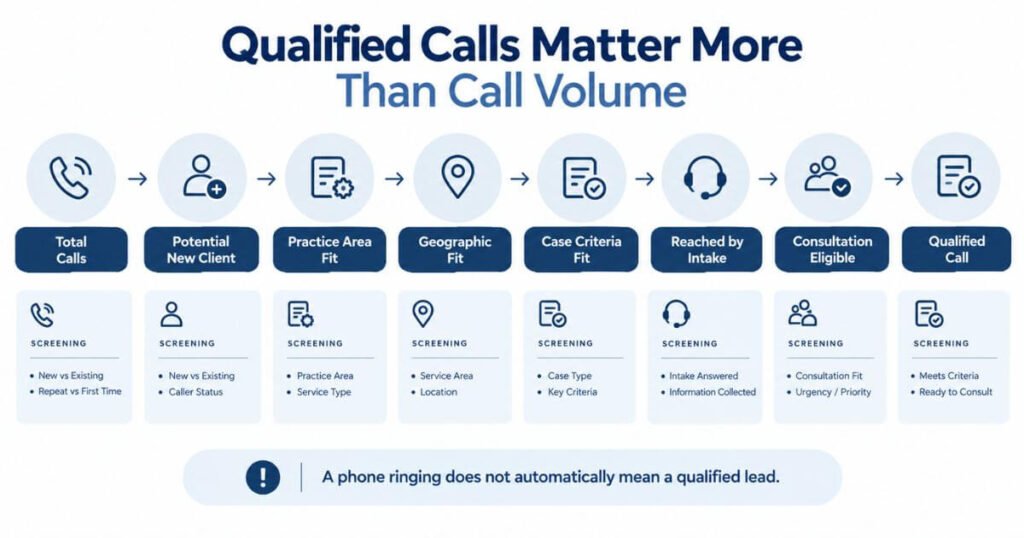
A call should never count as a successful lead just because the phone rang. Before counting it as real progress, check whether the caller fits these basics:
- Is this a potential new client, not an existing one calling about something else?
- Does the matter fall inside the firm’s practice area?
- Is the caller located within the firm’s actual service area?
- Does the situation fit the firm’s practice area and case criteria?
- Was the call actually reached by intake, not lost to voicemail?
- Is the caller eligible for a consultation based on basic screening?
That filtering process moves a firm from total calls to qualified calls, to actual consultations, and eventually to signed cases.
Measure SEO From Calls to Signed Cases
This is where every earlier piece connects into one complete picture. The full funnel runs from organic search visibility, to an organic visit, a phone inquiry, a qualified lead, a consultation, and finally a signed case. Firms can build this measurement approach into a broader law firm SEO strategy that connects search visibility with qualified inquiries and signed cases.
| Funnel stage | What to measure |
| Search | Impressions, rankings, queries |
| Visit | Organic sessions, landing pages |
| Call | Organic phone inquiries |
| Qualification | Qualified call rate |
| Consultation | Consultation rate |
| Case | Signed cases |
| Business outcome | Case value and return |
Rankings and traffic work as diagnostic signals showing whether visibility exists at all. Signed cases are the real business outcome sitting at the end of that entire chain.
Common Call Tracking Mistakes Law Firms Should Avoid
Most tracking setups fail for a handful of repeatable, avoidable reasons.
- Counting every single call as a lead, regardless of fit or intent
- Treating every lead as automatically qualified without any real screening
- Combining website and Google Business Profile calls without keeping them separate
- Using tracking numbers with no clear attribution strategy behind them
- Ignoring missed calls instead of tracking exactly where they slipped through
- Failing to connect call data with the firm’s intake process
- Reporting call volume alone without linking it to actual case outcomes
- Overstating what keyword level attribution can realistically prove
- Measuring SEO performance separately from signed case results
- Ignoring applicable call recording and privacy requirements. Call recording laws vary by state. Verify your state bar’s requirements and applicable state recording consent laws before recording calls.
FAQs
What is call tracking for law firm SEO?
Call tracking assigns unique numbers to different marketing sources so calls can be traced back to their origin. It shows which channel, page, or campaign produced each specific phone call.
Can call tracking show which SEO activity generated a phone call?
Yes, to a real but limited degree. It can trace a call back to organic search and a specific landing page, though exact keyword level attribution has real limits.
Are Google Business Profile calls the same as organic website calls?
No, they are not the same thing. GBP calls track interactions with a profile’s call button, while website calls track a full tracked session on the firm’s own site.
Can call tracking show which calls became signed cases?
Only when call data connects directly to the firm’s CRM or case management system. Without that connection, call tracking shows the inquiry but never confirms the outcome.
Does call tracking affect local SEO rankings?
DNI should not harm rankings if your real business number remains consistent across your GBP, website, and major citations. However, if a tracking number appears in your GBP or citations instead of your real number, consistency breaks, and rankings can be affected
Ready to connect your firm’s calls all the way to signed cases?
The most important next step: Connect your call tracking data to your CRM. Tag every call with its source (organic search, GBP, paid, etc.) and its outcome (qualified, consultation booked, case signed). Without that connection, call tracking shows you the inquiry but never confirms the business result. Visit Faheem Bhatti SEO at faheembhatti.com for a straightforward review of your current call tracking setup. We’ll help you trace every stage, from search visibility to signed cases, without putting your local rankings at risk.
