

A law firm can rank well, pull steady traffic, and still watch calls and forms fail to turn into real clients. Rankings can look strong on a dashboard, yet the firm may receive few inquiries that match its case criteria. Something can break between that first search interaction and an actual signed engagement. Assuming this means the SEO stopped working can overlook several other stages entirely.
The journey runs from search visibility to a relevant visitor, then an inquiry, contact, qualification, consultation, and finally a signed case. A low lead conversion rate is not necessarily a single problem in one spot. This article works as a diagnostic tool, not another list of generic marketing tips. The goal is to identify where a firm’s funnel may be breaking, one stage at a time.
The Leads You Attract Don’t Match Your Case Criteria
Lead volume rarely tells the full story about how well a firm’s marketing is performing. A firm can receive many inquiries while a significant share may not become suitable opportunities. Building a clear client profile helps a firm identify who its marketing should reach. That profile should map to practice area, case type, and geographic location.
Client circumstances matter alongside case type when judging real fit. Business priorities can determine which cases a firm actually wants, not just which cases it can technically take. Informational searches can bring people who are researching a problem rather than looking to hire a lawyer immediately. A broader targeting approach can increase inquiry volume without necessarily improving lead quality, so keyword targeting should be evaluated against the firm’s actual case criteria.
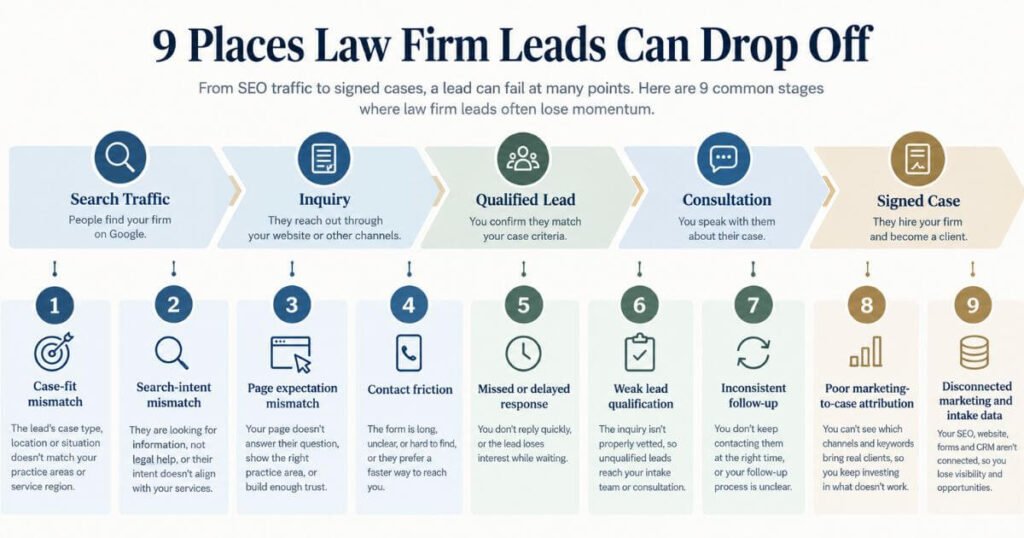
Check Whether Search Demand Matches Case Demand
Search intent can affect whether a click becomes a relevant lead. Case demand only counts when the person searching needs the firm’s specific service. Potential client fit depends partly on location targeting lining up with where the firm actually practices. Practice area match completes the picture, and search demand alignment can help turn a click into a relevant opportunity.
Your Pages Don’t Match What Searchers Expect
SERP expectation begins with what a person sees in the search results. That expectation needs to match the actual page purpose the visitor encounters next. Generic pages may not satisfy a specific legal question someone just searched. Entity relationships between a practice area, a location, and a case type can help a page address the needs behind a particular search.
Semantic SEO can be used as an internal way to evaluate those connections rather than simply counting keywords or words. Geographic relevance can matter when the firm’s service area is part of the user’s decision. Missing decision-making information can leave a visitor unsure whether the firm can help. A CTA mismatch can create additional friction, especially when the search and the landing page headline communicate different expectations.
Match Each Page to Its Search Intent
Every query has an underlying intent that the matching page should address directly. Page intent should align with that need rather than forcing a visitor to work out the purpose of the page. We evaluate pages against the questions and needs they are intended to address. A clear next action gives a satisfied visitor an obvious way to continue.
Your Website Makes Contact Harder Than Necessary
A relevant visitor can still leave without reaching out if the site makes contact unnecessarily difficult. A sticky phone number can keep contact information visible while a visitor scrolls. Tap to call functionality can make calling easier on compatible mobile devices than requiring someone to copy a number manually. A clear contact button placed where visitors can find it can be easier to use than one hidden inside a hamburger menu.
Mobile usability matters because visitors may access legal websites from mobile devices. Bloated form fields can ask for more information than is necessary at the first contact stage and may create additional friction. A slow page load time can also interfere with the visitor’s ability to reach and use the page. Clear trust signals paired with appropriate CTA design can help visitors understand what to do next.
Here’s a quick self check for spotting where contact may break down:
- Does the bounce rate differ significantly between pages intended to generate contact and other pages?
- Do session recordings show visitors looking for a phone number or contact option?
- Does form analytics show where people abandon the form?
- Is live chat available, and is there a defined process for handling after-hours intake?
- Does form completion rate change as additional fields are introduced?
- Is click to call enabled where mobile visitors are expected to call?
- Has inquiry volume changed without a corresponding change in traffic?
Your Firm Is Losing Leads After They Reach Out
The visitor called or filled out a form, but the opportunity can still be lost during the intake process. Missed calls during business hours can result in an inquiry receiving no immediate response. A delayed response can reduce the chance that an inquiry continues through the firm’s intake process. Unassigned inquiries can sit untouched when no one owns responsibility for handling them.
A firm can establish a clear response time SLA for each incoming channel. Tracking first-response time helps identify where lead leakage may begin after contact. An inconsistent response process can create a communication gap between different staff members handling the same lead. A documented phone script paired with an instant form confirmation can create a more consistent response process when those systems are properly implemented. Even after hours inquiries deserve a defined plan so the firm knows when and how they will be handled.
Your Intake Process Doesn’t Qualify Leads Properly
Lead qualification determines whether a promising inquiry meets the firm’s criteria for further consideration. Intake needs a defined client intake and screening process, rather than relying entirely on an informal conversation. Triage can help staff organize incoming leads based on urgency and fit before additional time is committed. A proper conflict check is an important part of a law firm’s intake process before representation is undertaken.
Separate Poor Leads From Poor Qualification
A wrong lead was not necessarily a good fit in the first place, regardless of how well intake handled the inquiry. Poor qualification describes a different problem, where a potentially suitable opportunity may have been missed or incorrectly classified during intake. Case fit and practice area match help determine which category a lead falls into.
A qualified lead can move forward, while a not a fit case can receive refer-out treatment when appropriate. Tracking the follow-up outcome on each lead helps the firm identify whether the problem came from acquisition, qualification, or another stage.
Good Leads Are Being Lost During Follow Up
A promising lead can still disappear if follow up is inconsistent or responsibility is unclear. A single unanswered call does not necessarily mean the opportunity is no longer viable. Multi-step follow-up across several touchpoints can give prospects additional opportunities to respond when an immediate response does not result in contact. Not ready now can also describe a prospect who needs more time before making a decision.
Clear follow-up ownership prevents leads from becoming unclear during a handoff. Lead scoring can help staff prioritize leads according to the firm’s chosen criteria. Automated follow up can support the gaps between manual contacts when it is appropriate for the firm’s process. The number and timing of follow up attempts should be based on the firm’s own data, intake process, and client context rather than treated as a universal number.
You Can’t Connect Marketing Leads to Signed Cases
A firm can generate plenty of leads while having limited visibility into which ones eventually became clients. Marketing attribution provides a way to assign source or channel credit to interactions or conversions. First-touch attribution gives credit to the channel that started the measured journey, while last-touch attribution gives credit to the final measured touchpoint. Multi-touch attribution distributes credit across multiple touchpoints according to the selected methodology.
This measurement requires reliable call tracking, CRM integration, and consistent UTM discipline where those systems are being used. Without reliable source data, some cases may remain difficult to attribute, making cost per signed case harder to calculate on a consistent basis. Every lead should have a clearly defined campaign source, whether that source is organic search, local search, or paid search, along with a defined process for handling sources that cannot be confidently identified.
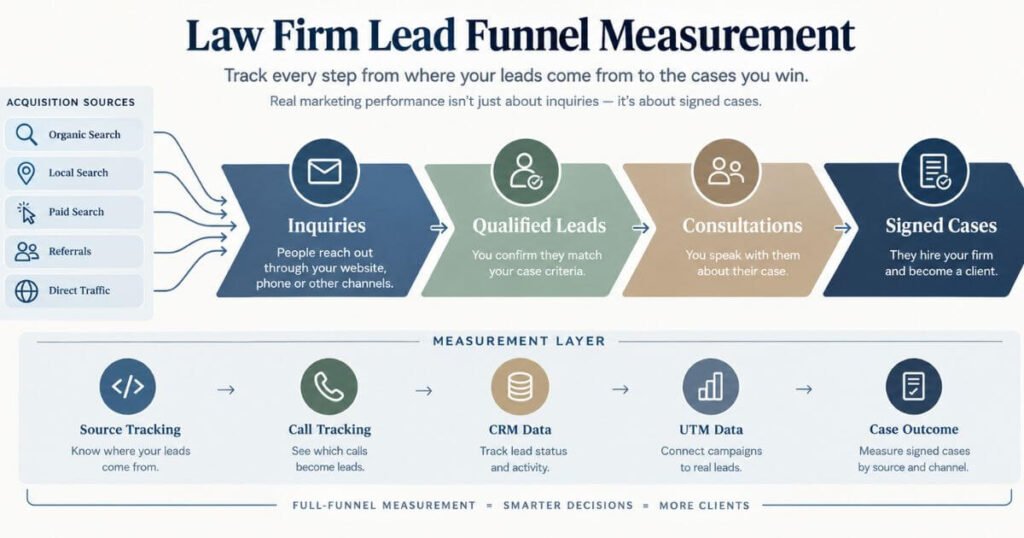
| Marketing source | Inquiries | Qualified leads | Consultations | Signed cases |
| Organic search | ||||
| Local search | ||||
| Paid search | ||||
| Referrals | ||||
| Direct traffic |
Connecting referrals and direct traffic to the same measurement framework can provide a more complete view of the firm’s lead sources.
Marketing And Intake Don’t Share The Same Data
Data silos form when marketing and intake track different pieces of the same client journey. Fragmented data can make it difficult to connect a page visit or inquiry with an eventual signed case. Disconnected systems can leave marketing watching rankings, organic traffic, and landing pages separately from the calls, inquiries, and qualified leads tracked by intake.
An integrated technology platform can connect a case management system with relevant CRM record data when the systems support that integration. Without that connection, practice-area data and location data may remain separated across different reports. A firm can have plenty of data while still lacking a connected view of the client journey.
You Don’t Know Where The Funnel Breaks
Saying leads aren’t converting is a symptom, not an actual diagnosis. Every firm benefits from a diagnostic framework that traces the symptom back to the stage where performance changes. Finding the first major drop-off gives the firm a starting point for investigating the problem. That drop-off may occur during acquisition, website conversion, or the response process after contact.
The problem can also sit inside qualification, consultation, or follow-up further down the chain. Careful measurement at each stage helps reveal the root cause behind a stalled funnel. Investigating the earliest meaningful break can be more useful than changing several parts of the funnel at once without knowing which one caused the problem.
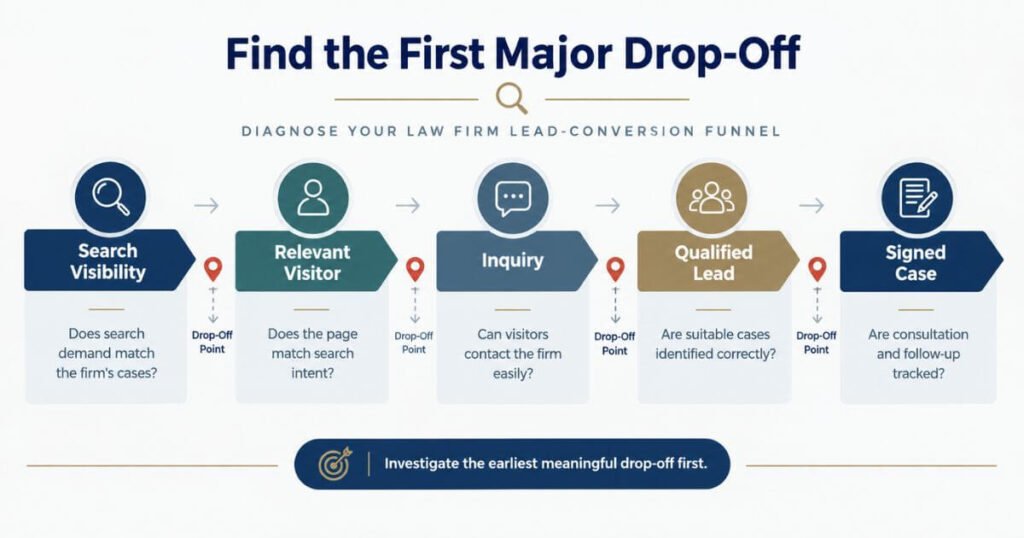
Measure SEO By Cases, Not Just Leads
Don’t judge search visibility on rankings or organic traffic numbers alone when the firm’s goal is generating clients. Track each inquiry through to a qualified lead, then a consultation, and finally a signed case. That full path connects SEO with the firm’s actual business outcomes, rather than relying only on traffic metrics. A ranking signal becomes more useful for business evaluation when it connects to downstream outcomes. Firms that want to improve this full funnel need a law firm SEO for US firms strategy that connects search visibility with relevant inquiries and business outcomes.
SEO can continue generating organic traffic after individual pieces of work are completed, but the economic result varies by firm, market, page, and measurement period. Tracking revenue per intake hour alongside cost per signed case can provide another perspective on the business value of marketing and intake activity. The real question is not only how many leads SEO generated, but what happened to those leads after they arrived.
FAQs
What Is A Good Law Firm Lead Conversion Rate?
There is no single conversion benchmark that fits every firm equally well. Lead definition, traffic source, case type, geography, and practice area can all affect the measured rate. Firms should agree on the conversion stage being measured before comparing rates against another firm or published benchmark.
Why Are My Law Firm Leads Not Qualified?
Two possibilities can explain this. An acquisition problem can bring in wrong demand through a search intent mismatch. A qualification problem can occur when suitable prospects arrive, but the intake evaluation does not identify or advance them properly.
Can Good SEO Still Generate Poor Law Firm Leads?
Yes. Ranking success does not guarantee that every visitor will match the firm’s desired cases. A search demand mismatch can still occur when the traffic does not align with the firm’s practice area, location, or case criteria.
How Can I Tell If My Problem Is SEO Or Intake?
Look at the stage where the drop-off occurs. Problems in the pre-inquiry stage can point toward search demand, traffic relevance, or page relevance. Problems in the post-inquiry stage can point toward response, scheduling, qualification, or follow up.
Should Law Firms Measure Leads Or Signed Cases?
Both, at different points. Lead volume shows activity within the acquisition funnel. A signed case or retained client represents a later business outcome. Tracking the stages between them helps the firm understand where opportunities are being lost.
Start By Finding The First Major Drop-Off
Your firm’s own funnel data is more useful for diagnosis than a generic conversion benchmark. Every firm has different practice areas, locations, intake processes, case criteria, and client journeys. Compare the stages using consistent definitions rather than assuming one metric explains the entire problem. Visit faheembhatti.com to see how we help firms get their leads into signed cases.
