
A law firm’s Google Business Profile helps it show up when nearby people search for legal help. Showing up in the Local Pack takes more than a name, phone number, and address on file. Three things drive local results: relevance, distance, and prominence.
Keeping profile details complete and correct helps match a firm to the right searches. For a law firm, this means the profile should clearly show its practice areas, location, services, and reputation. Rankings also depend on where the searcher stands. Someone across town will not see the same results as someone next door.
What Makes Google Business Profiles Rank Higher
Three factors drive local rankings: relevance, distance, and prominence. They work as a group, not as separate scores a firm can push up one by one. Relevance shows how well the profile fits the search. Distance shows how close the business is to the searcher. Prominence shows how established the business is. Google explains these local ranking factors in its official How to improve your local ranking on Google documentation.
A firm cannot control every part of this. Distance depends entirely on where the searcher stands. What a firm can control is relevance and prominence by keeping the profile accurate, earning real reviews, building a solid website, and keeping its details the same everywhere online.
| Situation | Relevance | Distance | Prominence | Likely problem |
| Strong profile, far away | High | Low | High | Distance |
| Nearby but generic firm | Low | High | Medium | Relevance |
| Highly relevant but unknown firm | High | High | Low | Prominence |
| Strong on all three | High | High | High | Strong candidate |
Optimize Your Google Business Profile Information
Choose Accurate Business Categories
Google uses your primary category to understand your business. It also uses this to decide when your profile shows up in local search. Google recommends picking the most specific category that fits your business. Don’t choose a category just because it has good keywords.
For a law firm, the primary category should match its core business. Secondary categories can help too. But they should only be used if they truly describe the firm. Don’t use them to list every legal service you offer. Example: A personal injury firm should pick the category that best fits its business. It should not add unrelated legal categories just to show up in more searches. The goal is to make your business identity clear. It is not meant to be a place to stuff keywords.
Complete Every Important Profile Field
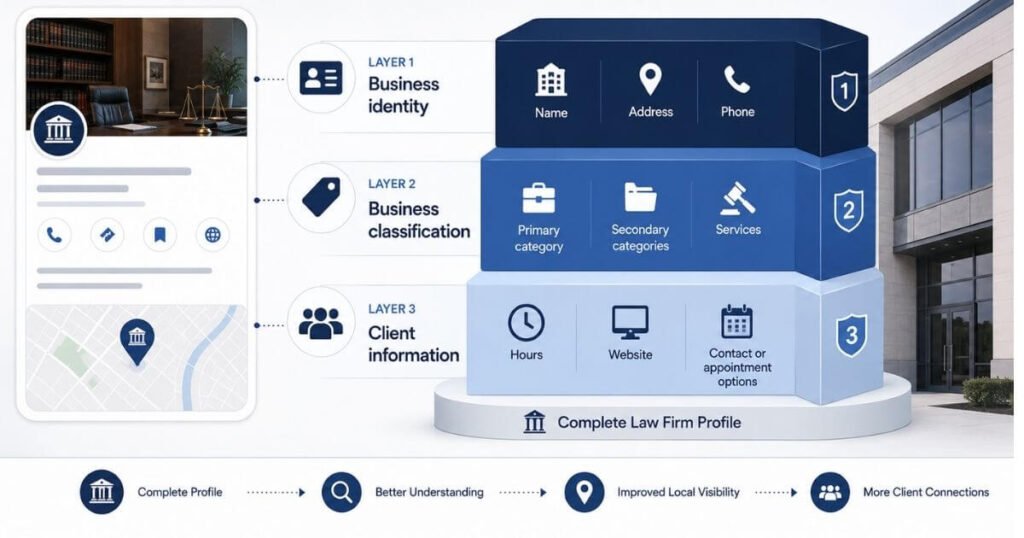
Google recommends completing your business profile in full. It should also be accurate. This includes your business name, address, and phone number. It also includes your hours and website. Add any other relevant details too. Accurate information helps Google understand what your business is. For a law firm, think of profile information in three layers.
Layer 1: Business identity
This includes your name, address, and phone number. It shows who you are and where you are located.
Layer 2: Business classification
This includes your primary category, secondary categories, and services. It explains what your firm actually does.
Layer 3: Client information
This includes your hours, website, and appointment or contact options. It helps potential clients take the next step.
Here’s the key point. Not every field is meant to boost your ranking. Fill out your profile because it accurately represents your firm. It should support Google’s understanding of your business. It should also give potential clients information they can rely on.
Build Relevance Around Legal Services
Relevance is about matching the Business Profile to what a person is searching for. Google describes it as how well a Business Profile matches a searcher’s query. Google recommends providing complete and detailed business information to help establish that match.
For a law firm, relevance should be built around genuine practice areas. It should not be built around keyword repetition. A strong profile shows a clear relevance chain from search query to supporting content.
The relevance chain: Search query → Legal practice area → GBP category → GBP services → Website practice area page → Supporting content
Example:
- A search for “Houston truck accident lawyer” should connect to:
- Personal Injury Attorney → Truck Accidents → Houston → Truck Accident Practice Area Page
- Each layer supports the one before it. This is what makes the profile relevant, not just optimized.
Match Services to Real Practice Areas
The services section should reflect the firm’s genuine areas of practice. This is not simply a list of keywords. A firm should not create a GBP service just because a keyword exists. The service should correspond to a real legal offering the firm actually provides.
Bad approach:
Keyword exists → create a matching service.
Better approach:
Real legal service exists → describe it accurately → support it with relevant website content.
Depending on the firm, real services might include personal injury, car accidents, truck accidents, criminal defense, family law, or immigration law. Clear service information helps Google understand the firm’s offerings. It also gives potential clients a faster way to confirm the firm handles their legal issue.
Write Clear Business Descriptions
The business description should explain what the firm does in plain language. It should cover:
- what the firm does
- practice areas
- geographic context
- client-facing clarity
- avoiding keyword stuffing
Weak example: “Best Houston personal injury lawyer, Houston injury attorney, top injury law firm in Houston…”
Better example: A natural description explaining the firm’s actual practice areas and location, written for a real person searching for help.
A good description should make sense to a potential client first. Search engines need context, but repeating phrases like “best personal injury lawyer” makes the profile look unnatural. It does not improve the user experience.
Strengthen Prominence Through Reviews And Authority
Prominence is how well known a business is. Google says it depends on web signals like reviews, links, mentions, citations, and website visibility. More reviews and positive ratings can help local ranking, but review count alone isn’t the goal. Prominence is not simply a review count. It works more like a broader reputation and authority ecosystem, built from several signals together:
- Reviews
- Web mentions
- Links
- Citations
- Brand recognition
- Website visibility
Together, these form Google’s broader web information and reputation context. None of these should be treated as a guaranteed individual ranking factor. But together, they shape how prominent a firm appears. This makes reputation development an important part of a law firm’s local SEO strategy. Review quantity should never become the only objective. Genuine client experiences, consistent activity, and a strong overall web presence create a more sustainable foundation.
Build a Consistent Review Generation Process
Law firms should make it easy for genuine clients to leave honest feedback. This should happen after an appropriate interaction or a completed matter. Google allows businesses to request reviews through a review link or a QR code.
A simple workflow looks like this:
Completed matter → Appropriate client interaction → Review request → Google review link or QR code → Professional response
This workflow should run consistently over time. It should not produce a sudden, artificial-looking burst of reviews. Firms should also follow these rules:
- No incentives for reviews
- No fabricated reviews
- No review manipulation
Google prohibits incentives tied to posting, changing, or removing reviews. Following a consistent, honest process protects the firm long term.
Respond Professionally To Client Reviews
Responding to reviews shows that the firm pays attention to feedback. Replies should stay professional, relevant, and useful. A short, personal note works well for positive reviews. Negative reviews require more care. Under ABA guidance, lawyers may not disclose information relating to client representation when responding to a negative review. This applies even when the review is inaccurate.
Risky response: “We’re sorry you didn’t tell us about the settlement offer before you disappeared for two months.”
This is risky because it reveals information related to the representation. It could violate client confidentiality rules, even if the goal was just to correct the record.
Safer response: “We take client feedback seriously. Please contact our office directly so we can discuss your concerns.”
This response stays professional. It protects the firm’s reputation. It also avoids disclosing any confidential details, even when a negative review stays online.
Improve Local Signals Beyond The Profile
Google does not rely only on information entered directly by a business owner. Its local listings can combine information from public web content, third party data, user contributions, business owners, and Google’s own interactions with a local place. Law firms that want a broader strategy can explore local SEO services for law firms to strengthen these signals beyond the Business Profile itself.
That means a law firm’s local SEO strategy should extend beyond the Business Profile itself. The firm’s website, legal directories, citations, reviews, and other legitimate references can all contribute to the broader information Google uses to understand the business.
Keep NAP Information Consistent Everywhere
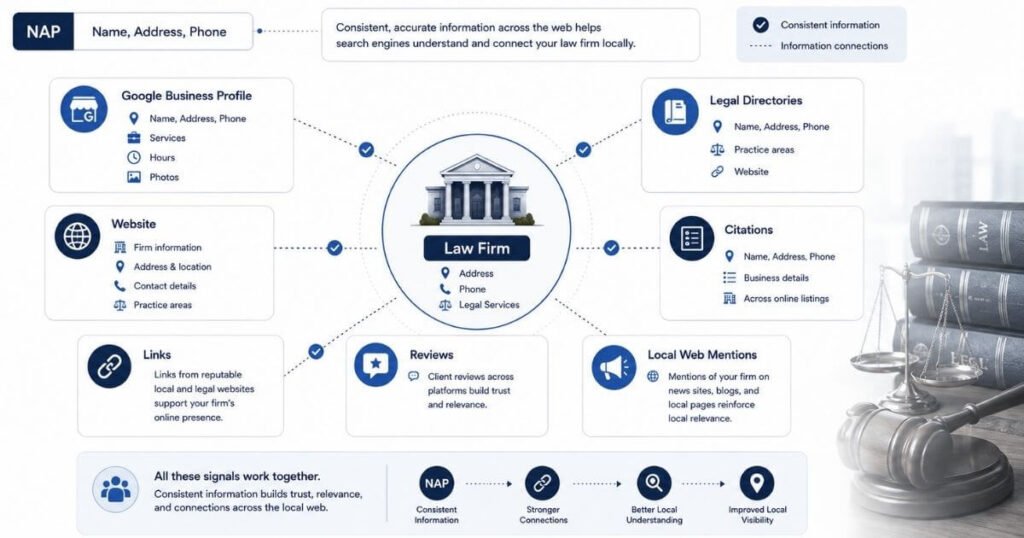
NAP means the firm’s name, address, and phone number. These details should match across the website, the Business Profile, legal directories, and other listings.
A mismatch will not remove a profile from search results on its own. It does make it harder for search engines and clients to confirm that different listings belong to the same firm.
Build Relevant Legal Directory Citations
Legal directories can strengthen a firm’s broader online presence when the information is accurate and relevant. Depending on the market, this may include established legal directories, professional organizations, local business directories, and other authoritative sources.
The goal is not hundreds of low quality listings. The goal is consistent, accurate information on the directories that actually matter.
Use The Website To Support Local Visibility
Create Strong Location And Service Pages
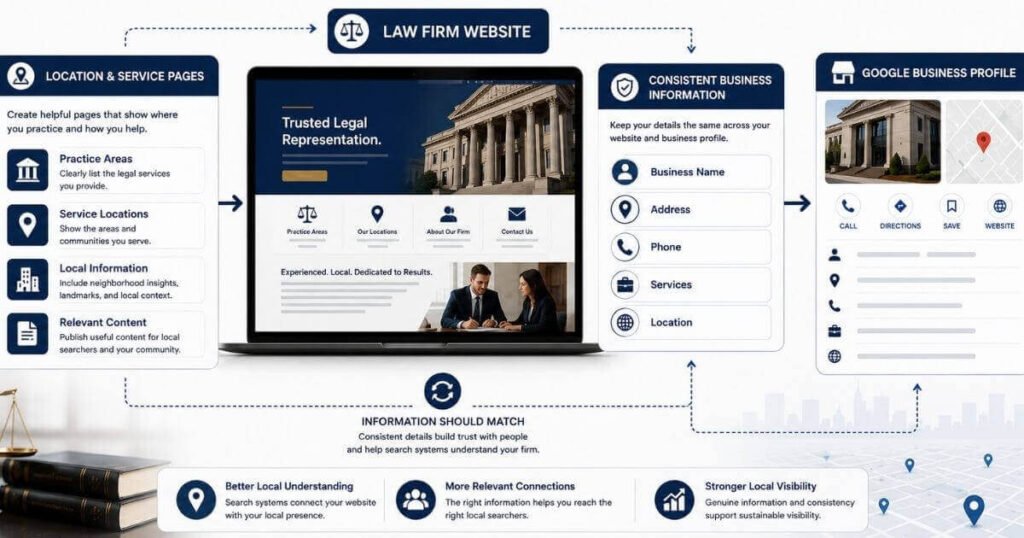
A law firm’s website should clearly explain its services and the geographic markets it legitimately serves. Dedicated pages can provide more detailed information than the limited space available inside a Business Profile.
For example, a firm serving Austin could have a detailed Austin legal service page supported by relevant practice-area content. These pages should provide genuine local information rather than simply changing the city name across duplicated templates.
Connect Website And Profile Information
The firm’s name, address, phone number, services, and location should line up across the website and the profile. Nothing important should contradict what appears elsewhere.
Keep your business information consistent across directories so customers can reach you and your profile displays accurately. It also helps clients confirm they found the right firm.
Manage Photos And Profile Activity Regularly
Regular updates keep the profile current. Good options: real office shots, the attorneys, staff, meeting spaces, signage out front. Skip the stock photos. They give a false impression of the office and team. The profile should show the actual business clients will walk into.
For a law firm, useful visual content can include genuine office photographs, attorneys, staff, meeting spaces, exterior signage, and other images that accurately represent the business. Avoid using stock photography to create a false impression of the firm’s office or team. The profile should represent the actual business clients can contact.
Avoid Tactics That Can Damage Rankings
Trying to game local rankings tends to backfire. A firm cannot pay for a better spot, and the exact ranking formula stays private. Stick to real improvements instead of shortcuts that might not hold up. Law firms should therefore focus on legitimate improvements instead of shortcuts.
Common problems include:
- Adding unnecessary keywords to the business name
- Creating fake or virtual locations that do not represent the actual business
- Buying or incentivizing reviews
- Creating misleading business information
- Building large numbers of low-quality citations
- Publishing duplicate location pages without useful local information
- Ignoring inaccurate profile information
- Using review responses to reveal confidential client details
A sustainable Local Pack strategy should improve the profile for both Google and prospective clients.
Track Local Pack Performance Over Time
Local rankings are not fixed positions. Distance changes with the searcher’s location, and competitors can improve their own profiles and websites. Google also explains that local results are based on the specific circumstances of each search, meaning two people can see different local results.
For this reason, a law firm should evaluate local visibility across relevant searches and locations instead of relying on one manual Google search.
Track meaningful indicators such as:
- Local Pack visibility for important practice-area searches
- Google Business Profile interactions
- Website visits from local search
- Calls generated from local visibility
- Direction or location actions where applicable
- Review growth and response activity
- Changes in competitor visibility
The objective is not simply to claim the number-one position. It is to build consistent visibility that produces qualified inquiries from people who actually need the firm’s services.
Turn Better Profile Rankings Into Signed Cases
A better ranking is only worth something if it brings in real clients. Get there through a complete profile, accurate details, relevant services, honest reviews, and a solid website working together. Paying or asking for a ranking boost simply isn’t an option.
Google itself makes clear that there is no way to request or pay for a better local ranking. The practical approach is to improve the signals a firm can control while recognizing that distance and search context will always influence the results.
FAQs
Can SEO Improve Google Business Profile Rankings?
Yes. Google says prominence can include a business’s position in web results, while local rankings are primarily based on relevance, distance, and prominence. Strong website SEO can therefore support the broader local visibility of a law firm.
How Many Reviews Does A Law Firm Need?
No fixed review number guarantees a particular ranking. Google says more reviews and positive ratings can help local ranking, but review quality, relevance, overall prominence, and other local factors also matter.
Can A Law Firm Rank Without A Physical Office?
Distance is one of Google’s primary local ranking factors, so location matters significantly. A firm should represent its business location accurately and follow Google’s eligibility and representation guidelines rather than creating locations solely to manipulate rankings.
How Long Does Profile Optimization Take?
There is no universal timeline for reaching a particular local position. Google notes that ranking changes depend on its algorithms and that new businesses can take up to a month to appear in search results.
Can Negative Reviews Hurt Local Rankings?
They can shape how potential clients see the firm, yes. The better move is responding professionally and earning honest feedback, not trying to steer reviews behind the scenes.
Turn Local Visibility Into More Client Calls
Local Pack rankings can shift from one search to another, and a complete Google Business Profile audit can show exactly where your firm stands against nearby competitors. Faheem Bhatti can review your local visibility, identify the gaps holding your profile back, and help turn relevant local searches into client calls.
