
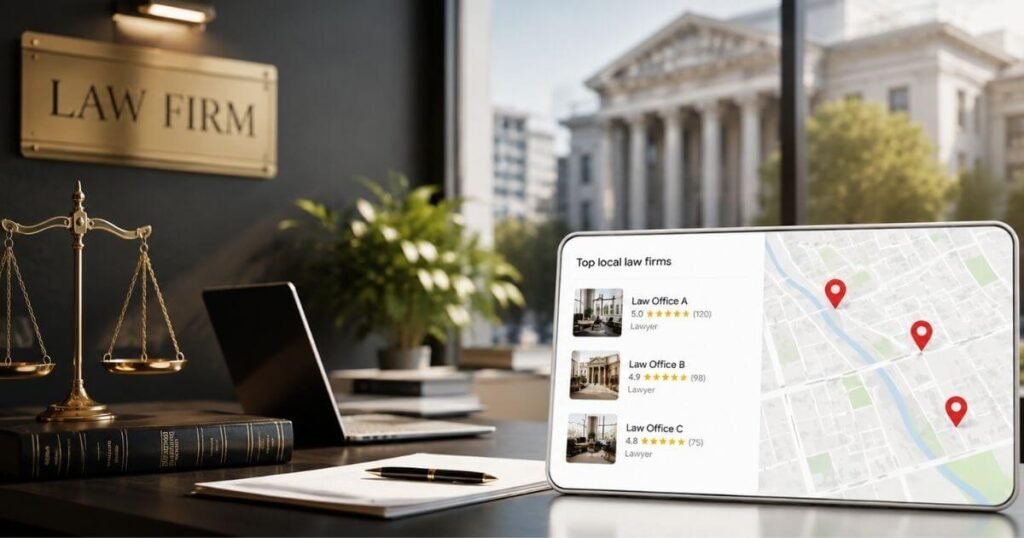
Three law firms show up first when someone searches for legal help nearby. This spot is called the Google Maps local pack. Google ranks these three listings on relevance, distance, and prominence, the same three factors Google names directly in its own local ranking guidance.
A firm’s position here can shift from one search to the next, even for the same query, because distance is calculated from each searcher’s location. This local pack sits above the regular search results on the page.
What the Google Maps Local Pack Means for Law Firms
The Google Maps Local Pack is a set of three listings that appear below Google ads and above organic results. Law firms use this Local Pack to reach searchers browsing for injury lawyers near me and similar local queries.
A firm’s proximity to the searcher often decides which three firms show up. Proximity alone can beat a stronger backlink profile in this system. The Google Maps algorithm ranks this listing on its own. It treats the listing as a separate property and asset from your website. Mobile users trust the map more than plain text links. Reviews and accurate business information, including hours, both contribute to how Google ranks local results.
The Three Ranking Factors Google Uses to Rank Law Firms
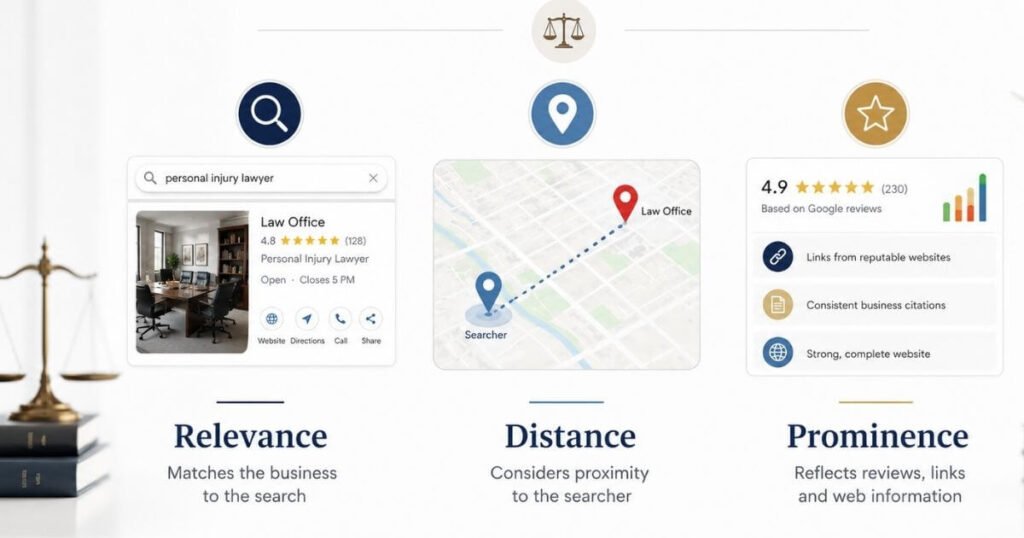
Relevance, distance, and prominence decide which three firms show up first. Google calls these its three main factors for local rankings, and this system stays separate from organic algorithm results on the search page. A firm close to the searcher gets an edge because proximity is one of the three named factors.
Relevance: Matching Your GBP to Legal Searches
Your primary category choice shapes how Google reads your firm’s specialty. A firm labeled Personal Injury Attorney is read more specifically than a plain Law Firm tag. Generic tags like Legal Services blur what a firm actually does. Service areas should list exact cities and zip codes rather than a vague region, since vague coverage keeps a profile out of granular local searches.
A full services list tells Google every task the firm handles. Listing Car Accident Lawyer work alongside Truck Accident Lawyer cases, or Slip and Fall Attorney work if the firm takes those claims, gives clearer coverage. Listing all practice areas the firm actually handles gives clearer information to searchers. Clear labels help search results match a client’s exact legal need.
Distance: Why Searcher Location Matters
Office location shapes how close a firm appears to searchers. Virtual offices without dedicated staff or signage risk getting flagged, and Google can suppress or suspend listings that fail this check. A firm chasing extra cities needs a real multi location strategy, not just a listing.
Physical location affects how distance is calculated in Google’s local ranking algorithm. Law firms can designate service areas that cover multiple cities without creating a physical office in each location, subject to Google’s eligibility rules for service-area businesses. A firm should match its business setup (storefront, service-area, or hybrid) to its actual practice structure and review Google’s eligibility requirements.
Prominence: How Reviews, Citations, and Organic Authority Combine
Google’s local ranking guidance identifies reviews as part of the prominence factor. Citations across the web tell Google information about the business. A citation lists the firm’s name, address, and phone (NAP). Google’s guidance names “links and other web information” as contributing to the prominence factor.
Consistency matters more than count across directory entries. Keep the business information accurate and consistent wherever it is published. The goal is to ensure that the firm’s core information (name, address, phone) matches across all directories where it appears.
Google Business Profile Setup for Better Local Pack Visibility
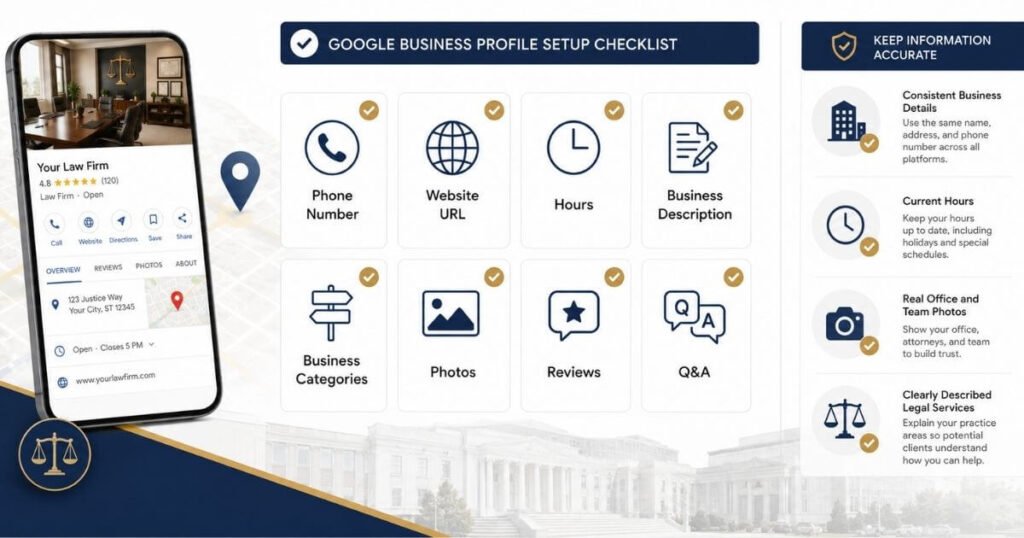
The Google Business Profile works as the new front door for the firm, and Google treats it as close to a homepage for most mobile searchers. Keeping fields complete and accurate helps ensure your profile displays correctly to searchers.
| Profile Field | What to Check |
| Phone number | Must match every other listing across the web |
| Website URL | Links straight to the firm’s main site |
| Hours of operation | Kept current so calls land during open hours |
| Business description | Short, plain text on what the firm handles |
| Business categories | Tells Google the exact type of legal work |
| Images | Real office and team photos, not stock art |
| Reviews from clients | Client feedback shown right on the profile |
| Q and A | Public questions answered directly by the firm |
Keeping all fields complete and accurate ensures your profile displays correctly to searchers.
Choose the Right Primary and Secondary Categories
The primary category tells Google the one main service a firm offers, and secondary categories add extra detail without replacing that main label. A firm can list Trial Attorney and Civil Law Attorney as secondary categories alongside a more specific primary category.
A more specific primary category helps Google understand your firm’s specialty more clearly than a generic “Law Firm” tag. Optional attributes add small details that can help a listing surface in niche searches, such as accessibility features for clients who need them.
Keep Your Name, Address, and Phone Number Consistent
NAP stands for name, address, and phone across every listing. A local phone number helps confirm that the firm is within its service area, so it is worth skipping a unique call tracking number on the main profile listing. Keeping business hours up to date stops missed calls after closing time.
Consistency across directories carries more weight than most firms realize. An address format mismatch between two sites breaks that consistency fast, and Google gets less confident when the same firm shows two different addresses.
Complete Your Profile With Accurate Business Information
| Profile Element | What to Do |
| Description | Keep the business description brief and thorough, not padded |
| Keywords | Add relevant terms naturally, never keyword stuff the text |
| Specialty line | Name the firm’s specialty clearly if it fits, such as a personal injury law firm |
| Practice detail | State the exact type of law and specialty handled |
| Location | Confirm the exact location matches the website |
| Photos | Upload high quality photos of the office and team |
| Updates | Post updates regularly to show the profile is active |
| Case wins | Share a new case result when a case closes, where bar rules allow it |
Keeping your profile current with accurate hours and recent photos helps searchers know the firm is still operating.
Review Strategy for Law Firms Under FTC and Bar Advertising Rules
Good reviews build trust fast when new clients search nearby. Bad reviews still show up, and hiding them is not an option. Responding promptly to any review signals an active, engaged office, and responding professionally matters even more on a negative review than a positive one. Responding promptly and professionally to reviews matters for client trust and compliance, not as a ranking mechanism.
Why Review Volume, Recency, and Quality Matter
Review volume shapes trust alongside review quality. A profile with dozens of reviews tends to read as more credible than one with three. A steady stream of reviews works better than one large batch. Review volume and ratings can support local visibility. More reviews generally create more credibility for prospective clients, regardless of recency.
A steady, authentic review stream reflects ongoing client satisfaction, though Google’s published guidance does not specify how review recency or velocity affects ranking. Quality and pace together matter more than either one alone.
What the FTC Consumer Reviews and Testimonials Rule Restricts
This federal rule took effect on October 21, 2024. It bans reviews that fake a reviewer’s identity or experience. A firm cannot pay for reviews tied to a star rating, and staff members cannot post reviews without disclosing their connection to the firm. The Federal Trade Commission enforces this rule under 16 CFR Part 465.
The rule specifically prohibits certain review-suppression practices, including threats, intimidation, unfounded legal threats, and misleading representations about whether submitted reviews represent the full body of reviews received.
How Attorney Advertising Rules Add Another Compliance Layer
Beyond the FTC rule, attorney advertising is separately governed by professional conduct rules. The American Bar Association’s Model Rules of Professional Conduct provide a widely used framework. Rule 7.1 states that lawyers cannot make false or misleading communications about their services.
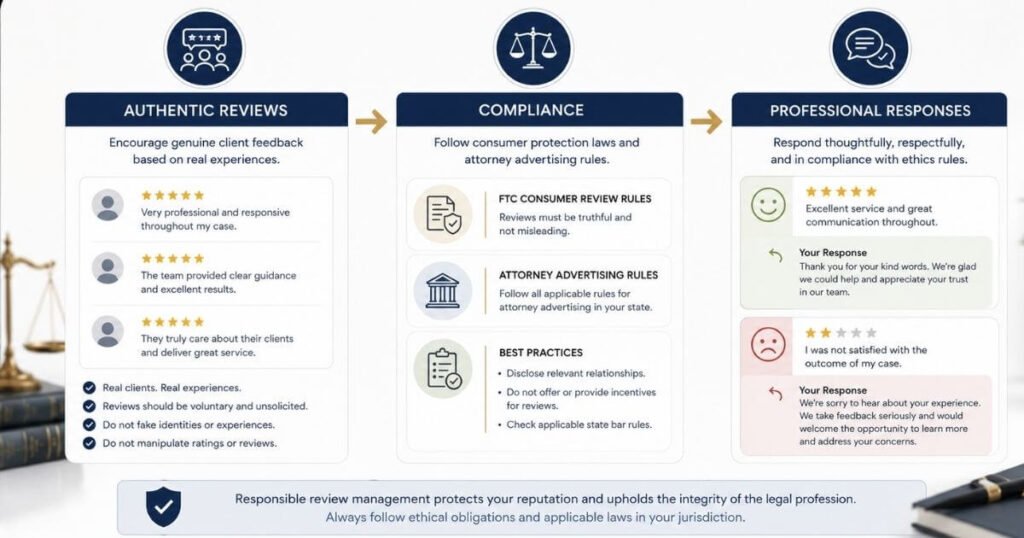
Individual jurisdictions set and enforce their own rules, which may be stricter. A firm should confirm the exact advertising requirements in its own state or jurisdiction before implementing a review campaign at scale. A single Google review can sit under both FTC and state bar oversight at the same time.
Local Pack Ranking Myths Law Firms Should Avoid
Some local ranking tactics sound useful but carry no real proof behind them.
- Geotagging photos used to be treated as helpful for local rankings, but there is no current evidence it affects placement
- GPS metadata on photos is not a confirmed ranking signal
- A keyword stuffed business name can trigger a suspension instead of a boost
- Virtual office risk grows for firms without real staff onsite
- No single ranking exists across an entire city at once
- Google calculates results from each searcher’s exact location, often within a few miles
- A firm can rank first on one block and drop several blocks over
- A competitive market shows this shift across its full coverage area
- Visibility stability across a wide coverage area takes months of steady work to build
Citations and Legal Directories That Support Local Pack Visibility
A citation lists a firm’s name, address, and phone number online. Every business directory that carries this data adds a trust signal. Core data aggregators collect this information first, then pass it along to smaller directories across the web. Foursquare, Data Axle, and Localeze sit at the center of that group, and mapping data providers like TomTom and Apple Maps also pull from this same pool.
Legal directories carry more weight than general business listings for law firms. Sites like Avvo and FindLaw already carry strong legal authority, and peer endorsements on these profiles add extra credibility for a lawyer. Justia often ranks well organically, alongside Super Lawyers profiles. Martindale Hubbell carries legacy trust built over decades, and HG.org works as a global legal directory covering firms worldwide.
How AI Overviews and the Local Pack Now Overlap
AI Overviews and AI Mode in Google Search may reference business information from Google Business Profile, reviews, and web content, but Google’s current guidance does not identify separate ranking factors or schema requirements for AI inclusion.
Standard SEO fundamentals still apply: useful textual content, internal linking, accurate structured data, and complete business information all support both traditional local rankings and general web search performance. There is no guaranteed method to appear in an AI Overview or AI generated answer.
Turning Local Pack Visibility Into Client Calls
Visibility alone does not pay the bills for a law firm. Law firms looking to turn local search visibility into a broader organic search strategy can explore law firm SEO services. Strong search engagement turns a listing view into real contact. Visibility in the local pack matters only if it drives actual client contact. Accurate hours, directions, and phone numbers help searchers reach you when they’re ready to call. Picking up the phone remains the clearest sign that visibility has turned into trust.
A Monthly Local Pack Ranking Checklist
A monthly routine keeps a law firm’s local ranking on track:
- Audit NAP across the web for mismatches
- Fix any address or phone number that does not match exactly
- Keep the firm’s review generation process running for the month
- Keep new reviews arriving at a steady pace, not all at once
- Run a full consistency check on categories and hours
- Review photos and posts for the month
- Catch small problems before they affect local rankings
FAQs
Can organic SEO help improve Map Pack rankings?
Google identifies web links and information as part of the prominence factor. A strong organic search presence may contribute to prominence indirectly, but Google ranks local results separately from organic results using different signals.
How many reviews does a business need to rank?
No fixed number exists, but more reviews generally create more credibility for prospective clients. Google’s guidance identifies reviews as part of the prominence factor.
Can a business rank in a neighboring city without an office there?
Generally not. Distance is calculated from a firm’s listed physical address, and a service area page on the website does not substitute for a real office in that city.
How long does it take to improve Map Pack rankings?
Timelines vary by market competitiveness, business type, and how quickly you can resolve missing or inaccurate information. Factors outside your control, competition, changes in searcher behavior, and algorithm updates also affect the pace of change.
Can negative reviews hurt Map Pack rankings?
A few negative reviews rarely hurt ranking on their own. A pattern of ignored complaints or slow responses tends to cause more damage over time than the negative reviews themselves.
Need Help With Local SEO?
Local pack rankings shift often, and a Google Business Profile review can help identify areas that may need attention. Learn more about our law firm SEO services and see how Faheem Bhatti SEO can help identify opportunities to improve your firm’s local search visibility.
