

There is no universal SEO timeline that fits every law firm. Some early changes can appear within just a few weeks. Meaningful organic growth, though, usually takes longer than most firms expect going in. Rankings, traffic, leads, and cases each move at their own separate pace.
This guide sets clear expectations before covering the factors behind your timeline. You will learn what actually shapes your specific timeline and why. The direct answer comes first, followed by the real factors behind it.
What Determines Your Law Firm SEO Timeline?
Two firms can start SEO on the same day and still see different results. Website age, competition level, and location shape the pace. Existing authority and content quality matter just as much as effort.
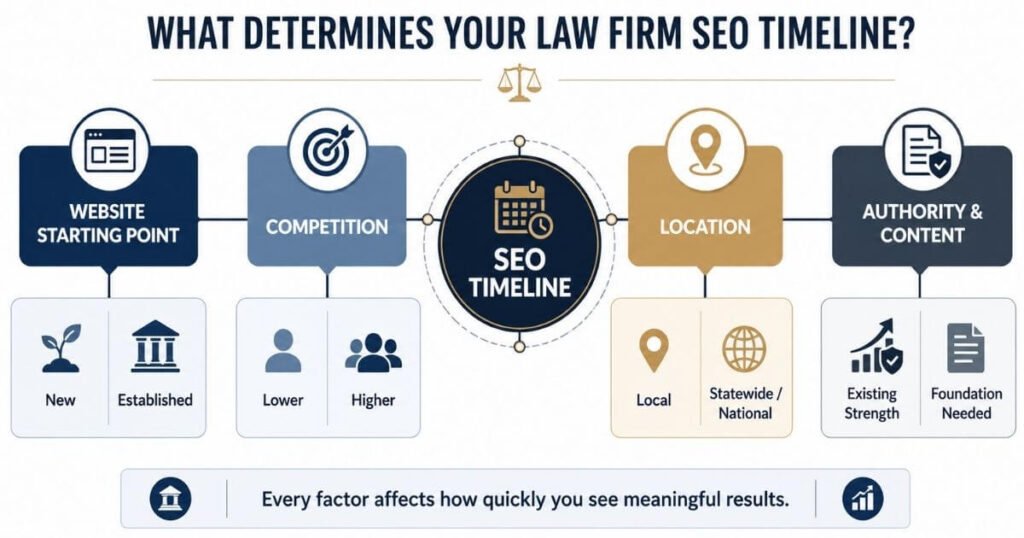
New Websites Need More Foundation
A new site typically starts without:
- Existing indexed content or search visibility
- Backlinks or outside validation
- A local presence registered with local searches
- A track record of relevant pages for search engines to evaluate
Foundation work here simply takes longer than for firms with existing content and visibility to build on.
Established Sites Have More Data
An established site typically already has:
- Existing rankings and indexed pages
- Backlinks that a new site hasn’t yet earned
- Local visibility built up over time
- Existing topical relevance across practice areas
- Existing branded search demand
Timeline depends heavily on the site’s starting condition, not just the tactics used going forward. Firms starting from an established base often see faster early movement.
Competitive Practice Areas Take Longer
Not every practice area competes at the same difficulty level. Competitive practice areas can take longer when the target search results contain established firms, strong local competitors, and pages with substantial existing authority.
Backlink profiles and content depth built over years are hard for a new page to match quickly, and high commercial search demand in these areas draws constant competitive pressure.
Location Changes The Competition
The same practice area can behave differently depending on where you compete. Smaller markets can sometimes see faster movement due to lighter competition, though this varies by practice area and search demand.
Statewide and national searches introduce a wider, tougher competitive field, often against firms with larger existing budgets and authority.
Match Your Starting Point To A Scenario
Comparing your situation against a few common starting points can make the pace easier to anticipate:
| Starting condition | Likely focus |
| New site + competitive market + no authority | Longer runway; foundation work first |
| Established site + existing rankings + technical issue | Faster potential recovery once fixed |
| Established site + healthy technically + content gap | Focus on content and intent, not rebuilding |
| Traffic decline tied to demand or seasonality | SEO work may not be the right lever at all |
The Real Stages Of Law Firm SEO
Build The SEO Foundation First
Every timeline starts with solid technical SEO work completed first. Proper indexing and clean site architecture come before anything else. Matching content to real search intent shapes every decision afterward. Thorough keyword research and topical mapping guide the whole strategy.
Practice area structure needs clear organization before content expansion begins. Strong internal linking connects every page into one coherent system. Initial content improvements often start showing small signals within this stage. This foundation stage rarely produces big visible results on its own yet. Google’s SEO Starter Guide covers realistic timelines and SEO fundamentals.
Watch Early Visibility Signals
Early progress shows up in quiet, easy to miss signals first. Watch indexed pages grow steadily as new content goes live. Search impressions often rise before actual rankings improve noticeably. Track ranking queries appearing for terms that never showed before.
Average position often moves slowly during this early window. Relevant page visibility expands even without page one placements yet. Search Console trends reveal this progress better than rankings alone. This stage builds a strong foundation, not immediate page one rankings.
Visibility Starts Building
As the foundation settles, real visibility growth becomes noticeable. More ranking queries begin appearing across different practice areas. Rising impressions show search engines trusting the site more each month. Improving positions move terms from page three toward page one steadily.
Increased organic clicks follow naturally as positions keep climbing. Greater practice area visibility spreads across more of the site. Local search visibility often improves alongside these broader gains too. This stage feels like real momentum after a quiet foundation period.
Content And Authority Start Compounding
Growth accelerates once supporting content surrounds core practice pages. Practice area depth grows as related topics get properly covered. Clear connections between the firm, attorneys, services, and locations make the site easier for users to understand and help search engines interpret its content. Relevant external references can strengthen a site’s authority, but earning them requires real editorial or relationship-based opportunities.
Local authority compounds alongside this broader content growth. These represent common stages in an ongoing process, not a finish line. Compounding growth like this rewards patience more than any quick fix.
What To Expect At Each Stage
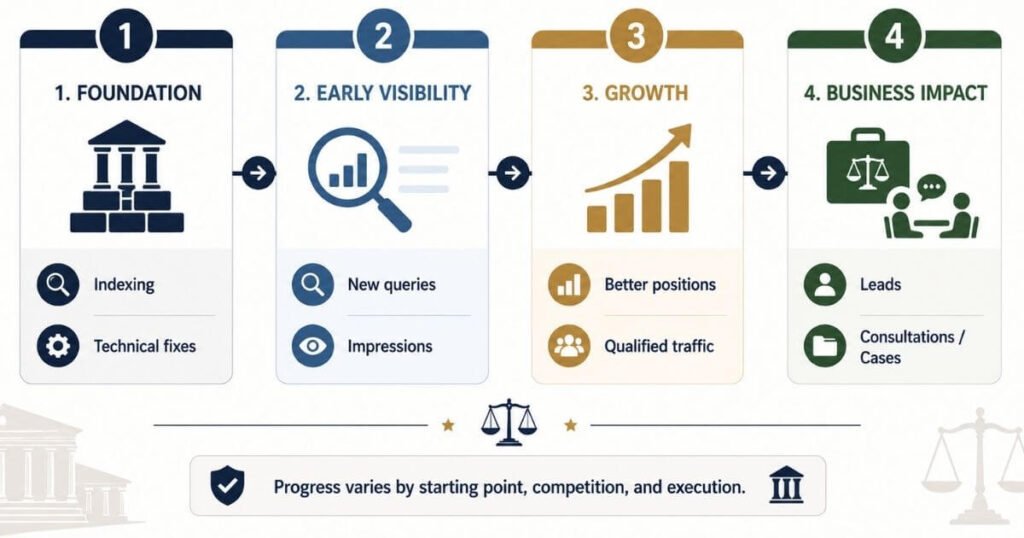
| Stage | What may change | What to measure |
| Foundation | Indexing, technical fixes, page structure | Indexed pages, technical errors |
| Early visibility | New queries, impressions | Impressions, query coverage |
| Growth | Positions, qualified traffic | Clicks, rankings, qualified traffic |
| Business impact | Leads, consultations | Qualified leads, calls, cases |
Why Rankings Do Not Guarantee Cases
Traffic Does Not Equal Qualified Leads
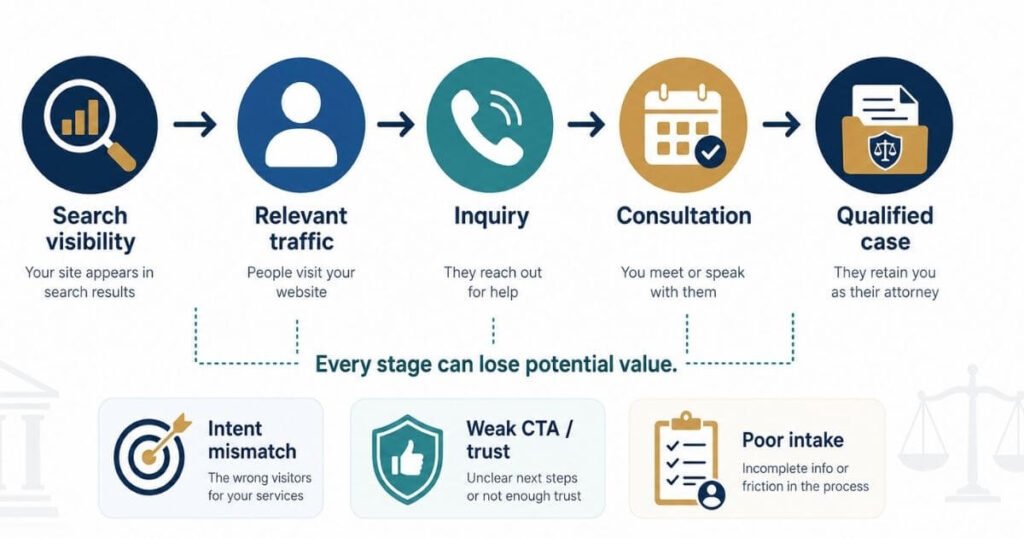
An impression turning into a click feels like early success. That click becomes a relevant visitor only if intent matches the page. From there, a visitor needs to reach contact, then book a consultation. Only some of those consultations become a qualified matter worth pursuing.
Even fewer of those matters ever become a signed case. Several problems commonly break this chain along the way. Search intent is informational when the page targets a service instead. Sometimes the page does not match the service a visitor actually needs. Other times the CTA is unclear, trust is weak, or the contact process creates friction.
Case Growth Needs More Than SEO
SEO builds visibility, but visibility alone rarely closes a case. Visibility turns into traffic only when rankings match real intent. Traffic turns into leads only through a smooth conversion experience. Conversion turns into real intake through a fast, capable team.
Intake finally turns a lead into an actual case. Weak execution anywhere along this chain slows the whole system down. Strong SEO paired with weak intake still produces disappointing results.
What Actually Slows Down Progress
Before blaming a slow timeline, it helps to diagnose which of these actually applies:
- Technical or indexing problems that block progress before anything else matters
- Search intent or content mismatches, including thin practice area pages or generic location pages with only the city name swapped
- Weak authority relative to competitors in a highly competitive market
- Poor internal linking that isolates strong pages from the rest of the site
- Outdated information or missing answers to real client questions
Diagnosing which gap applies matters more than guessing at a fix. Firms with some existing history should also lean on what already works; reinforcing existing rankings and strong pages often beats starting from scratch.
How To Actually Measure Progress
Measure Visibility Before Traffic
Search Console impressions and query coverage can often show movement earlier than traffic or leads, but track them alongside each other rather than assuming a strict order. Track impressions and ranking queries as early signals.
Watch average position shift across your most important terms, and note how many indexed pages actively contribute to visibility.
Measure Leads Before Cases
Once traffic grows, shift focus toward lead indicators next. Track organic inquiries, phone calls, contact forms, and consultation bookings, and separate qualified leads from casual browsers early in this process.
Revenue attribution can help connect signed cases back to SEO efforts, though attribution is rarely exact. Remember, rankings are an SEO signal; cases are a business outcome. Measuring both levels together paints the most accurate picture available.
Be Careful With Fixed Guarantees
A fixed timeline is misleading because:
- Every website starts from a different condition
- Competition varies widely between practice areas and locations
- Search demand varies too, shaping how fast visibility can realistically grow
- Google does not guarantee rankings to any website, regardless of effort
- Individual changes take different amounts of time to show impact
- Rankings do not automatically produce cases even once they arrive
Any promise of a fixed, guaranteed timeline deserves real skepticism.
Ask What Happens During SEO
A good SEO partnership starts with clear, honest questions upfront:
- What happens in month one?
- Which pages will be improved, and in what order?
- What will be measured throughout the engagement?
- What happens if rankings don’t move as expected?
- How will qualified leads be tracked over time?
- How will SEO connect to cases in practical terms?
These questions build an accountability framework, not a sales promise.
Build A Realistic Law Firm SEO Timeline
A realistic timeline moves through four connected stages over time. Foundation covers the technical and strategic setup, focused on indexing, structure, and visibility. Early growth follows, built around content and relevance, showing up as impressions and rankings. Expansion comes next, built on authority and topical depth, producing qualified traffic for valuable queries. Firms unsure about timelines can book a free consultation to get a realistic roadmap.
Compounding arrives last, driven by ongoing optimization and authority, finally producing leads, consultations, and cases. Every firm’s exact pace depends on its starting point, competition, and location. Practice area, existing authority, and technical condition all shape the pace too. Content quality and consistent execution ultimately decide how fast these stages unfold.
Frequently Asked Questions About Law Firm SEO Timelines
How Long Does Law Firm SEO Usually Take?
No fixed timeline applies to every law firm. The real pace depends on starting point, competition, and execution quality.
Can Law Firm SEO Work Within 90 Days?
Meaningful results within 90 days usually reflect only the early foundation stage. Early visibility signals can appear, but full case growth typically needs more time.
When Should A Law Firm Expect Leads?
Leads follow visibility and conversion, not a fixed date on a calendar. Firms should expect variation depending on their starting authority and market competition.
Why Is My SEO Traffic Growing Slowly?
Slow growth often traces back to competition, technical gaps, content depth, or authority gaps. Identifying which factor applies matters more than assuming the whole strategy failed.
Can You Guarantee Law Firm Rankings?
No, Google does not guarantee rankings to any website, regardless of budget or effort. Any agency claiming otherwise should raise real doubt, since no agency can guarantee position.
Know When Your SEO Is Actually Working
Track impressions, clicks, qualified leads, and signed cases separately rather than relying on one number. Search visibility is expanding, and valuable queries are improving steadily. Qualified traffic is increasing, and consultations are being generated regularly. Don’t judge SEO by a fixed countdown; judge it by these real signals instead. Request a free SEO progress review at faheembhatti.com today, and see exactly where your firm currently stands.
