

Thin content sounds simple until you try to define it clearly. Many firms assume thin means little or no meaningful value on the page. That definition misses the real standard Google actually uses. A page gets judged by how well it meets search intent, not by length.
No minimum word count required for ranking exists anywhere in Google’s guidance. What matters is helpful, original people first content, built around real answers. This makes thin content a value question, not a word count question. Thin content generally fails because it doesn’t satisfy the reader’s actual need, though pages can also underperform for other reasons.
Is Your Page Actually Thin? A page is likely thin if:
- It doesn’t satisfy the primary reader task
- Important questions go unanswered
- It adds no original information beyond competitors
- It’s substantially similar to another page on your site
- It exists mainly to capture search traffic rather than help the reader
If none of these apply, a short page is probably fine as it is.
Thin Content Isn’t the Only Explanation
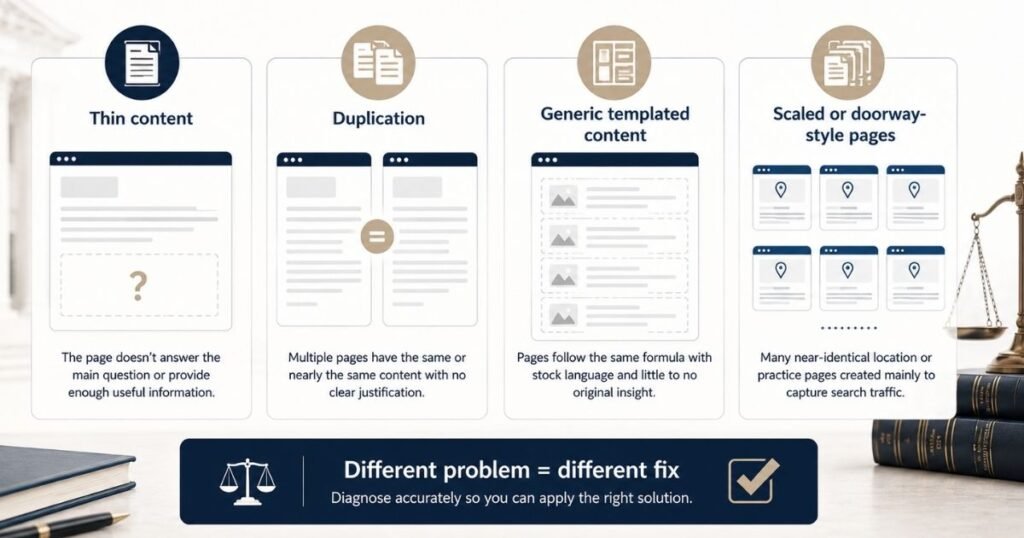
Not every low value page has the same cause. Before editing, identify which problem you’re actually looking at:
- Thin content: The page doesn’t provide enough useful information for its task
- Duplication: The page repeats another page on your site with only minor changes, like a swapped city name
- Generic templated content: The page follows a formula with little unique value
- Scaled or doorway style pages: Many near identical pages, often location based, created primarily to capture search traffic rather than serve readers
Each of these needs a different fix. Expanding a duplicate page with more words doesn’t solve duplication; consolidating it does.
Spot Duplication Hiding Across Your Site
Identify Pages Saying The Same Thing
Look for repeated introductions copied across multiple practice pages. Generic practice area descriptions often repeat the same vague claims everywhere. Similar location pages frequently swap only the city name and nothing else. Reused FAQs and rewritten blog content add little real value too.
Watch for duplicate explanations scattered across unrelated pages on the site. Template based paragraphs create near duplicate pages with only a variable swapped. This pattern can happen with or without automation. The cause matters less than the fact that the pages are substantially similar. Some firms rely on programmatic SEO implementations that produce large content volumes with low editorial investment per page.
Replace Generic Claims With Evidence
Phrases like experienced attorneys and dedicated legal team say almost nothing specific. Claims like aggressive representation and client focused service sound identical across every firm. Replace these with relevant attorney experience tied to real cases handled. Show specific legal knowledge instead of vague personality claims.
Add original analysis that reflects real thinking, not marketing language. Where the firm can verify it, include case related experience that supports the claim being made. Useful examples ground abstract claims in something a reader can trust. Supporting sources add credibility that generic phrases can never provide alone
Understand What Thin Content Really Means
Short Content Is Not Always Thin
Word count alone tells you very little about a page’s real value. Strong search intent match matters more than any length target. Full topic coverage and genuine usefulness decide whether a page works. Real completeness means every important client question gets a clear answer.
Real information gain can happen in very little space sometimes. A 400 word guide can meet the user’s needs completely. This proves a short page can be valuable when built correctly. The reverse holds too, since a long page can still be thin. No official magic number exists for judging length either way.
Measure Value Beyond Word Count
Check the page against these criteria:
- Does it address the searcher’s need directly?
- Does it include original insight, not recycled content?
- Are claims backed by supporting evidence?
- Does it reflect genuine expertise or first hand experience?
Check Your Coverage Against Real Intent
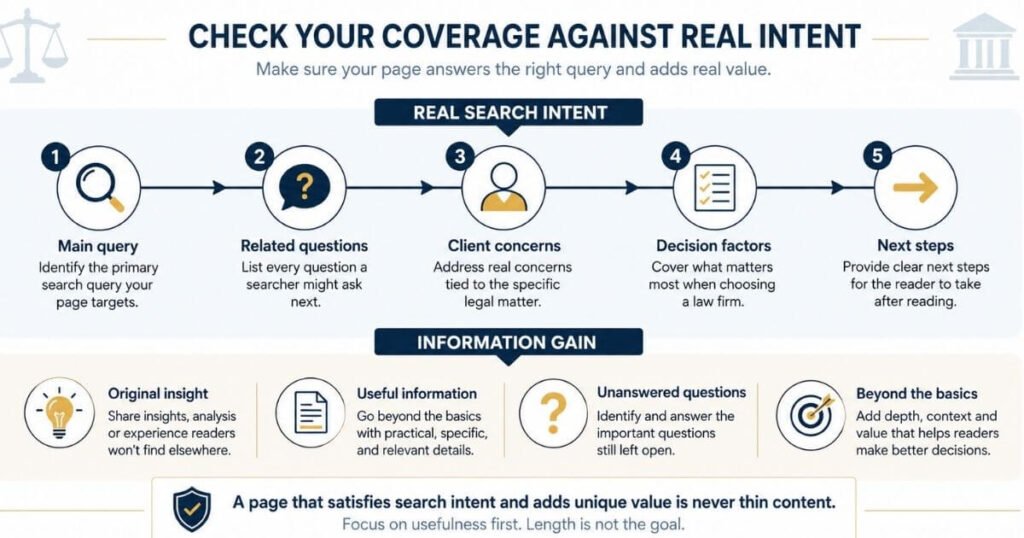
Compare Coverage With Search Intent
Start every review by identifying the main query the page targets. List every related question a searcher might ask next. Note real client concerns tied directly to that specific legal matter. Check whether the page mentions relevant services connected to the problem.
Cover the decision factors a visitor weighs before choosing a firm. Spell out clear next steps once a reader finishes the page. A page that fails to satisfy the query has a clear usefulness problem, satisfying it is necessary, but not a guarantee of ranking. Missing even one of these pieces often signals real thin content underneath. Google’s helpful content guidance addresses this, emphasizing usefulness and people first content over a specific word count.
Find Missing Information Gain
Ask what the page explains that a reader could not guess alone. Then ask what useful information it adds beyond the basics. Note which important questions remain unanswered after a full read through. Check whether the page provides original insight, not recycled talking points.
Ask whether it helps the reader decide between hiring a firm. The strongest test asks for information the reader could not easily find elsewhere. Fixing this gap often matters more than any other single change.
Review Your Practice Area Pages Closely
Review Your Core Practice Pages
Start with your highest traffic practice pages first. Check personal injury, family law, and criminal defense pages closely. Review workers compensation, immigration, business law, and estate planning next. Each page needs real depth tied to that exact practice.
Strong pages explain the actual service instead of describing the practice area generally. A vague overview of family law helps no one searching for real answers. Specific guidance about custody, divorce, or support shows real expertise instead. A structured Law Firm SEO approach ensures every practice page gets this level of depth.
Connect Services With Client Problems
Every strong page starts by naming the practice area clearly. Then it connects that practice area to a specific legal matter. From there, it addresses the exact client problem behind the search. Real attorney expertise should appear alongside the location served.
Spell out the next step a visitor should take immediately. Every element should answer whether the firm can help with their situation. Pages missing this connection often feel generic and unconvincing. Building this chain deliberately makes every practice page stronger.
Study What Stronger Competing Pages Do
Identify What Better Pages Explain
Study a competitor’s top ranking page for real topic coverage depth. Note how it handles common client questions throughout the content. Check its explanation of relevant legal concepts in plain language. Strong pages include real examples tied to actual situations clients face.
Look for solid evidence backing up every claim made on the page. Notice the practical guidance offered beyond basic definitions. Real expertise and original information separate these pages from thin competitors. Do not copy competitors directly, but study why their pages provide greater value.
Find Your Most Important Content Gaps
Pick one practice area and compare your page against the top ranking page. Note the gap in topic coverage between your page and theirs. Check whether their page answers more client questions than yours does. Compare the evidence and expertise shown on each page directly.
List every piece of original information their page includes that yours skips. Note the practical value their page offers beyond yours. This comparison often reveals real content currently outranking your best pages. Treat each gap found as a clear opportunity, not a criticism.
Fix Thin Pages The Right Way
Add Relevant Legal Expertise
Start by adding clear attorney authorship to every important page. Show relevant experience tied directly to that specific practice area. Include real practice area knowledge, not general legal background. List professional credentials that connect to the exact service offered.
Add first hand insights pulled from real cases your firm has handled. Cite appropriate legal sources to support any factual claim made. Strong expert authorship turns a thin page into a trusted resource.
Add Useful Information Instead
Build content around real client questions your intake team hears often. Offer practical explanations instead of abstract legal theory. Address common situations clients actually face during a legal matter. Cover important considerations a client should weigh before deciding anything.
Include relevant examples that mirror real client circumstances closely. End with clear next steps a reader can act on immediately. Add information because it improves understanding, not because you need more words. This mindset keeps every addition focused on real reader value.
Know When To Expand And When To Stop
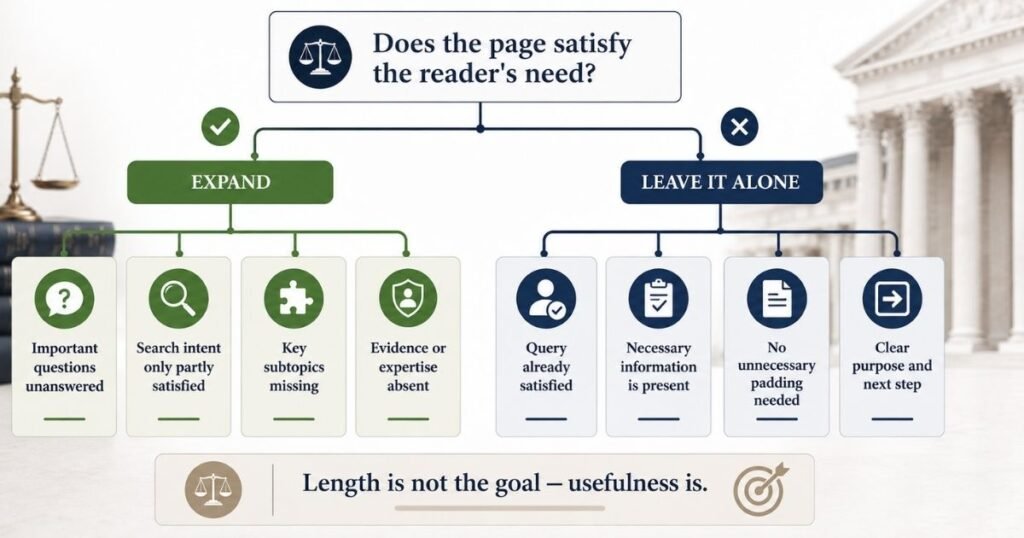
Expand Pages With Real Gaps
Expand a page only when real evidence points to a problem. Watch for important questions that remain unanswered after a full read. Note if search intent is only partially satisfied by current content. Check whether key subtopics are missing from the page entirely.
Look for pages where relevant evidence is absent throughout the content. A page offering little useful information needs real expansion, not polish. This especially applies where ranking competitors provide substantially better coverage already. These signals together justify real investment in expanding the page.
Leave Strong Short Pages Alone
Do not expand a page simply because it is short compared to others. If the page already satisfies the query, leave it alone. Check whether it provides necessary information without unnecessary padding. A page with a clear purpose rarely needs more words added.
Confirm it demonstrates expertise clearly within its current length. Check whether it helps the reader take the next step easily. A concise page can be strong exactly as it stands today. Expanding a page that already works can dilute its clarity instead.
Build A Sustainable Content Strategy
Prioritize Your Highest Value Pages
Start with your most important practice area pages first. Move next to high value location pages tied to major markets. Prioritize pages losing visibility over pages already performing well.
Give extra attention to pages supporting valuable services with real case potential. Improve existing content before creating multiple similar articles around the same topic. This approach builds lasting depth instead of scattered thin pages. Real prioritization saves both time and editorial resources over the long run.
Build Depth Through Meaningful Relationships
Strong content connects clearly back to the law firm behind it. Each attorney should link naturally to their specific practice area. Every practice area should connect to the legal matter it covers. Client problem pages should link toward the location they serve.
Use internal links to reinforce these relationships naturally throughout the site. This structure helps both readers and search engines understand context faster. Isolated pages without these connections often read as thin, standalone content. Internal links can improve discoverability and context, but they don’t substitute for adding sufficient information to the page itself.
Frequently Asked Questions
How Short Is Too Short For Law Firm Content?
No minimum word count exists for law firm content specifically. What matters is whether the page satisfies search intent completely. Even a 300 word page can concisely answer a specific query well. Value over length decides whether a page succeeds or fails.
Does Google Penalize Short Content?
Google applies no official word count penalty to short pages directly. Google’s guidance emphasizes usefulness and people-first content rather than a specific word count penalty. There’s no single documented mechanism for how thin content affects rankings.
Should Every Practice Area Page Be Long?
Page length depends on search intent for that specific practice area. Competitor depth and topic complexity both shape the right length too. A simple query needs less than a complex, multi part legal question. Length is not the goal; satisfying the reader always is.
Should I delete a thin page or improve it?
Improve a page if it targets real search demand but lacks depth or evidence. Delete or consolidate it if it duplicates another page or offers nothing unique on its own.
Is More Content Better For SEO?
More content only helps when it adds real depth and value. Quality over quantity remains true for every practice area page. Padding does not address the quality signal search engines actually measure. Publishing volume rarely helps on its own. Value and usefulness matter more than page count every time.
Turn Thin Content Into Search Value Now
A useful starting point is comparing your pages against the diagnostic questions above before deciding what to expand, consolidate, or leave alone. We identify where existing content lacks depth, relevance, expertise, or information gain. Request a free content audit at faheembhatti.com today, and see exactly which pages need real work.
