

A real law firm SEO audit helps a firm discover, index, and understand its own site. It should evaluate important pages, keywords, backlinks, and real page speed together. Good audits also check technical accessibility, search intent, and content quality at once.
They confirm real expertise, trust, local signals, and entity signals across the whole architecture. It is common for firm sites to rank once and quietly lose authority over time. This guide sets clear priorities for a real audit sequence.
Start With Crawlability and Indexing
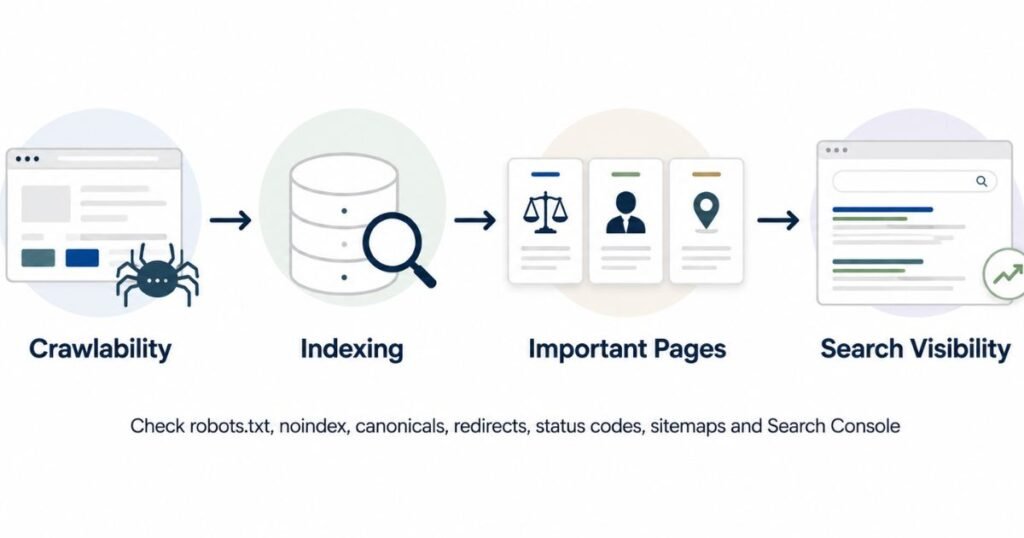
Crawlability and indexing come before anything else. Without real Google access, no page can rank at all. Check whether important pages even get discovery and real indexation. This is the true technical foundation behind an accessible website. Skip this step, and every later fix rests on shaky ground.
Check What Google Can Access
Start with the robots.txt file. Look for stray noindex tags and confirm real canonical directives. Check for messy redirects and bad status codes too.
Watch for blocked resources sitting on important URLs. Use the URL Inspection tool to confirm the real crawl path. Review canonical selection and rendering closely, since small errors here quietly hide whole sections of a site.
Check Which Important Pages Are Indexed
Confirm the homepage shows up first. Then check practice area pages, attorney pages, and location pages one by one. These count as real important resources, not extra pages. An accessible website still fails if the right indexed page never appears. Track true index coverage, not just a general feeling that things look fine.
According to the Google Search Central SEO Starter Guide, these fundamentals still shape everything else. Search Console documentation points straight to the Page indexing report and the URL Inspection tool for this exact check. Crawl stats and clean sitemap submission round out this first pass.
Audit Pages Against Legal Search Intent
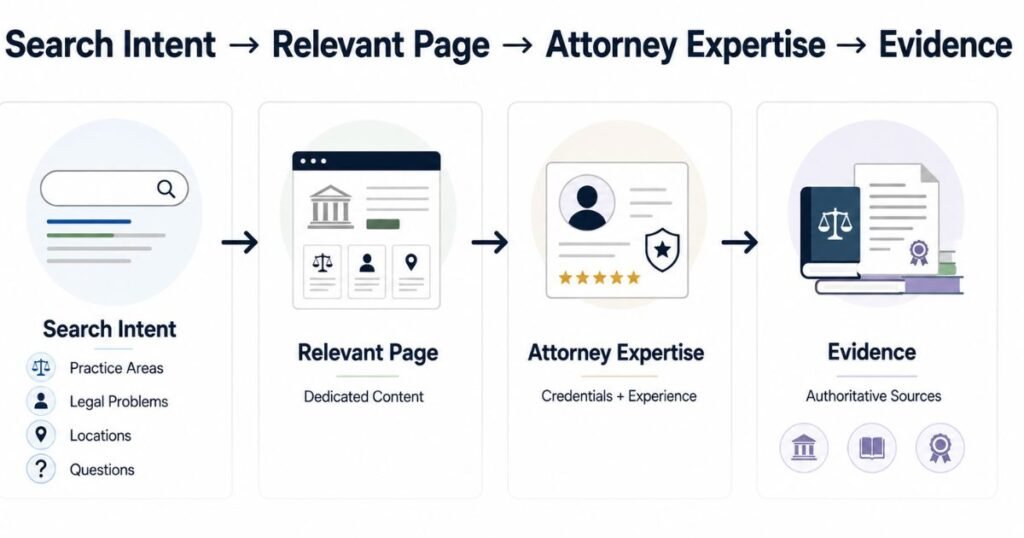
Real search intent decides whether a page earns its spot. Check whether the site actually built the right pages for real client needs. Cover practice area searches, legal problem searches, and location searches together. Add informational questions and attorney firm searches to that list too. This is where true intent satisfaction either shows up or quietly falls apart.
Match Pages to Search Intent
Line up practice area searches, legal problem searches, and location searches against real pages. Check informational questions and attorney firm searches the same way. Weak query alignment shows up fast once you look closely. Strong intent mapping means every major search has a real page ready to answer it, not a vague catch all page trying to do everything.
Evaluate Practice Area Depth
Check for real dedicated pages, not thin placeholders. Look for supporting legal topics built around each one. Confirm the content answers real client questions and shows genuine relevant attorney expertise. Supporting resources and contextual internal links should tie everything together. This kind of true topical depth separates real practice coverage from a page built just to exist.
Find Thin and Overlapping Pages
Watch for duplicate intent across similar pages. Templated location pages often repeat the same weak content over and over. Repetitive practice area content signals real trouble. So does content built as pages created for keywords, not readers. Every page needs a distinct purpose and real useful coverage. Fix any cannibalization and clear out old thin content.
Check Whether the Site Demonstrates Legal Expertise
Legal expertise needs real proof, not just claims. Search engines look for a clear firm identity behind every page. This section checks true EEAT and real trust signals. It runs a fair expertise evaluation and asks a simple question. Does the site actually show who the firm is?
Connect Attorneys to Practice Areas
Every attorney should connect clearly to real credentials and real experience. That experience should tie back to a specific practice area. Link that area to real legal topics too. This kind of clean relationship mapping builds a full expertise chain, one that a stressed reader can actually follow and trust.
Review Firm and Author Information
Check that firm identity stays clear across the site. Confirm real attorney identities, listed credentials, and working contact information everywhere. Look for real authorship tied to genuine relevant experience. A solid author bio builds honest transparency. Thin or missing bios quietly hurt trust more than most firms realize.
Examine Supporting Sources and Claims
Check whether informational legal content leans on real authoritative sources. Any claims requiring support should have that support nearby. This is where true EEAT and real trust either hold up or fall apart. Confirm proper source citation backs up factual backing, especially for content that touches things like trust signals for criminal defense attorney websites.
Audit Local and Entity Signals
Local signals and entity signals confirm the correct firm across the web. Check attorneys, practice areas, and locations together. This step is about the real Google connection between the site and the outside world. Strong entity accuracy here supports everything built earlier in the audit.
Verify Firm and Location Information
Check real business information against external profiles. Confirm NAP consistency, meaning the exact name, address, and phone number matches everywhere.
Weak citation accuracy across directory listings quietly damages trust. Small mismatches add up fast, especially across older, outdated directory entries nobody has checked in years.
Connect Locations to Real Services
Check that location pages show genuine local relevance. Watch for pages built only around city names, with little real substance behind them.
Templated pages rarely reflect a real service area accurately. Confirm true local content depth exists for each location the firm actually serves, not just ones added to chase extra traffic.
Review Google Business Profile Connections
Check the Google Business Profile against the website directly. Confirm it matches the firm, its location, and its practice area claims.
Treat this as more than an isolated optimization tactic. Real profile consistency and steady map presence work best when they match the site closely, not when they sit off on their own.
Audit Site Architecture and Internal Links
Site architecture and internal links show whether a site holds together. Check for a real coherent topical structure, not scattered pages. Map out true page relationships across the site. A clear link map reveals gaps that a glance would miss entirely.
Connect Practice Areas With Supporting Topics
Check core areas like personal injury, car accidents, and truck accidents. Confirm injury claims connect to real supporting questions.
This structure should reflect actual expertise, not guesswork. It should also reflect real search demand. Strong architecture reflection here means the site organizes itself around real client needs.
Evaluate Internal Link Context
Check links between related pages for real, meaningful contextual anchors. Confirm important practice pages get linked from relevant spots.
Look for links that lead to deeper information, not random ones. Strong link quality depends on real anchor text relevance, not generic phrases like “click here” repeated everywhere.
Find Important Orphaned Pages
Search for orphaned pages with little internal linking or no internal linking at all. These often hide real, valuable pages nobody can find.
Fixing this improves true link equity distribution across the site. A single missed link can quietly bury a page that should be pulling real weight.
Review Technical On-Page SEO
Check title elements and headings across every important page on the site. Confirm descriptive URLs and clear meta descriptions are actually in place everywhere. Review image alt text and hunt down duplicate titles hiding across the site. Fix any broken links you find along the way before they pile up.
Confirm strong mobile usability and a smooth page experience for every visitor. Clean up unnecessary redirects too, since chains slow down real page speed. This kind of steady technical optimization protects useful content already on the site. It keeps real search accessibility intact for both readers and search engines alike.
Compare Authority Against Real Competitors
Check relevant referring domains, not just raw numbers pulled from any random tool. Look closely at the real quality of links, not the count alone. Confirm authoritative mentions and local references actually exist across trusted sites. Compare practice area authority and real content depth against direct competitors nearby.
Study which pages attracting links earn that attention and why readers link to them. Weigh true relevance inside this real competitive context every single time you review it. A raw backlink count rarely tells the full story on its own without context. This is also where a fair look at domain authority and law firm rankings becomes genuinely useful. Real competitors reveal gaps a spreadsheet full of numbers never quite shows on its own. That real world comparison usually points straight to the next useful move.
Turn Audit Findings Into a Priority Roadmap
Sort every finding into real critical issues first, before touching anything else. This covers discovery problems and indexation problems above everything else on the list. Nothing else matters if search engines cannot find or read the pages. Fix these two categories before spending time on smaller improvements elsewhere. For a deeper resources section and your next educational step, visit our full resource library.
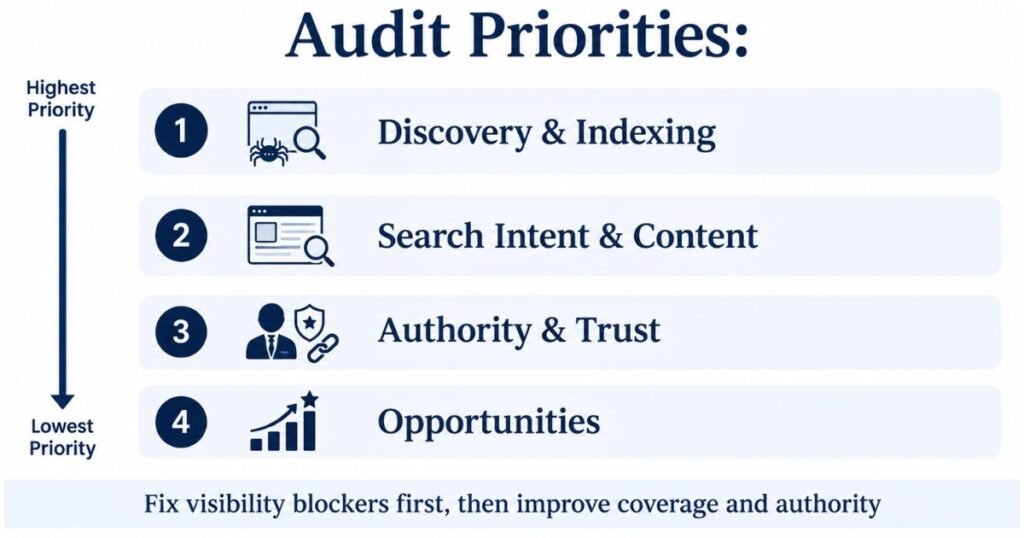
Next, look at strategic issues tied to topical coverage and real search intent satisfaction. Then weigh authority issues, including competitive strength and external credibility. Save smaller opportunity improvements for later, once the real fundamentals are solid. Use clear priority levels and a simple decision rule for every single finding. Fix what blocks visibility first, then build from there step by step. This order keeps limited time and budget pointed at the work that actually matters.
Frequently Asked Questions
How often should a law firm audit its website for SEO?
Set a clear audit frequency, ideally a scheduled review every few months. Add light ongoing monitoring with a periodic check in between.
What should I check first in a law firm SEO audit?
Start with a full crawlability check and indexing check. Technical accessibility should always sit as the top discovery priority.
How can I tell whether my important pages are indexed?
Pull the Page indexing report and use the URL Inspection tool. This gives real Search Console verification of the exact indexed status.
Should law firms audit their backlinks?
Yes. Run a real backlink audit covering referring domains. Add a proper link quality review as part of that authority signal check.
Can an SEO audit improve law firm rankings?
Yes, when it leads to real ranking improvement. Fixed issues should lead to a genuine visibility increase, tracked as a real measurable outcome.
What a Complete Law Firm SEO Audit Should Reveal
A strong audit does more than list problems. It explains why it matters, names the affected pages, and shows what should be fixed first. Real improvement measurement should follow every fix, not just a one time check. That is a genuinely meaningful audit outcome, not a generic checklist. Ready to see where your firm stands? Visit faheembhatti.com and let’s start the audit together.
