
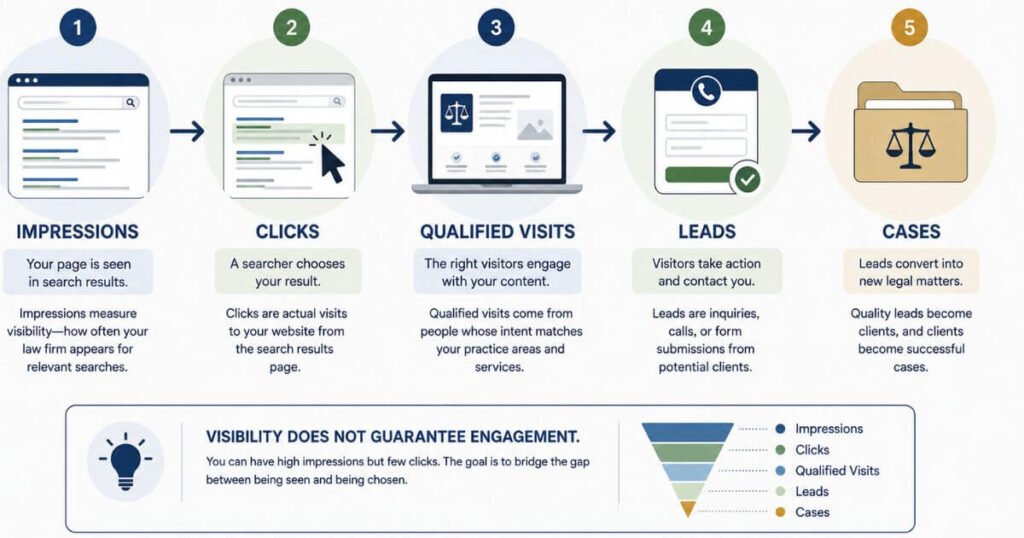
Impressions measure visibility. CTR measures how often that visibility turns into an actual click. Impressions count each time Google shows a SERP result for a search. A click happens only when someone opens that result. Click through rate compares total clicks to total impressions per query.
Google surfacing results never equals a relevant visit. Visibility does not guarantee engagement anywhere along the full search journey. This gap describes coverage versus response, not failure. The central diagnostic question asks why query wording creates this zero click pattern. First party evidence from Search Console lets us trace one inquiry to a case.
What High Impressions Actually Tell You
Deep impressions mean Google displays your law firm listing often. That volume alone does not confirm visits, calls, or new client inquiries reaching the law firm’s page each business day.
Impressions Show Search Visibility
Impression count tracks daily surfacing events for a page. An impression is counted any time your page shows up in search results, regardless of whether it’s actually seen or clicked by anyone.
Visibility does not guarantee engagement from any searcher. Ranking highly still does not mean visibility guarantees qualified traffic for the firm. Exposure without action is the core pattern worth watching.
Position Changes: The Meaning Of Impressions
Average position shows where a page typically ranks. A page sitting around position 8 typically still earns meaningful visibility on the first page. Impression volume drops sharply once rankings pass position ten or worse. Impression volume drops sharply once rankings pass position ten or worse.
We track click opportunity at every single position. Ranking depth matters more than raw keyword count for most law firms. Opportunity differs by position, since each rank pulls a different click share.
Determine Whether Low CTR Is Actually The Problem
Compare CTR With Average Position
Position decides how many searchers see your listing. Impressions and clicks both shift as ranking spots change. CTR ties those two numbers together for one query.
Search Console benchmarks show a steady drop as rank falls:
- Position 1: 28 percent average CTR across most searches
- Position 2: 16 percent average CTR right below it
- Position 3: 11 percent average CTR at third place
- Position 4: 8 percent average CTR near page top
- Position 5: 6 percent average CTR as clicks fade
- Branded query CTR 30 to 60 percent for firm name searches
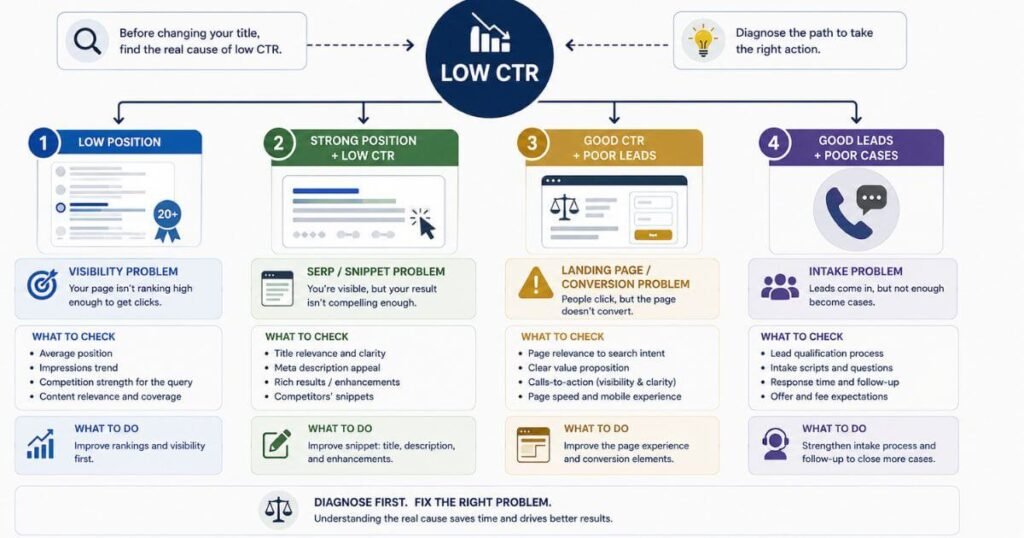
CTR benchmarks by position set the baseline for comparison. Low position, low CTR is normal behavior. High impressions, low CTR at a top spot signals trouble. Strong position, low CTR often means the snippet text underperforms. We see good CTR, poor leads most often on intake page mismatches.
Separate Search From Business Performance
A diagnostic chain separates search performance from business performance clearly. Each link in that chain exposes a different gap:
- Impressions not equal to clicks shows a visibility gap
- Clicks not equal to qualified visits shows a landing page gap
- Qualified visits not equal to leads shows a conversion gap
- Leads not equal to cases shows an intake gap
CTR works as one snippet quality signal. Strong clicks send Google a real traffic signal too. Dwell time after each click adds another layer. Together, these combine into a single ranking signal over time.
Diagnose The Real Cause Before Fixing CTR
Low Position Means Visibility First
A page sitting in positions 30 to 50 faces a clear ranking problem most sites never solve. Weak search intent match often causes this drop before anything else. Poor topical relevance and thin content quality push a page down fast. Low internal authority and weak external authority make competing pages win the spot instead.
Once a page ranks well, the real work shifts toward smaller details. Check the title and snippet first for clear query alignment with the search term. Study what competitors show and which SERP features sit above your listing. Strong brand recognition and solid entity recognition often decide who gets the click.
Strong Position Means Inspect The SERP
A page already ranking well still needs a closer look sometimes. Check the title and snippet first for clear query alignment with the search term. Weak alignment between the two often costs real clicks even at a good spot. Study what competitors show right above and below your listing.
Look next at which SERP features crowd the page near your result. Strong brand recognition pulls clicks even when a listing sits lower down. Solid entity recognition helps search engines connect your page to the right topic. Together, these signals often decide who gets the click and who gets skipped.
Zero Click Results Need Different Diagnosis
Many searches now end before a single click happens at all. AI Overviews, featured snippets, and the local pack answer questions directly on the page. Direct answer boxes and knowledge panels pull attention away from organic listings fast. People Also Ask boxes and rich snippets add even more competition for space.
This pattern, called zero click search, now affects a huge share of results. Studies show up to 60 percent of searches end without a single click. Some reports place 65 percent of Google queries in that same category today. On phones, that number climbs to 75 percent on mobile devices alone. Users get an answer without clicking thanks to this SERP feature disruption across search results.
Match The Result To Searcher Intent
Identify The Query’s Intended Outcome
A search for personal injury lawyer near me should surface a service location attorney focused page, not a blog post. Someone typing what should I do after a car accident wants a useful informational resource instead. Mixing these two up hurts rankings and frustrates real visitors fast. The query intent page type user expectation must match, or the page underperforms.
We check this by studying the dominant intent search engines already show for a term. If informational pages rank, that signal points away from a service page. Matching page type to intent fixes many ranking problems we see. This step alone often solves what feels like a mystery drop.
Check Whether The Right Page Ranks
Every search hides a clear goal a searcher wants met. Some people want plain information about a legal topic first. Others need real legal guidance before deciding on next steps. A search might point toward an attorney, a practice area, or a local firm directly.
Some searches show someone ready for a consultation right now. Others reveal a need for immediate legal help after an accident or injury. Reading the searcher’s intended outcome correctly shapes what a page should say. Watch for intent rich terms that reveal exactly what a visitor wants next.
Make Your Search Result Worth Clicking
Align The Title With Intent
A strong result tells searchers exactly what the page covers before they click. It also shows who it helps and what question it answers right away. This clarity explains why it deserves the click over every other listing. We always avoid misleading claims and avoid clickbait, since broken promises hurt trust fast.
The meta description carries most of this promise inside 150 to 160 characters. Write unique, accurate summaries for every page; never reuse copy across the site. Front load value proposition so the key benefit appears in the first few words. Remember, your page becomes a snippet candidate, but Google often uses dynamically generated snippets instead.
Strengthen The Search Result Promise
A strong title starts with real relevance to the exact search term used. Add specificity so readers know precisely what the page offers. Clarity matters more than clever wording in every title we write. The title should also show clear page purpose within the first few words.
Real differentiation separates a title from ten other identical results on the page. We avoid keyword repetition inside the title tag, since repeated words waste space. A clickable headline respects strict character limits, checked often with a pixel counter to prevent truncation.
Investigate Competitors Winning The Click
Compare The Actual Search Results
Start by pulling up the exact search and noting every ranking position above yours. Study each result’s title and snippet for clues about what searchers prefer. Check the page type too, since a service page rarely beats a guide for informational searches. Note which results show a strong brand name searchers already trust.
Location relevance often decides rankings for local legal searches more than people expect. Watch for SERP features sitting near the top, since they steal clicks from every listing below. Judge each result’s perceived usefulness the way a real searcher would, not as a marketer. Try an ad preview or a SERP preview tool to see exactly how your listing appears for priority queries.
Find Their Strongest Click Advantage
Winning competitors often show clearer relevance to the exact search term used. Some win through better specificity, naming the exact service a searcher wants. Others succeed through stronger intent alignment, matching the page type to the query perfectly. Better local relevance and more useful positioning also pull clicks away from weaker listings.
A few competitors simply carry stronger brand recognition from years of visibility. We study these patterns closely, but do not copy competitor titles directly. Instead, we borrow the strategy behind front loaded value words placed early in the title. Real usefulness, real authority, and true location alignment matter more than mimicking a rival’s wording.
Turn More Impressions Into Qualified Clicks
Prioritize Clicks With Case Potential
Not every click brings real business value to a law firm. A visitor searching a general legal problem may never need to hire anyone. Strong practice area relevance and geographic relevance matter more than raw traffic. Real attorney intent or clear consultation intent signals someone closer to hiring.
We chase qualified clicks, not maximum clicks for every campaign we run. Not every click has equal business value, even when total numbers look impressive. A page pulling thousands of clicks can still produce zero real cases. Smart firms target intent first, then worry about volume second.
Measure What Happens After Clicking
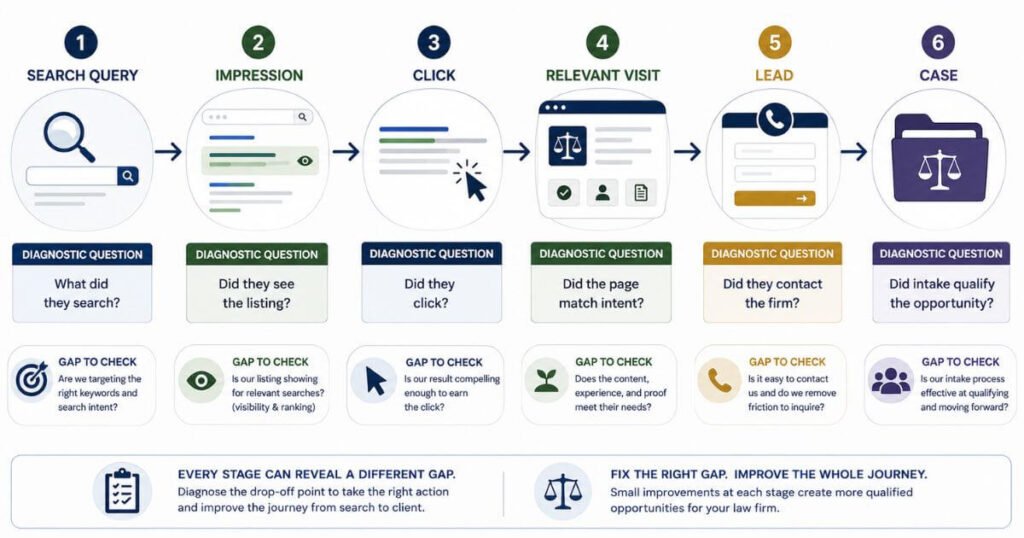
Every search starts with a query typed into the SERP. That query leads to a landing page, where trust either builds or breaks. Strong pages turn a simple impression into a real click, then into a relevant visit. From there, a visitor takes contact action, turning into an inquiry.
Some firms face a low CTR search result problem, where few people click at all. Others hit a good CTR, poor lead conversion problem, pulling clicks that never convert. A third pattern shows a good leads, poor cases intake problem, where inquiries never become real cases. Each gap needs its own fix, not one blanket solution.
Build A Law Firm CTR Audit Process
Pull Your Highest Value Queries
Start any audit by choosing where to look first. Select the relevant page tied to your top service or location. Then review its queries inside your search console data. Sort by impressions to see which terms bring the most visibility.
Next, identify unusually low CTR entries hiding inside that list. Check average position for each query before concluding. Separate branded and non branded searches, since they behave very differently. Always prioritize commercially relevant queries tied to real practice areas first.
Diagnose Each Query Before Editing
Every low performing query needs a clear diagnosis before any fix. Sometimes a low position ranking diagnosis explains the whole problem outright. Other times you see high impressions, low CTR SERP intent diagnosis, meaning the page ranks fine but fails to earn clicks. Check for wrong intent page alignment, where the page type does not match the search.
A wrong page architecture internal linking setup can quietly hurt strong content too. Sometimes the real issue is a zero click SERP visibility diagnosis, where answers appear before any link. Fixing the wrong problem wastes real time and budget. Correct diagnosis always comes before any title or content edit.
Measure Changes Against Baseline
Track impressions, clicks, and CTR before making a single change. Note average position too, since it shifts the whole picture. After changes, watch for real gains in qualified traffic and leads. A solid before and after comparison shows whether the fix actually worked.
Keep query level CTR tracking running for at least a few weeks. Numbers alone can mislead without real business context behind them. Higher CTR does not automatically mean better business performance for every firm. Real success means more calls, not just more clicks.
Frequently Asked Questions
Why does my law firm have deep impressions?
Broad ranking visibility often comes from page two positions across many terms. Low value keyword matches and wide query coverage boost query visibility without real search exposure value.
Why are my law firm clicks low?
A weak snippet or mismatched intent often explains low clicks fast. Poor title relevance, low position, or competing SERP features hurt too, since title is not always the problem.
What is a good CTR for law firms?
An average CTR of 1 to 3 percent is common for most search terms. Branded query CTR 30 to 60 percent runs much higher, since position based CTR benchmarks shift by rank and industry variation stays wide.
Can changing titles increase CTR?
Testing title tag variants can bring a 5 percent CTR lift in many cases. Studies point to emotional meta descriptions with a 13.9 percent lift too. Test one page first before a full snippet rewrite.
Does low CTR affect Google rankings?
CTR works mostly as CTR as indirect signal, tied closely to a broader user experience signal. It is not a direct ranking factor, but strong engagement quality still sends a positive signal to search engines.
Turn Search Visibility Into Better Opportunities
Real search visibility means little without better opportunities attached. Strong qualified traffic turns clicks into calls that matter. Ready to see where your numbers stand? Review your metrics at faheembhatti.com today. Let us identify the gap holding your firm back from real growth.
