
AI search visibility works differently than traditional Google results. Organic rankings track position on a page. AI mentions and AI citations track something else entirely. There is no guaranteed AI ranking formula.
A Houston law firm website can get cited one day and skipped the next, while a competitor gets surfaced instead. This pattern shows up repeatedly when firms test their own visibility across AI features. This guide explains how AI generated answers actually shape a firm’s search presence.
What Counts as AI Search Visibility for a Law Firm?
AI search visibility covers more than one thing. AI Overviews and AI Mode both build synthesized answers with supporting links attached. Organic ranking still matters, but it is not the whole story anymore. A firm can get mentioned, get cited as a source, or get skipped while a competitor appears instead.
AI Overviews and AI Mode
AI Overviews and AI Mode are two separate generative AI features inside Google Search. Both build synthesized answers with supporting links below them.
The practical difference sits in the search interface itself. One shows an AI generated summary on a normal results page. The other runs a full conversational experience built for deeper exploration, comparisons, and follow up questions
Mentioned, Cited, or Ranked?
A firm website cited as a source earns real citation visibility. A simple brand mentioned without a link is weaker. AI answer inclusion and a normal ranked result are not the same thing, even when they look related on the surface.
According to Google Search Central, the fundamental best practices for SEO still apply here. Google states there are no additional requirements, and no special optimizations, needed to appear in these features. Relevant links still come from solid content discovery, built the same way it always has been.
How to Check Your Firm’s AI Search Visibility
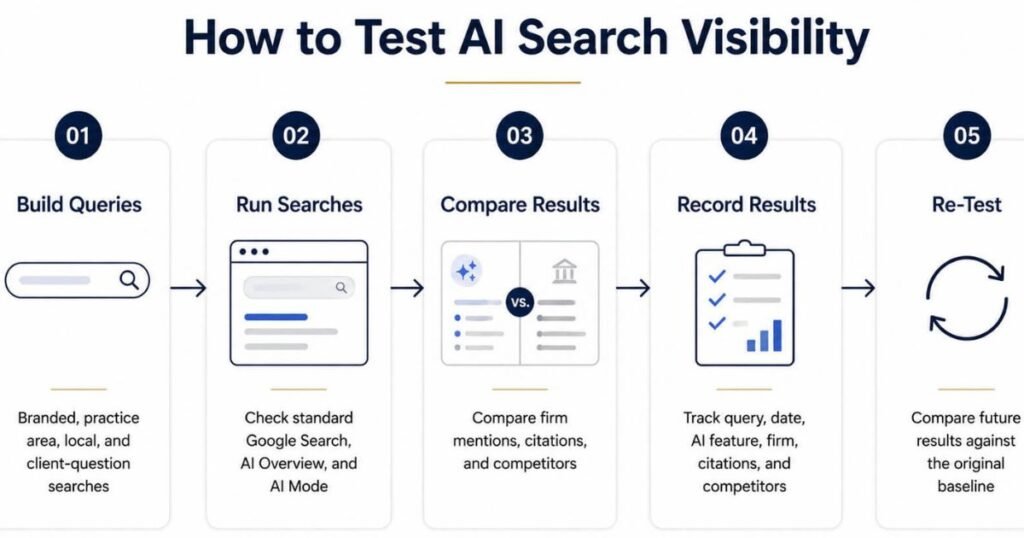
Checking this is a repeatable process, not guesswork. Query testing starts by searching your firm the way a real client would. This practical section walks through a real visibility check. It builds a baseline comparison you can return to later. A simple tracking method beats relying on manual testing done just once.
Build a Houston Query Set
Start broad. Try “practice area lawyer Houston” and “best practice area lawyer in Houston” for each real service. Add “legal problem attorney Houston” style searches too.
Include “who handles legal issues in Houston” as a real client question search. Mix in branded searches for the firm name itself. Different query types matter here, since one query alone has a real limitation. Build a short list of priority prompts to test first.
Compare Google’s Search Experiences
Run the same query through standard Google results first. Then check the AI Overview for that same search. Then check AI Mode too.
Small query variation or context variation can shift the answer completely. This search experience comparison often shows a real result difference between the three views, even for the same question.
Record What Appears
Keep a simple record for each query. Note the date, whether an AI feature is present, and whether the firm is mentioned or the firm’s website is cited.
Track competitors mentioned and any cited sources tied to the relevant practice area. This tracking record becomes a real baseline for future comparison, not just a one time snapshot.
Why Ranking on Google Doesn’t Guarantee AI Visibility
Crawlability and indexing support organic search first.To be eligible as a supporting link in AI Overviews or AI Mode, a page must be indexed and eligible to appear in Search with a snippet, meeting the same technical requirements as regular Search results. Strong organic pages can still miss a supporting citation. Ranking traditionally and earning an AI citation are related but separate outcomes.
AI answers often pull from multiple supporting pages, drawing on related searches and different sources at once. Build a realistic mental model here and drop the replacement myth that one guarantees the other, an idea worth exploring further in AI changing law firm SEO strategy. The AI features documentation from Google Search Central confirms this directly. AI features rely on core search ranking and quality systems already in place. They can also use a technique called query fan out, running multiple related searches to surface a wider and more diverse set of supporting links than a standard search result.
What Helps Google Understand a Houston Law Firm?
Clarity helps here more than anything else. A clean content structure helps readers and search engines both understand a firm faster. As an SEO practice, we recommend clearly connecting the firm, attorney, practice area, and legal problem on every page tied to Houston. A clean practice area structure is usually more useful than vague full service messaging. Give Google the underlying information it needs for a real diagnosis of what the firm actually offers.
Clear Practice Area Relationships
As an SEO practice, we recommend making the relationship between the firm, attorney, practice area, legal problem, and Houston explicit on relevant pages. A clearly defined practice area structure makes that connection obvious.
Skip vague full service messaging that tries to cover everything at once. A real relationship hierarchy works better than that. A structured practice offering helps both readers and search systems understand the firm fast.
Direct Answers to Legal Questions
Answer first writing should sit under descriptive headings built around real questions. Address specific client questions directly, right at the top.
Keep the first answer concise, then add supporting depth below it. Contextual internal links tie related answers together. This kind of AEO thinking helps, but no particular format brings an AI citation guarantee by itself.
Evidence Across the Web
Attorney profiles on outside sites confirm real people. Legal directories and professional organizations add outside proof too. Local sources count here as well.
Authoritative references work best when consistent firm information appears everywhere. Consistent information across reputable third party profiles can make the firm’s identity easier. It allows users to verify and reduce conflicting business information online. Review platforms and recognition sites round out this picture.
What Google Actually Requires for AI Visibility
There are no special AI specific technical requirements to chase here at all. There is no special AI markup either, beyond normal Search eligibility rules already in place. A page still needs to stay crawlable and indexable, the same as before. It still needs real people first useful content that actually answers something.
Structured data accuracy helps, tied to a real answer for how schema markup helps law firms rank better. Chasing some AI ranking trick myth wastes real time better spent elsewhere. The presentation and retrieval experience runs through the same system, not a separate technical checklist. Firms hunting for a hidden AI shortcut usually miss the basic work Google already rewards. Real content, clear structure, and accessible pages remain foundational to what gets seen.
Where Houston Law Firms Can Find Visibility Gaps
Use a simple diagnostic framework to check the real Houston market picture. Most gaps fall into one of three buckets. Check visibility gap patterns around practice area consistency, local presence, and entity representation. Each one deserves its own honest look.
Practice Area Visibility
Check personal injury, family law, criminal defense, employment law, business litigation, and maritime law separately. Add medical malpractice to that list too, since it carries its own separate audience.
Look for consistent appearance across all of them, not just one strong page. There is no automatic visibility myth at play here, no matter how big the firm gets. Weak coverage in one area rarely fixes itself on its own without direct attention. A practice area usually deserves its own page when it has distinct client intent, enough unique detail, and real service differentiation. Rather than a shared paragraph buried elsewhere.
Local Relevance
Check how clearly the firm ties to Houston and nearby Houston area markets. Each practice area should connect back to the firm’s real physical location. A defined service area matters here more than most firms realize at first.
Real local content presence should carry genuine geographic clarity throughout every page. A scattered list of city names dropped in for keywords does not count as real relevance. Genuine neighborhood detail works better than a copied city list.
Entity Consistency
The same firm, its attorneys, and its practice areas should read the same way everywhere online. Geographic relationships should match too, across every listing and page. Consistent representation across third party sources supports credibility with readers. Many SEO practitioners treat it as a helpful signal alongside other visibility factors.
Normal website consistency does the same work internally, page by page. Small mismatches quietly weaken this picture over time, even when each one looks minor alone. Correcting a wrong address or an outdated attorney title is a straightforward first step toward cleaning up that inconsistency.
How Should Law Firms Measure AI Visibility?
Track AI visibility through AI Overview appearances, AI Mode appearances, and real branded mentions. Watch practice areas mentioned closely too, since these show which services actually get noticed. Pair this with citation visibility, checking whether firm pages cited beat out external sources cited or competitor sources cited elsewhere. That comparison shows whether the firm is winning its own share of voice online.
Keep watching normal organic performance at the same time, including impressions, clicks, and relevant queries. Track landing page growth and real business outcomes, like qualified enquiries, calls, and consultation requests. None of these numbers matter in isolation, so review them together every single month. Use the generative AI performance report inside Search Console to see impression data across AI Overviews and AI Mode. It shows visibility patterns, not a complete picture of clicks or business impact on its own. Must check this report every reporting cycle, not just once a year.
What Should You Fix First?
Follow a clear prioritization sequence instead of chasing every fix at once.
- Start with technical eligibility, meaning solid crawling and indexing across the entire site
- Nothing else matters until this works, since broken access blocks every later improvement
- A firm cannot rank pages Google cannot properly reach in the first place
- Sharpen real practice area expertise with unmistakable services, not vague claims
- Build question coverage around genuine client questions, backed by internal relationships and supporting topics
- Fix entity consistency across firm, attorney, location, and practice area information everywhere it appears
- Re test queries against your original baseline to measure real progress
- Skip the shortcut mindset of an AI SEO add on bolted onto old content
- Fix the real information gap, content gap, technical gap, or authority gap first, in that order
This sequence helps prioritize the most fundamental problems before investing in broader content or authority work.
Frequently Asked Questions
How can I check if my law firm appears in Google AI Overviews?
Use a simple manual testing method. Build a query set, run a direct search check, and note AI Overview presence for each one.
Does ranking first on Google guarantee AI visibility?
No. Traditional ranking and AI citation are related but not identical outcomes. A page can rank well and still not get cited, or get cited without holding the top position.
Do law firms need special AI schema markup?
No. There is no special AI specific schema and no special AI markup required. Structured data accuracy still matters, based on real Google documentation reference.
Can a small Houston law firm appear in AI search results?
Yes. A small Houston law firm is not automatically excluded from AI search visibility. There is no promised visibility and no specific position. Clear signals of attorney credentials, authorship, and accurate practice area information can support the visibility.
How often should law firms check AI visibility?
Use consistent query sets regularly. A periodic comparison beats one search reliance. However tracking frequency affects how useful your baseline re-check actually is.
Turn AI Search Visibility Into a Measurable SEO Strategy
Real progress never happens by accident; it happens through a repeatable process. Test one change, watch the result, then move to the next weak spot. No firm can shortcut its way into AI generated answers. This is the process Faheem Bhatti SEO applies for law firms.
